Table of Contents

For a VP of Engineering or a CTO, the decision to hire offshore talent is usually driven by two things: the need for specialized skills and the pressure to scale without exploding the budget. However, the true cost of a new hire isn’t found in the hourly rate. It is found in the onboarding tax. If your senior US-based engineers spend twenty hours a week hand-holding a new hire, your team’s velocity doesn’t just stall, it regresses.
The goal of a sophisticated onboarding strategy for remote developers is to move from access granted to code merged as fast as possible. This requires a shift from viewing onboarding as a HR checklist to viewing it as a high-stakes engineering integration.
The Hidden Cost of Slow Onboarding in US Tech Teams
Every day an offshore developer is not productive, you are losing more than just their daily rate. You are burning the opportunity cost of the features they should be building and the mental bandwidth of your local leads. In many US tech departments, the friction of integrating a remote hire often leads to the “I’ll just do it myself” syndrome among senior staff, which is the ultimate killer of scalability.
When onboarding remote developers, the primary friction point is usually not technical aptitude. It is the gap in context. A developer in India might be a master of React, but if they do not understand the specific business logic of your SaaS platform or your internal deployment workflow, they are effectively sidelined. To avoid this, you must treat onboarding as a repeatable process that prioritizes Time to First PR.
Would you like to review pre-vetted developer profiles who are already trained in US-style agile workflows?
Phase 0: Why Onboarding Starts During the Interview
Most leaders wait until a developer’s first day to begin the integration process. This is a mistake. When you are onboarding offshore developers, success is largely determined by the vetting process. You cannot “onboard” away a fundamental lack of communication or a mismatch in work culture.
During the evaluation phase, you should be looking for onboard ability. Ask yourself:
- Does this candidate ask clarifying questions, or do they simply nod?
- Can they explain their logic in a way that aligns with your team’s documentation style?
- Do they have the infrastructure (stable internet, quiet environment, power backups) to hit the ground running?
At WeblineGlobal, we minimize this “Phase 0” risk by pre-vetting developers not just for their syntax knowledge, but for their ability to integrate into US-based engineering cultures. When the developer is already accustomed to the pace of a US sprint, the onboarding heavy lifting is already half-done.
Day 1 to 5: Technical Readiness and Frictionless Access
Security and Tooling: Beyond the VPN
Nothing kills the momentum of a new hire like spending three days waiting for Jira access or battling a misconfigured VPN. For a remote hire, “Ready to Work” means having every credential active on Day 1. This includes access to the code repository, communication channels like Slack or Teams, and any cloud environments.
Documentation as a Service
If your internal documentation is a messy collection of outdated Confluence pages, your remote developer will be forced to ask your senior engineers for help every ten minutes. To scale effectively, your documentation needs to be a self-service portal. A getting started guide should walk a developer through setting up their local environment, running tests, and submitting their first pull request without needing a 1:1 call.
Bridging the Time Zone Gap: The 12-Hour Advantage
The time difference between the US and India is often viewed as a hurdle, but for a savvy CTO, it is a competitive advantage. The key is to establish a follow the sun model. While your US team sleeps, your offshore team is clearing the backlog. When the US team starts their day, the work is ready for review.
To make this work, you must define overlap hours. Usually, a 2 to 3-hour window in the morning (EST/PST) is sufficient for stand-ups and real-time handoffs. Outside of those hours, lean heavily on asynchronous communication. A well-written Loom video or a detailed Jira ticket is worth more than a dozen midnight Zoom calls.
Need to scale your team without the management overhead? Let’s discuss how our dedicated pods can integrate into your workflow.
Cultural and Process Alignment for Offshore Teams
The “Shadowing” Phase
For the first week, have your remote developer shadow a US-based Lead Engineer. This isn’t about teaching them how to code; it’s about teaching them how your team thinks. Seeing how a lead handles a bug or how they prioritize a feature provides more context than any manual ever could.
Feedback Loops and Initial Wins
Don’t give a new offshore developer a complex, three-week architectural overhaul as their first task. Give them low-hanging fruit—small bugs or minor UI tweaks—that allow them to push code to production within the first 48 hours. This builds confidence and allows you to test your CI/CD pipeline and code review process with low stakes.
Common Onboarding Pitfalls to Avoid
- Treating them as ticket takers: If you don’t explain the why behind a feature, you will get code that technically works but doesn’t solve the business problem.
- The Communication Black Hole: Never let more than 24 hours go by without a touchpoint during the first two weeks. Isolation is the enemy of integration.
- Ignoring Soft Skills: A developer who can’t articulate why they chose a specific library will eventually become a bottleneck during code reviews.
Measuring Success: KPIs for Remote Integration
You cannot manage what you do not measure. When onboarding remote developers, track these three metrics:
- Time to First PR: How many days from their start date until their first code contribution?
- Churn Rate of Initial PRs: How many rounds of revision are required for their first five tasks?
- Stand-up Participation: Are they contributing ideas, or just reporting status?
Streamlining Growth with a Partner Who Understands the US Pace
Onboarding doesn’t have to be a drag on your resources. By choosing a partner like WeblineGlobal, you are not just buying hours; you are accessing a refined delivery model. Our RelyShore® approach is designed specifically to bridge the gap between US engineering expectations and India-based execution.
We ensure that when our developers join your team, they aren’t just technical assets—they are ready-to-ship contributors who understand the urgency of your roadmap.
Ready to add high-velocity talent to your engineering team?
Social Hashtags
#RemoteWork #TechHiring #CTOTips #DeveloperOnboarding #OffshoreDevelopment #AgileTeams #EngineeringLeadership #RemoteTeams #TechManagement
Frequently Asked Questions
While full mastery takes time, a well-onboarded developer should submit their first Pull Request (PR) within the first 3 to 5 days. If a developer hasn't contributed code by the end of week one, it usually indicates a bottleneck in your environment setup or access permissions.
The most effective teams utilize a 2-hour daily overlap for synchronous meetings (stand-ups or handoffs). For the remaining hours, use documentation-first communication, where every task has enough written context for the developer to work independently while the US team is offline.
The core technical training remains the same, but offshore onboarding requires more focus on contextual immersion. You must be more intentional about explaining the business "why" and providing clear, written definitions of "ready" and "done" to compensate for fewer casual office interactions.
The two primary risks are "Isolation" (the developer working on the wrong thing due to lack of feedback) and "Tooling Friction" (delays in security clearances or environment access). Both can be mitigated by having a designated "onboarding buddy" and a Day 1 checklist.
We reduce onboarding friction by providing developers who are already vetted for the "soft skills" required for US integration—such as proactive communication and Agile proficiency. This means your leads spend less time teaching "how to work" and more time teaching "what to build."




Success Stories That Inspire
See how our team takes complex business challenges and turns them into powerful, scalable digital solutions. From custom software and web applications to automation, integrations, and cloud-ready systems, each project reflects our commitment to innovation, performance, and long-term value.
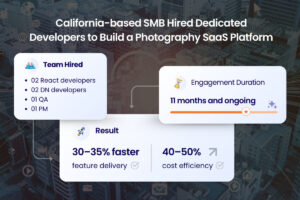
California-based SMB Hired Dedicated Developers to Build a Photography SaaS Platform
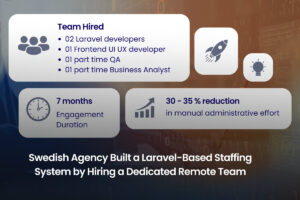
Swedish Agency Built a Laravel-Based Staffing System by Hiring a Dedicated Remote Team