Table of Contents

INTRODUCTION
While working on an enterprise NLP pipeline for a SaaS compliance platform, our engineering team encountered a significant performance bottleneck. The system was responsible for analyzing cross-stream data deduplication and text similarity across three independent data lakes. To measure text overlap without strict sequential constraints, the application relied on finding the Longest Possible Common Subsequence (LPCS) between three strings.
During a recent project phase scaling up to process millions of daily records, we realized the existing architecture was buckling. The legacy implementation executed the LPCS algorithm directly within the SQL database layer. As traffic surged, the database CPU spiked, causing systemic latency. The traditional approach to sequence matching was computationally expensive, and attempting to sort large strings before applying standard DP-based Longest Common Subsequence (LCS) algorithms resulted in unacceptable delays.
We needed a highly optimized, application-level solution to calculate multi-string intersections efficiently. This challenge inspired this article, detailing how we fundamentally shifted our approach from database-heavy sorting to a linear-time Python implementation. We are sharing these architectural insights so other engineering teams can avoid the pitfalls of applying O(N^3) or heavy string-sorting logic to what should be an O(N) frequency mapping problem.
PROBLEM CONTEXT
In standard string similarity problems, the Longest Common Subsequence (LCS) evaluates sequences while strictly preserving character order. However, our compliance validation use case did not require strict sequential order; it required the maximum theoretical overlap of characters—the Longest Possible Common Subsequence (LPCS).
To visualize this, consider two strings: “DDB089A3D8014E” and “83B8FC624F774A”. A standard LCS might return a short sequence like “8384” (length 4). But if we ignore order and focus purely on the multiset intersection, the LPCS would yield a theoretical sequence length of 6. Proving this previously required sorting both strings alphabetically and running an LCS against the sorted arrays, which inherently carries an O(N log N) sorting penalty on top of the LCS evaluation.
When extending this requirement to three simultaneous data streams, the sorting and dynamic programming approach became computationally prohibitive. CTOs and technical leaders looking to scale such operations often realize that this is precisely the stage where they need to hire python developers for scalable data systems to rethink the foundational data structures being utilized.
WHAT WENT WRONG
The initial symptoms surfaced as delayed asynchronous job completions. Upon reviewing the tracing logs, we noticed the compliance validation workers were spending an disproportionate amount of time blocked on database queries.
The legacy design leveraged SQL functions to split strings into characters, group them, count frequencies, and return the intersections. While SQL is excellent for relational set logic, using it to compute character-level frequencies across millions of short-lived text streams tied up valuable database connection pools and compute resources.
An early attempt to move this logic to the application layer involved a naive Python script that sorted the strings and attempted an LCS comparison. This resulted in CPU bottlenecks on the worker nodes. The architectural oversight was treating LPCS as an ordering problem rather than a frequency-counting problem.
HOW WE APPROACHED THE SOLUTION
To offload compute from the database and prevent worker node CPU exhaustion, we analyzed the mathematical reality of the LPCS problem. Since the order of characters does not matter, the length of the longest possible subsequence is simply the sum of the minimum frequencies of each character present in all strings.
For example, if the character ‘a’ appears 5 times in the first string, 4 times in the second, and 7 times in the third, the maximum possible common overlap for ‘a’ across all three is exactly 4.
By shifting our mental model from 2D/3D dynamic programming arrays to hash maps, we determined we could achieve an algorithmic time complexity of O(m + n + o), where the variables represent the lengths of the three respective strings. Using Python’s optimized standard libraries, specifically C-backed dictionary structures, we could compute the frequency map of each string in a single pass.
FINAL IMPLEMENTATION
We implemented a pure Python service utilizing the collections.Counter class. This approach precomputes the frequency maps of all three streams and iterates through the keys of the first map, checking intersections in constant time.
from collections import Counter
def compute_lpcs_tripartite(stream_a: str, stream_b: str, stream_c: str, return_sequence: bool = False):
    """
    Compute the LPCS length for three strings using optimized frequency maps.

    Time Complexity: O(m + n + o)
    Space Complexity: O(k) where k is the unique character alphabet size
    """
    freq_a = Counter(stream_a)
    freq_b = Counter(stream_b)
    freq_c = Counter(stream_c)

    total_overlap = 0
    common_sequence = []

    for char in freq_a:
        if char in freq_b and char in freq_c:
            min_freq = min(freq_a[char], freq_b[char], freq_c[char])
            total_overlap += min_freq

            if return_sequence:
                common_sequence.extend([char] * min_freq)

    if return_sequence:
        return total_overlap, ''.join(common_sequence)

    return total_overlap
Validation and Performance Considerations:
- Time Complexity: Generating the counters takes O(m), O(n), and O(o). The iteration strictly loops over the unique characters in the first string (O(k), where k is the alphabet size). This results in a highly predictable, linear execution time.
- Space Complexity: The memory footprint is bounded by the alphabet size (e.g., ASCII or a subset of Unicode), making it extremely memory efficient compared to multi-dimensional dynamic programming grids.
- Security: By moving the string processing to isolated stateless worker nodes, we eliminated the risk of injection vulnerabilities or excessive database load.
LESSONS FOR ENGINEERING TEAMS
When resolving complex algorithmic bottlenecks in production, teams should consider the following insights:
- Reframe the Algorithm: Don’t blindly apply dynamic programming. When order constraints are relaxed, sequence problems often reduce to simpler hash-map or frequency-counting operations.
- Offload String Manipulation from Databases: Relational databases are not designed for intensive character-level algorithmic operations. Move these tasks to stateless application workers.
- Leverage Native C-Optimized Libraries: In Python, tools like Counter from the collections module are implemented in C, offering massive performance gains over custom nested loops.
- Architect for Scale: If you anticipate growing data requirements, structuring your team properly is essential. Companies that hire backend developers for enterprise modernizations are better equipped to catch these algorithmic inefficiencies early in the design phase.
- Parameterize for Flexibility: By building functions that can optionally return the sequence or just the integer length, we reduced memory allocation overhead when only the intersection score was required.
WRAP UP
Migrating the LPCS calculation from a database-bound process to an O(N) Python implementation successfully eliminated our scaling bottlenecks. By analyzing the mathematical properties of the business requirement rather than forcing a traditional LCS approach, we achieved sub-millisecond processing times per record, completely stabilizing the compliance validation pipeline.
Social Hashtags
#PythonOptimization #NLPEngineering #AlgorithmOptimization #ScalableSystems #DataEngineering #BackendDevelopment #SystemDesign #PerformanceTuning #BigDataProcessing #AIInfrastructure #SoftwareArchitecture #PythonDevelopers
If your organization is facing similar architectural challenges and you are looking to hire software developer expertise to build resilient, scalable platforms, feel free to contact us.
Frequently Asked Questions
LCS (Longest Common Subsequence) evaluates strings while strictly maintaining the original character order. LPCS (Longest Possible Common Subsequence) ignores sequence order and finds the maximum theoretical overlap, essentially measuring the intersection of character frequencies.
While standard dictionaries work, collections.Counter is highly optimized in Python's underlying C implementation for frequency counting. It requires less boilerplate code and executes counting loops significantly faster than manual dictionary assignments.
The time complexity remains O(m + n + o). However, the space complexity O(k) scales with the number of unique characters. Even with extensive Unicode usage, the memory overhead per string comparison remains negligible compared to dynamic programming matrices.
Yes. NLP preprocessing frequently involves tokenization and similarity scoring. Organizations that hire ai developers for production deployment often rely on frequency intersection techniques to build fast heuristics for text classification and duplicate detection before passing data into heavier transformer models.
Absolutely. The logic can be generalized to accept an arbitrary list of strings. You map all strings to frequency counters, then iterate through the characters of the shortest string, finding the minimum frequency across all maps.

Success Stories That Inspire
See how our team takes complex business challenges and turns them into powerful, scalable digital solutions. From custom software and web applications to automation, integrations, and cloud-ready systems, each project reflects our commitment to innovation, performance, and long-term value.
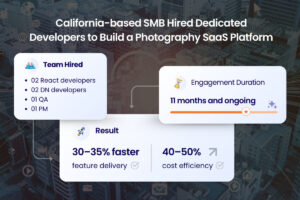
California-based SMB Hired Dedicated Developers to Build a Photography SaaS Platform
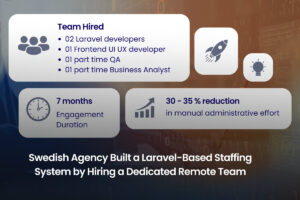
Swedish Agency Built a Laravel-Based Staffing System by Hiring a Dedicated Remote Team