
Table of Contents

How Did We Use Amazon Bedrock To Generate Stylized Content For A SaaS Platform?
While working on a content-generation feature for a fast-growing B2B marketing SaaS platform, we encountered a fascinating generative AI challenge. The platform allowed users to automate drafts for outbound campaigns. Initially, we integrated a foundational model via Amazon Bedrock to handle the heavy lifting. However, user feedback quickly highlighted a glaring issue: the AI-generated text sounded far too generic.
Every professional has a unique writing style. Some users write punchy, terse and highly analytical content, while others prefer a verbose, conversational and storytelling approach. Delivering a one-size-fits-all AI output degraded the user experience.
We realized that we already possessed the perfect solution hidden in our architecture: millions of rows of historical user-generated content sitting in an Amazon RDS MySQL database. We needed a way to securely extract existing content tied to a specific user_id and use it to influence the style and format of Amazon Bedrock’s responses. This challenge inspired this article, detailing how we built a dynamic, data-driven prompt pipeline so other engineering teams can avoid common pitfalls when personalizing AI output at scale.
Why Is Integrating Amazon Bedrock With RDS MySQL Challenging For Personalization?
The business use case was straightforward: when a user requested a new draft, the system needed to analyze their previous work and mimic their voice. Architecturally, this required bridging a traditional relational database (Amazon RDS MySQL) with a stateless, serverless generative AI API (Amazon Bedrock).
The core challenge lay in the execution bridge. Amazon Bedrock does not natively connect directly to an RDS database to “read” user styles on the fly. The application layer must act as the orchestrator. This meant our backend needed to query the database, extract the right subset of historical data, format it into a context window and inject it into the prompt payload—all within a latency budget of a few seconds.
Furthermore, we had to ensure strict tenant isolation. Querying the wrong user_id could result in generating content in a competitor’s tone or leaking proprietary formatting, leading to a massive security and trust violation.
What Bottlenecks Surfaced When Feeding MySQL Data to Amazon Bedrock?
When we built the initial proof of concept, things did not go smoothly. Several architectural oversights and bottlenecks surfaced immediately in our staging environment.
- Context Window Overflows: Initially, we queried all historical posts for a user and fed them into the prompt. High-volume users had megabytes of text, instantly blowing past the token limits of our chosen Bedrock model (Anthropic Claude).
- Prompt Confusion: Instead of mimicking the style, the LLM often got confused by the massive dump of historical data. It started summarizing the old posts rather than writing new content based on the requested topic.
- Latency Spikes: Fetching large blobs of text from the RDS MySQL database and serializing them over the network into the Bedrock API call added unacceptable latency (often 10+ seconds before the first token was generated).
- Database Thrashing: Missing indexes on our MySQL tables meant that querying by user_id and sorting by the most recent posts caused full table scans, spiking the RDS CPU usage.
How Can You Architect A Bedrock And RDS Integration For User-Specific Data?
To resolve these issues, we stepped back to evaluate how best to inject “style” into an LLM. We considered several approaches before settling on our final architecture. If you plan to hire ai developers for production deployment, it is critical that they understand these architectural tradeoffs rather than just basic prompt engineering.
Should You Fine-Tune A Custom Model?
Our first thought was to fine-tune a model for each user. While fine-tuning is excellent for highly specialized domain knowledge, doing this for thousands of individual users is practically impossible. The compute costs, lifecycle management and storage of thousands of bespoke models would bankrupt the project.
Should You Use A Vector Database And RAG?
We briefly considered migrating user content into a Vector Database and using Retrieval-Augmented Generation (RAG). RAG is perfect for fetching factual knowledge (e.g., answering questions from a knowledge base). However, our goal wasn’t factual retrieval; it was style extraction. Semantic search would retrieve posts similar in topic, not necessarily posts that best represent the user’s overarching formatting and tone.
Should You Use Dynamic Few-Shot Prompting via RDS?
We concluded that the most efficient and cost-effective approach was dynamic Few-Shot Prompting. By querying the RDS MySQL database for just the 3 to 5 most recent and highest-rated posts for a specific user_id, we could dynamically build a prompt that says: “Here are examples of the user’s style. Analyze the tone, structure and vocabulary. Now, write a new post on [Topic] using this exact style.”
How Did We Implement The Final Amazon Bedrock And RDS MySQL Solution?
Our final implementation involved optimizing the RDS queries and structuring the LLM prompt using strict XML tags to separate historical context from the new instruction. This approach ensures security and high performance. Companies looking to hire python developers for scalable data systems often require this level of integration maturity.
Here is a sanitized, generic version of the backend implementation using Python and Boto3:
import boto3
import json
import pymysql
# Initialize Bedrock Client
bedrock = boto3.client(service_name='bedrock-runtime', region_name='us-east-1')
def fetch_user_style_examples(db_connection, user_id):
    # Fetch top 3 recent posts to capture current writing style
    with db_connection.cursor(pymysql.cursors.DictCursor) as cursor:
        sql = """
            SELECT content
            FROM user_publications
            WHERE user_id = %s AND is_published = 1
            ORDER BY created_at DESC
            LIMIT 3
        """
        cursor.execute(sql, (user_id,))
        return cursor.fetchall()
def generate_stylized_content(user_id, target_topic):
    # 1. Establish DB connection (using pooled connection in production)
    db_conn = get_db_connection()
    examples = fetch_user_style_examples(db_conn, user_id)

    # 2. Format examples cleanly using XML tags for the LLM
    formatted_examples = ""
    for idx, row in enumerate(examples):
        formatted_examples += f"<example_{idx+1}>n{row['content']}n</example_{idx+1}>n"
    # 3. Construct the Few-Shot Prompt
    prompt = f"""
    You are an expert ghostwriter. Below are examples of the client's unique writing style:

    <style_examples>
    {formatted_examples}
    </style_examples>

    Your task: Analyze the vocabulary, sentence length, formatting and overall tone of the examples above.
    Then, write a new piece of content about "{target_topic}".
    You must strictly mimic the tone and formatting found in the <style_examples>. Do not reference the examples directly.
    """
    # 4. Invoke Amazon Bedrock (Example using Anthropic Claude)
    body = json.dumps({
        "prompt": f"nnHuman: {prompt}nnAssistant:",
        "max_tokens_to_sample": 1024,
        "temperature": 0.7
    })

    response = bedrock.invoke_model(
        body=body,
        modelId='anthropic.claude-v2',
        accept='application/json',
        contentType='application/json'
    )

    response_body = json.loads(response.get('body').read())
    return response_body.get('completion')
Validation & Performance: By limiting the query to just 3 examples, we eliminated context bloat. We also added a composite database index on (user_id, is_published, created_at), which dropped query latency from 800ms down to 12ms. If you need to hire backend developers for secure api integration, ensuring they understand database indexing alongside AI prompting is non-negotiable.
What Can Engineering Teams Learn From This Amazon Bedrock Integration?
Based on our experience bridging traditional RDBMS architectures with GenAI APIs, here are actionable insights engineering teams should apply:
- Limit Context to High-Signal Data: Do not feed the LLM everything. 3 to 5 strong examples of a user’s writing are more than enough to establish a voice. More data only increases token costs and latency.
- Use XML Tags for Prompt Isolation: Always wrap database extractions in distinct XML or markdown tags (e.g.,
<style_examples>). This prevents the LLM from confusing the historical data with the actual instruction. - Optimize RDS Indexes: Generative AI workflows often distract teams from basic database hygiene. Ensure queries that fetch user context are backed by appropriate composite indexes.
- Sanitize Database Output: Before passing RDS data to Bedrock, ensure no sensitive Personally Identifiable Information (PII) is inadvertently swept up in the historical text or use Bedrock Guardrails to enforce data safety.
- Cache Style Context: If a user generates multiple drafts in a session, cache the extracted historical examples in Redis to avoid hitting the MySQL database repeatedly.
- Temperature Tuning: Set your model’s temperature carefully. A temperature of 0.7 allows enough creativity to write a new topic while remaining anchored to the structural constraints of the provided examples.
Ready To Build Scalable GenAI Workflows?
Integrating Amazon Bedrock with a relational database like Amazon RDS MySQL is a powerful way to inject personalized, user-specific data into generative workflows. By utilizing dynamic few-shot prompting, optimizing database queries and structuring prompts securely, we delivered a highly customized AI experience that mirrored our users’ exact writing styles without breaking the bank on token usage.
Building resilient, production-ready AI pipelines requires more than just API calls; it requires deep architectural experience across databases, backend services and machine learning principles. If you are looking to hire software developer talent capable of navigating these complex integrations, contact us.
Social Hashtags
#AmazonBedrock #GenerativeAI #AWS #GenAI #RDSMySQL #PromptEngineering #FewShotPrompting #LLM #ArtificialIntelligence #AWSCloud #AIEngineering #BackendDevelopment #PythonDevelopment #SaaS #AIIntegration
Frequently Asked Questions
No, Amazon Bedrock is a managed service for foundational models via API. You cannot connect it directly to an SQL database. You must use an application backend (like AWS Lambda, EC2 or ECS) to query RDS, format the data and send it as context in the Bedrock API payload.
In most text generation scenarios, 3 to 5 well-written examples are sufficient for Few-Shot Prompting. Going beyond this offers diminishing returns on style accuracy while significantly increasing latency and API token costs.
No. According to AWS data privacy policies, the data you send to Amazon Bedrock via prompts is not used to train or improve the base foundational models.
If the user's historical texts are lengthy articles, do not send the full text. Instead, truncate the query results in your backend code to send only the first few paragraphs or a representative summary of each post to stay within the model's token limits.
Models from the Anthropic Claude family (available via Bedrock) excel at following detailed instructions and mimicking writing styles, especially when context is separated clearly using XML tags in the prompt.
Success Stories That Inspire
See how our team takes complex business challenges and turns them into powerful, scalable digital solutions. From custom software and web applications to automation, integrations, and cloud-ready systems, each project reflects our commitment to innovation, performance, and long-term value.
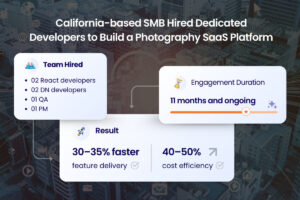
California-based SMB Hired Dedicated Developers to Build a Photography SaaS Platform
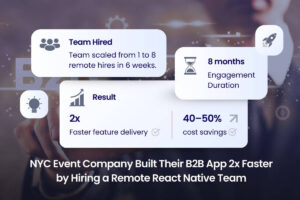
NYC Event Company Built Their B2B App 2x Faster by Hiring a Remote React Native Team