Table of Contents

Reaching product-market fit is the holy grail for any California-based SaaS startup. It is the moment when the market finally pulls the product out of the company, and the focus shifts from finding a problem-solution fit to scaling the infrastructure and feature set to meet surging demand. However, this transition often reveals deep-seated bottlenecks in engineering capacity. Founders and CTOs in hubs like San Francisco, Palo Alto, and Los Angeles frequently find that their early-stage generalist teams are no longer sufficient to handle the complexity of a rapidly expanding user base.
The pressure to maintain momentum while ensuring system stability creates a unique set of challenges. This is where the decision to hire dedicated developers California becomes a strategic necessity rather than an operational luxury. Companies that successfully navigate this phase do not just add more headcount; they adopt specific organizational structures and delivery models that allow for rapid iteration without sacrificing the long-term health of the codebase. By analyzing post PMF scaling patterns, leadership teams can make informed decisions about whether to continue local hiring or leverage high-performing remote pods.
Understanding the Post-PMF Growth Spurt in California SaaS
In the California tech ecosystem, the period immediately following product-market fit is characterized by an aggressive expansion of the product roadmap. Stakeholders demand new features, enterprise clients request specific integrations, and the technical debt accumulated during the “move fast and break things” phase starts to come due. Decision-makers often face a critical crossroads: do they continue to compete for hyper-expensive local talent in the Bay Area, or do they look for a more scalable model to extend their runway? Many successful firms choose to hire full stack engineers who can bridge the gap between frontend user experience and complex backend logic during this volatile growth phase.
The Shift from Building to Optimizing
During the initial build phase, the goal is validation. Post-PMF, the goal is reliability and scale. This shift requires a different mindset from the engineering team. You no longer need “hackers” who can ship a feature overnight; you need engineers who understand distributed systems, database optimization, and CI/CD pipelines. This is why many VPs of Engineering begin to review growth teams to identify where the current talent stack falls short. The pattern usually involves moving away from individual contributors working in silos toward structured pods that own specific functional areas of the product.
Managing Technical Debt While Shipping Features
One of the most common post PMF scaling patterns is the realization that the initial MVP architecture cannot support ten times the current traffic. CTOs must decide how much capacity to allocate to refactoring versus new feature development. If you try to do both with a small local team, you risk burnout and turnover. When you hire dedicated developers California, you can effectively bifurcate your team: one group focuses on maintaining the legacy system and addressing debt, while the other drives the roadmap forward. This separation of concerns is vital for maintaining delivery velocity in a competitive SaaS market.
Balancing Speed and Stability
The urgency to capture market share can lead to reckless hiring. However, the cost of a bad hire at this stage is magnified. A single engineer who doesn’t understand the long-term implications of their code can introduce bugs that stall the entire roadmap. Therefore, the evaluation process must prioritize architectural thinking alongside coding speed. The ability to hire backend developers who are comfortable with microservices and API-first design becomes a competitive advantage for SaaS companies trying to dominate their niche.
Scaling after product-market fit isn’t just about hiring more engineers—it’s about building the right team structure to sustain growth.
Discover how top California SaaS companies accelerate delivery without burning out their core teams.
Transitioning from Generalist Squads to Specialized Engineering Pods
In the early days, a SaaS team is usually a tight-knit group of generalists. Everyone does a bit of everything. But as the user base grows, the “generalist” model starts to fail. Complexity increases, and specialized knowledge in areas like security, data engineering, or frontend performance becomes essential. California SaaS leaders often observe that the most successful post PMF scaling patterns involve the creation of specialized pods. These pods are autonomous units consisting of a product manager, a designer, and several developers who are responsible for a specific outcome, such as “User Onboarding” or “Payment Infrastructure.”
Why Pod-Based Hiring Works for Scaling
Hiring individuals one by one is slow and introduces significant integration risk. When you hire dedicated developers California through a managed pod model, you are essentially plugging in a pre-vetted team that knows how to work together. This reduces the “storming and norming” phase of team development. For a CTO, this means less time spent on middle management and more time spent on high-level technical strategy. This model is particularly effective when you need to scale after PMF quickly to beat a competitor to market.
The Role of the Lead Engineer in Distributed Pods
In a distributed or remote pod, the lead engineer acts as the primary point of contact and technical gatekeeper. They ensure that the remote team’s output aligns with the core architectural standards of the California headquarters. This role is critical for maintaining quality. When we look at post PMF scaling patterns, we see that the companies that struggle are those that treat remote developers as “task-takers” rather than integrated team members. By empowering pod leads, companies ensure that their remote hire dedicated developers California strategy actually yields enterprise-grade software.
Integrating Remote Pods into the Core Culture
Culture is often cited as a reason to keep hiring local. However, with the rising costs of office space and the talent wars in Silicon Valley, maintaining a 100 percent local team is becoming unfeasible for many. The pattern among high-growth SaaS firms is a hybrid model. The “brain” of the company remains in California, while the “engine” is distributed. This requires robust documentation, asynchronous communication tools, and a clear definition of success for every sprint. Leveraging a partner like WeblineGlobal can help facilitate this integration through the RelyShore model, providing US-based assurance with the scale of offshore talent.
Overcoming the Local Hiring Bottleneck in the Bay Area
The talent landscape in California is unique. You are not just competing with other startups; you are competing with Google, Meta, and Netflix for the same pool of talent. These giants can offer compensation packages that are often out of reach for a mid-stage SaaS company, even one that has just raised a significant Series A or B. This bottleneck is one of the primary drivers for why firms hire dedicated developers California using remote models. The ability to find and onboard a high-quality engineer in weeks, rather than months, is the difference between hitting your quarterly targets and missing them.
The Cost of Delayed Hiring
Every month, a key engineering position remains open, your product roadmap slips. For a post-PMF SaaS company, this delay has a direct impact on valuation and market share. When you review growth teams, look at the “time-to-fill” metric. If it exceeds 60 days, your growth is being throttled by your HR process. By expanding your search to include dedicated remote teams, you gain access to a much larger pool of vetted talent. You can hire full stack engineers who bring diverse perspectives and experience from other global SaaS markets, often at 40 to 60 percent of the cost of a local SF hire.
Comparing Local Hires vs. Dedicated Teams
When evaluating the trade-offs, it is not just about the hourly rate. You must consider the total cost of ownership, which includes benefits, office space, payroll taxes, and equity. Furthermore, the risk of a local hire being poached is extremely high in California. Dedicated remote teams often provide higher retention rates, especially when they are part of an established engineering culture. For a CTO, this stability is priceless. It allows for consistent knowledge retention and steady progress on long-term projects like cloud migration or a backend overhaul, where you need to hire backend developers who will stay for the duration of the project.
Speed to Market as a Competitive Advantage
In SaaS, the first mover advantage is real, but the “best mover” advantage is even stronger. Being able to iterate faster than your competitors is what allows you to maintain PMF as the market evolves. One of the most effective post pmf scaling patterns is the use of “burst” capacity. This involves bringing on a dedicated team for a specific 6-month push to launch a new product line or enter a new geographic market. This flexibility is only possible when you hire dedicated developers California through a flexible staff augmentation or dedicated pod model.
Struggling with hiring delays or engineering bottlenecks post-PMF?
Access pre-vetted remote developers and fully managed pods that integrate seamlessly with your in-house team—so you can scale faster without compromising quality.
Strategic Delivery Models: Augmentation vs. Dedicated Pods
Not all hiring models are created equal. Post-PMF companies must choose the model that fits their specific technical needs and management capacity. Staff augmentation is great for filling specific skill gaps, such as a temporary need for a DevOps expert or a specialized frontend developer. However, for core product development, the dedicated pod model is often superior. This is a common realization in post PMF scaling patterns: as the product matures, you need teams that understand the “why” behind the code, not just the “how.”
When to Use Staff Augmentation
If you have a strong internal team and a well-defined set of tasks, augmentation is a cost-effective way to increase velocity. For example, if you need to hire backend developers to help with a specific API integration, augmentation allows you to add that capacity without the long-term overhead of a full-time hire. This is a tactical move. It solves a short-term capacity problem but does not necessarily build long-term institutional knowledge. WeblineGlobal often assists clients in this phase by providing pre-vetted specialists who can hit the ground running within 48 hours.
Building Long-Term Value with Dedicated Pods
For strategic initiatives, such as rebuilding a legacy core or launching an enterprise-grade mobile app, dedicated pods are the preferred pattern. A pod operates as an extension of your company. They use your tools, follow your processes, and are committed to your product’s success. This model is ideal for those who want to scale after PMF because it provides a predictable delivery cadence. When you hire dedicated developers California under this model, you are investing in a partnership where the vendor takes responsibility for the delivery and quality of the output.
Managing the Communication Overhead
The biggest risk in remote models is communication breakdown. Successful California SaaS firms mitigate this by ensuring that their remote teams are in overlapping time zones or have a dedicated project manager who can bridge the gap. Using tools like Slack, Jira, and Zoom is standard, but the real key is the frequency and quality of interaction. Daily stand-ups and weekly demos should include everyone, regardless of location. This integration is a hallmark of successful post PMF scaling patterns in the modern, distributed tech world.
Risk Mitigation and Intellectual Property Protection
For any SaaS company, the codebase is the primary asset. When you hire dedicated developers California, especially through remote or offshore partners, protecting your Intellectual Property (IP) is paramount. Many founders worry that moving development away from their direct oversight increases the risk of code leaks or IP theft. However, established engineering firms have rigorous protocols in place to ensure that your data and code remain secure. Understanding these protocols is a vital part of the vendor selection process during the post PMF scaling patterns evaluation.
Legal Frameworks and NDAs
The first line of defense is a strong legal framework. This includes non-disclosure agreements (NDAs) and IP assignment clauses that are enforceable in both the developer’s location and the United States. At WeblineGlobal, we provide US-based assurance, meaning you are dealing with a company that understands and complies with US legal standards. This significantly reduces the risk for California companies. When you review growth teams, always ask about their legal structure and how they handle IP transfers.
Technical Access Controls and Security
Security is not just a legal issue; it is a technical one. You should maintain full control over your code repositories (like GitHub or GitLab) and your cloud environments (AWS, Azure, or GCP). Developers should only have access to the specific environments they need for their work. Implementing multi-factor authentication (MFA) and using VPNs for accessing internal staging environments are standard post PMF scaling patterns for security-conscious firms. When you hire full-stack engineers, ensure they are trained in secure coding practices to prevent vulnerabilities from being introduced into your application.
The RelyShore Model: Security and Delivery
WeblineGlobal’s RelyShore model is designed specifically to address the concerns of US-based CXOs. It combines the cost-efficiency of offshore talent with the security and accountability of a US-based partner. This model includes strict access controls, background checks for all developers, and regular security audits. For a SaaS company looking to scale after PMF, this provides the peace of mind needed to focus on growth rather than worrying about the integrity of their engineering operations.
Determining the Right Team Composition for Your Next Phase
As you plan your next 12 to 18 months of growth, the composition of your engineering team will be the single biggest factor in your success. You cannot rely on the same structure that got you to PMF to get you to $10M or $50M in ARR. The post PMF scaling patterns suggest that a mix of local strategic leadership and dedicated remote execution teams is the most resilient and scalable approach. This allows you to hire dedicated developers California who can execute the roadmap while your local leaders focus on product-market expansion and investor relations.
Identifying Skill Gaps Early
Don’t wait for a crisis to start hiring. Conduct a skills audit of your current team. Do you have enough backend depth to handle a move to microservices? Is your frontend team capable of building a modern, responsive SaaS UI? If the answer is no, you need to hire backend developers or frontend specialists immediately. The goal is to build a “well-rounded” engineering organization where every critical functional area has a designated lead and sufficient supporting capacity.
Scaling the QA and DevOps Function
Two areas that are often neglected in the pre-PMF phase are Quality Assurance (QA) and DevOps. As you scale, manual testing becomes impossible, and automated deployment pipelines become essential. A key pattern in post pmf scaling patterns is the integration of QA and DevOps into the development pods. This “Shift Left” approach ensures that quality and deployability are considered from the very first line of code. Contact us to scale after PMF, and we will make sure that our dedicated teams include these critical functions.
The journey from a successful startup to a market-leading SaaS company is fraught with technical and organizational challenges. By recognizing the common post PMF scaling patterns and strategically choosing to hire dedicated developers California, you can build a resilient, high-velocity engineering organization. The decision to leverage remote pods is not just about cost savings; it is about accessing the global talent pool, increasing your speed to market, and ensuring that your core team can focus on the strategic decisions that will define your company’s future. As you evaluate your options, remember that the right partner does not just provide “resources” but becomes an extension of your vision, helping you navigate the complexities of growth with confidence.
Social Hashtags
#SaaSScaling #ProductMarketFit #StartupGrowth #SaaSCalifornia #TechLeadership #HireDevelopers #RemoteTeams #EngineeringTeams #StartupHiring #ScaleYourStartup #TechStartups #DevTeams #SaaSGrowth #SoftwareDevelopment #CTOInsights
Ready to scale your SaaS product with confidence?
Talk to our experts and build a high-performance engineering team tailored to your roadmap, timeline, and budget.
Frequently Asked Questions
When working with an established partner like WeblineGlobal, you can typically expect to see a shortlist of pre-vetted developer profiles within 48 hours. The entire process, from initial consultation to the developer starting on your project, usually takes between 1 to 2 weeks, which is significantly faster than the 2 to 3 months common for local hiring in the Bay Area.
Quality is ensured through a multi-stage vetting process that includes technical assessments, communication evaluations, and cultural fit interviews. By following the post PMF scaling patterns of successful firms, we also recommend a "trial period" or a small initial project to ensure alignment before fully integrating the developers into your core roadmap.
The client retains 100 percent ownership of all intellectual property, source code, and assets created during the engagement. This is protected through clear legal contracts and IP assignment agreements, backed by a US-based entity to ensure enforceability and peace of mind for California SaaS companies.
The model is flexible. Most post-PMF SaaS companies prefer to have their internal CTO or VP of Engineering manage the developers directly to ensure tight alignment with the product vision. However, we can also provide a dedicated project manager or pod lead to handle the day-to-day administrative and delivery management if your internal leadership is stretched thin.
One of the advantages of the dedicated developer model is flexibility. If a developer is not meeting expectations, we provide a replacement process. This reduces the hiring risk and administrative burden on your internal HR team, allowing you to maintain velocity even if you need to make changes to your team composition.



Success Stories That Inspire
See how our team takes complex business challenges and turns them into powerful, scalable digital solutions. From custom software and web applications to automation, integrations, and cloud-ready systems, each project reflects our commitment to innovation, performance, and long-term value.
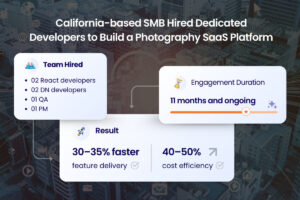
California-based SMB Hired Dedicated Developers to Build a Photography SaaS Platform
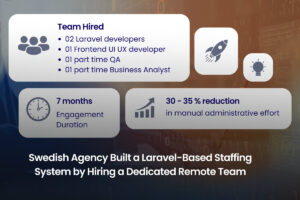
Swedish Agency Built a Laravel-Based Staffing System by Hiring a Dedicated Remote Team