
Table of Contents

What Led Us to Investigate QML Slider Access in PySide6?
While working on a high-performance healthcare imaging platform, our team was tasked with building a hybrid desktop application. The system required a fluid, hardware-accelerated user interface for rendering complex medical video streams (MRI and ultrasound playbacks) alongside a heavy Python backend to process AI-driven diagnostics. To achieve this, we chose PySide6, utilizing QtQuick (QML) for the frontend and Python for the logic layer.
During the integration phase, we encountered a situation where the Python backend needed to accurately track and process specific frames in the video stream. The user interface featured a slider to scrub through the video frames. The value of this slider dictated which frame our complex Python-side AI logic would analyze. However, when our engineers attempted to retrieve the slider component and read its value directly from Python, the application threw exceptions. We realized that interacting with QML-managed components from PySide6 is drastically different from traditional QtWidgets, leading to assertion errors and missing attributes.
This challenge is quite common for engineering teams transitioning to QtQuick. We extracted the core architectural problem to share our insights. Organizations looking to hire python developers for scalable data systems or complex UI integrations often face these exact paradigm shifts. This article breaks down why the issue occurred, how we diagnosed it and the definitive way to bridge QML controls with Python backends.
Why Do UI Components Fail to Map Between QML and Python?
In a standard desktop application using QtWidgets, developers are accustomed to direct mapping. If you create a slider, it is an instance of a specific class (like QSlider). You can easily find it using Qt’s object tree and access its properties natively in Python.
However, QML operates on a completely different rendering engine and object model. When you declare a Slider in QtQuick Controls, it does not map to a standard C++ QSlider class. Instead, QML components are instantiated as generalized QQuickItem objects. Their properties—such as value, position or stepSize—are dynamically resolved through Qt’s Meta-Object System.
When the Python logic requires external context to process a video frame, attempting to retrieve a specific QtQuick component by casting it to a QtWidgets class results in immediate failure. The architecture mandates that Python treats QML objects dynamically, requesting properties via meta-object methods rather than expecting statically typed Python attributes.
How Did the PySide6 Integration Issue Surface in Production?
The issue surfaced during sprint testing when our AI processing engine failed to initialize the correct video frame. The symptom was an unhandled AssertionError followed by an AttributeError. The developer logs showed an attempt to locate the QML Slider component using the PySide6 object tree.
# Initial attempt to find the slider in the object tree
root = engine.rootObjects()[0]
# Symptom 1: Fails because QSlider is a QtWidgets component, not a QML component
assert root.findChild(QSlider)
# Symptom 2: Fails because 'value' is a QML dynamic property, not a standard Python attribute
slider_item = root.findChild(QQuickItem, 'slider_here')
print(slider_item.value)
When we inspected the tree using a recursive debugging function, the QML Slider was identified only as a generic QQuickItem (or internally as a QQuickTemplate derivative), not as a QSlider. The failure became an architectural bottleneck because the video processing pipeline relied entirely on the frame index generated by this slider.
Decision-makers who hire ai developers for production deployment realize that the bridge between AI algorithms and the user interface is just as critical as the models themselves. A UI mapping failure like this halts the entire data pipeline.
How Did We Approach Fixing the QML to PySide Communication?
We needed a robust way to retrieve the slider’s value in real-time without tightly coupling the Python backend to the QML frontend structure. We evaluated several approaches to bridge the gap.
Could We Use Standard QObject Property Access?
Our first consideration was fixing the immediate syntax error. Instead of looking for a QSlider and expecting a .value attribute, we could find the QObject and use Qt’s native property() and setProperty() methods. This approach is straightforward but requires querying the UI tree dynamically, which can be fragile if the QML structure changes.
Could We Use Context Properties for Python-to-QML Binding?
We considered exposing a Python controller object directly to the QML engine via QQmlApplicationEngine.rootContext().setContextProperty(). In this model, the QML slider would explicitly call a Python method whenever its value changed (e.g., onValueChanged: videoController.setFrame(value)). This is a highly scalable architectural pattern, similar to challenges faced when companies hire dotnet developers for enterprise modernization, where view models separate UI from business logic.
Could We Implement a QML Connections Element?
Another option was using the QML Connections type to listen for signals emitted by an injected Python object. While useful for Python-to-QML updates, it didn’t solve the immediate requirement of Python fetching the current state from the QML interface effortlessly.
Ultimately, to satisfy the requirement of keeping the complex Python-side logic independent and avoid creating custom QML wrapper classes for existing controls, we decided to combine the dynamic property extraction method with explicit signal connections.
What Was Our Final Implementation for QtQuick Controls?
To safely access the QML slider and read its value without assertion errors, we completely decoupled from the QtWidgets module. We utilized the core QObject capabilities to read dynamic properties and connect to QML signals. Here is the sanitized and corrected implementation.
from sys import path, argv, exit
from PySide6.QtCore import QObject, Slot
from PySide6.QtGui import QGuiApplication
from PySide6.QtQml import QQmlApplicationEngine
from PySide6.QtQuickControls2 import QQuickStyle
from PySide6.QtQuick import QQuickItem
class FrameProcessor(QObject):
    def __init__(self, parent=None):
        super().__init__(parent)
        self.slider_ref = None
    def attach_slider(self, root_object: QObject):
        # Locate the object generically, without QtWidgets dependencies
        self.slider_ref = root_object.findChild(QObject, "slider_here")
        if not self.slider_ref:
            print("Error: Could not locate QML Slider.")
            return
        # 1. Read the current value using the Qt property system
        current_frame = self.slider_ref.property("value")
        print(f"Initial Frame Set To: {current_frame}")
        # 2. Connect to the QML signal dynamically to receive updates
        # In QML, a property 'value' automatically generates a 'valueChanged' signal
        self.slider_ref.valueChanged.connect(self.on_frame_changed)
    @Slot()
    def on_frame_changed(self):
        if self.slider_ref:
            # Fetch the updated property
            new_frame = self.slider_ref.property("value")
            self.process_video_frame(new_frame)
    def process_video_frame(self, frame_index):
        # Complex Python AI logic executed here
        print(f"Processing AI inference on frame: {frame_index}")
if __name__ == "__main__":
    app = QGuiApplication(argv)
    QQuickStyle.setStyle("Material")

    engine = QQmlApplicationEngine()
    engine.addImportPath(path[0])
    engine.loadFromModule("QmlIntegration", "Main")
    if not engine.rootObjects():
        exit(-1)
    root = engine.rootObjects()[0]

    # Initialize processor and bind the QML UI
    processor = FrameProcessor()
    processor.attach_slider(root)

    exit(app.exec())
Validation and Performance: This approach bypassed the AttributeError by using property("value"). By connecting to the dynamically generated valueChanged signal natively, we eliminated the need to continuously poll the UI thread, freeing up CPU cycles for the heavy AI video processing.
What Are the Core Lessons for Engineering Teams?
When you hire software developer teams to build hybrid applications, it is crucial they understand the underlying architecture of the frameworks they use. Here are the core insights from this resolution:
- Never Mix UI Paradigms:
QSliderbelongs toQtWidgets. QMLSliderbelongs toQtQuick.Controls. They are not interchangeable. Attempting to cast QML elements into C++ widgets will always fail. - Embrace the Meta-Object System: QML properties are not standard Python class attributes. You must use
property("propertyName")andsetProperty("propertyName", value)to interact with them safely from PySide6. - Dynamic Signals Are Automatic: For every property in QML (e.g.,
value), Qt automatically generates a corresponding signal (valueChanged). You can connect to these signals directly in Python using standard PySide connection syntax. - UI Interfacing Requires Decoupling: Do not let UI logic dictate business logic execution. Binding QML changes to standalone Python controller classes (like the
FrameProcessorin our example) ensures the architecture remains modular and testable. - Consider Cross-Platform Mindsets: Developing fluid QML applications shares many architectural similarities with mobile development. Just as you would hire app developer to create a mobile app using cross-platform frameworks, applying strict MVVM or MVC patterns in PySide6 ensures long-term maintainability.
How Should We Wrap Up This QML PySide Architecture Journey?
Bridging the gap between a high-performance Python backend and a fluid QML frontend can be challenging if the fundamental differences in object mapping aren’t fully understood. By transitioning away from standard widget expectations and embracing dynamic property resolution, we stabilized the user interface and ensured continuous, accurate data flow into our AI processing engine. If your organization is facing complex architecture challenges, contact us to explore how experienced engineering teams can streamline your next software initiative.
Social Hashtags
#PySide6 #QML #Python #QtQuick #QtForPython #PythonDevelopment #QMLDevelopment #PythonGUI #SoftwareDevelopment #DesktopDevelopment #QtDevelopment #PythonProgramming #AIEngineering
Frequently Asked Questions
In the QtQuick rendering pipeline, all visual elements inherit from QQuickItem. QML is deeply abstracted to allow hardware-accelerated rendering, so it does not expose standard C++ widget classes to the runtime object tree.
Yes, but not as direct attributes. You must use the setProperty("propertyName", new_value) method on the found QObject. This ensures the change is registered with the QML engine, triggering any necessary UI updates or bindings.
The most robust architectural pattern is creating a Python class that inherits from QObject, defining properties using PySide6's Property decorator and exposing signals/slots. You then register this class as a context property in the QML engine, allowing QML to bind to the Python object natively.
Certain classes like QQuickWindow and QVideoSink are explicitly exposed and shared between the Qt C++ backends and the QML environment. Because they represent specific core infrastructure rather than templated UI controls, PySide6 maps them correctly when searching the object tree.
Memory management requires careful attention. When passing Python objects to QML, you must ensure the Python side maintains a reference to the object. Otherwise, Python's garbage collector may destroy the instance while QML still attempts to interact with it, leading to application crashes.

Success Stories That Inspire
See how our team takes complex business challenges and turns them into powerful, scalable digital solutions. From custom software and web applications to automation, integrations, and cloud-ready systems, each project reflects our commitment to innovation, performance, and long-term value.
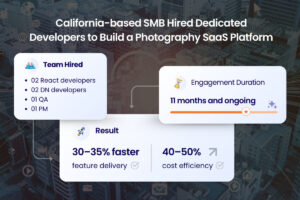
California-based SMB Hired Dedicated Developers to Build a Photography SaaS Platform
Swedish Agency Built a Laravel-Based Staffing System by Hiring a Dedicated Remote Team