

Table of Contents

INTRODUCTION
While working on a sophisticated machine learning and data analytics engine for a major healthcare provider, we encountered a strict infrastructure mandate: the production environment had to be completely air-gapped to comply with data privacy regulations. There was absolutely no outbound internet access allowed. During our initial deployment phase, what was typically a standard routine of setting up Python dependencies turned into a massive logistical bottleneck.
We realized that standard dependency management tools are highly optimized for cloud-connected environments. In our offline system, simple package installations threw endless errors regarding missing distributions, dependency conflicts, and incompatible wheels. Developers were wasting valuable hours manually downloading files on internet-connected machines, transferring them via secure USB drives, only to find out a transitive C-library dependency was missing.
When organizations hire python developers for secure offline systems, there is an expectation that the team can navigate these exact infrastructure constraints. This experience inspired this article to share how we established a deterministic, conflict-free Python package management workflow for air-gapped systems, ensuring other engineering teams can avoid the painful cycle of offline dependency hell.
PROBLEM CONTEXT
The system we were building was an AI-driven analytics platform designed to process massive volumes of sensitive patient data. Architecturally, the platform consisted of a core Python backend utilizing heavy scientific libraries like Pandas, NumPy, and various machine learning frameworks. The deployment target was a secure, isolated Linux cluster.
In a standard cloud environment, executing a simple requirement installation seamlessly fetches the main packages, recursively resolves their dependencies, and downloads the appropriate pre-compiled wheels for the target operating system. However, in our air-gapped healthcare cluster, this automated resolution was completely blocked. Every library, every sub-dependency, and every compiled C-extension had to be manually provided to the isolated environment before the application could run.
WHAT WENT WRONG
Our initial ad-hoc approach to offline package management quickly fell apart. The symptoms surfaced as a barrage of red error logs during the staging deployment:
- No matching distribution found: Developers were downloading packages on their local macOS or Windows machines and moving them to the offline RedHat Linux servers, leading to OS-architecture mismatches.
- Dependency conflicts: Manually picking versions without an automated resolver led to conflicting transitive dependencies, breaking the application at runtime.
- Missing build tools: Some packages were downloaded as source distributions (sdists) instead of pre-compiled wheels (whl). Because the offline server lacked the necessary C++ compilers and internet-based build tools, installation failed immediately.
- IDE fragmentation: Developers using Spyder, VS Code, and PyCharm struggled to configure their environments consistently without access to online plugin registries or language servers.
HOW WE APPROACHED THE SOLUTION
We needed a systematic way to bridge the gap between our internet-connected development machines and the air-gapped production servers. Our architectural reasoning required us to evaluate the best tools for the job: plain Python with venv/pip versus Anaconda.
While Anaconda is excellent for scientific computing and offers tools like Conda-pack for offline environment migration, we opted for a plain Python approach utilizing venv and pip. This decision was driven by the need for lightweight, strictly controlled containerized deployments without the overhead of the Conda base environment. For teams looking to hire ai developers for isolated production environments, standardizing on pure pip workflows often ensures tighter integration with minimal Docker base images.
We also addressed the IDE situation. For an offline development jump-box, we found that VS Code worked best, provided we manually downloaded and sideloaded the necessary VSIX extension files (like the Python extension and Pylance). Jupyter was also highly effective for interactive data exploration, provided its dependencies were bundled in our offline wheelhouse.
FINAL IMPLEMENTATION
To solve the dependency resolution and missing wheel issues, we implemented a strict “Environment Parity” workflow. Instead of randomly downloading packages, we used an internet-connected staging machine running the exact same OS and architecture as our offline production server (often using a Docker container to simulate the environment).
Here is the technical implementation of our offline wheelhouse generation:
Step 1: Download All Dependencies (Including Transitive)
On the internet-connected staging machine matching the target architecture, we executed a download command targeting our requirements file. This ensures pip resolves and downloads pre-compiled wheels for the target platform, not the host machine.
pip download
    --only-binary=:all:
    --platform manylinux2014_x86_64
    --python-version 3.9
    --implementation cp
    --abi cp39
    -r requirements.txt
    -d ./offline_wheels
Step 2: Transfer and Install Offline
The ./offline_wheels directory now acts as a complete, self-contained package repository. This folder was securely transferred across the air-gap to the production environment.
On the offline machine, we instructed pip to ignore the internet and only look at our local directory:
pip install --no-index --find-links=./offline_wheels -r requirements.txt
Step 3: Enterprise Scale – Local Package Repositories
As the project grew, passing around folders of wheels became cumbersome. We eventually deployed a private, offline instance of devpi (a caching PyPI server) inside the air-gapped network. We seeded this repository via secure data transfers. This allowed our offline build pipelines to run standard install commands by simply pointing to the local mirror registry via the pip.conf file.
LESSONS FOR ENGINEERING TEAMS
When you hire dedicated engineering teams for healthcare analytics or other highly secure systems, they must possess the operational maturity to handle infrastructure limitations. Here are the actionable insights we extracted from this deployment:
- Enforce Environment Parity: Never resolve dependencies on an OS that differs from your production target. Use Docker to simulate the offline Linux environment on an online machine to fetch the correct wheels.
- Avoid Source Distributions: Always force pip to download wheels using
--only-binary=:all:. Air-gapped servers rarely have the compilers needed to build from source. - Pin Everything: Use tools like
pip-compile(from pip-tools) to generate a fully locked requirements file that includes all transitive dependencies before attempting an offline download. - Establish a Local Mirror: For long-term projects, migrate from folder-based
--find-linksinstallations to an internal PyPI mirror (like Nexus, Artifactory, or devpi) hosted within the isolated network. - Standardize Offline Tooling: Ensure your team’s IDEs are configured for offline use. Pre-package necessary VS Code extensions (VSIX files) along with your Python wheels.
WRAP UP
Managing Python packages in an air-gapped environment fundamentally shifts how a team approaches dependency management. By abandoning ad-hoc manual downloads in favor of simulated platform downloads and offline wheelhouses, we eliminated build failures and accelerated our deployment cycles. Whether you are building AI platforms, healthcare data engines, or secure defense applications, treating your dependencies as immutable, pre-compiled assets is critical to offline success. If your organization is scaling complex, secure systems and needs to hire software developer expertise, contact us to learn how our dedicated remote engineering teams can help.
Social Hashtags
#Python #DevOps #MLOps #CyberSecurity #AirGapped #PythonPackages #DataEngineering #AIInfrastructure #HealthcareIT #Linux #SoftwareEngineering #PyPI #Docker #MachineLearning #OfflineDeployment
Frequently Asked Questions
Anaconda can be easier for heavy scientific workloads because you can use conda-pack to bundle an entire environment (including C-libraries and Python itself) into a single tarball. However, pip/venv is often preferred for lightweight, production-grade microservices and Docker containers due to a smaller footprint and stricter control over individual wheels.
Packages requiring external system libraries (like libpq for PostgreSQL or ffmpeg) cannot be resolved by pip alone. You must identify these OS-level dependencies and use your system's package manager (e.g., yumdownloader or apt-get download) on an online staging machine to bundle the necessary .rpm or .deb files alongside your Python wheels.
VS Code is highly effective but requires you to download extensions (.vsix files) on an online machine and install them manually via the "Install from VSIX" command. PyCharm Professional offers great offline capabilities but requires offline license activation. Jupyter Notebooks work perfectly offline as long as they are launched within your pre-configured offline virtual environment.
This happens because the wheel downloaded on the online machine does not match the operating system, architecture, or Python version of the offline machine. For example, downloading a wheel on Windows will pull a win_amd64.whl, which will fail to install on a Linux server. Always use the --platform flag when downloading.
Yes. Mature engineering teams operating in air-gapped environments typically deploy artifact repositories like JFrog Artifactory, Sonatype Nexus, or devpi inside the isolated network. These are periodically synced or updated via strict, secure data transfer protocols to provide developers with a traditional, albeit internal, package registry experience.

Success Stories That Inspire
See how our team takes complex business challenges and turns them into powerful, scalable digital solutions. From custom software and web applications to automation, integrations, and cloud-ready systems, each project reflects our commitment to innovation, performance, and long-term value.
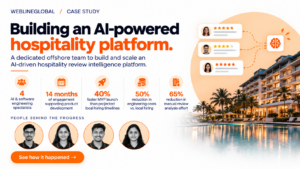
Hospitality Review Intelligence Product Development with Offshore AI Team
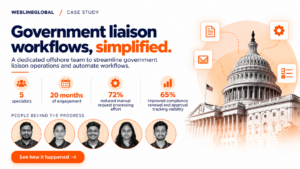
Government Liaison Operations Digitization with Dedicated Offshore Team