

Table of Contents

Why do React Native nested FlatList components trigger premature analytics callbacks?
While working on a scalable FinTech application recently, our engineering team was tasked with building a complex financial product discovery dashboard. The architecture was standard for heavy content platforms: a vertical scrolling list of product categories, with each category containing a horizontally scrolling carousel of individual financial instruments. Naturally, we relied on the standard React Native nested FlatList pattern to handle the UI virtualization.
Accurate impression tracking was a strict regulatory and business requirement. The analytics team needed to know exactly which financial products a user actually saw on their screen. To achieve this, we utilized the built-in onViewableItemsChanged callback on both the parent and child lists.
However, during our QA cycles on physical Android devices (running React Native 0.79.x and React 19), a severe data anomaly was discovered. Our analytics dashboard was recording thousands of impressions for products that users had never actually scrolled to. We realized we had encountered a situation where the child viewability callbacks were triggering long before the elements were physically visible to the user.
Understanding the internals of React Native’s virtualization is a core competency when you hire software developers for enterprise-grade mobile solutions. This challenge inspired this article so other engineering teams can avoid polluting their production analytics databases with false-positive visibility events caused by render-ahead buffers.
How does the render-ahead buffer impact a React Native nested FlatList architecture?
To understand the business impact, we have to look at how virtualization operates. In our architecture, the parent FlatList renders vertical rows. To ensure smooth scrolling, React Native mounts rows that are outside the viewport—this is the render-ahead window. When the parent mounts a row off-screen, it entirely mounts the child FlatList within that row.
Because the child FlatList is now mounted, its internal layout calculation determines that its initial items are visible relative to its own container. Consequently, it fires onViewableItemsChanged immediately. The child list has no spatial awareness that its parent container is currently existing off-screen in a render buffer.
For our FinTech client, this meant that simply opening the application generated marketing impressions for rows of products sitting two screens below the fold. This architectural oversight artificially inflated click-through denominators, skewing the entire conversion funnel.
What exactly went wrong in the React Native flatlist execution?
The symptoms surfaced directly in our debug logs. We configured both lists with a standard viewabilityConfig requiring a 30 percent visibility threshold.
When the screen initialized, the logs showed a cascade of misaligned events:
- Row 1 Mounts (Visible): Parent registers Row 1 as viewable. Child registers its first 3 items as viewable. (Correct)
- Row 2 Mounts (Visible): Parent registers Row 2 as viewable. Child registers its items as viewable. (Correct)
- Row 3 Mounts (Off-screen render-ahead): Parent does not register Row 3 as viewable.
- Row 3 Child Mounts: Child immediately registers its items as viewable. (Incorrect – False Positive)
The core failure was treating onViewableItemsChanged as a global screen viewport intersection observer, when in reality, it only observes intersections relative to the immediate scrollview container. Because the child items were fully visible inside their off-screen parent container, the callback executed perfectly according to the VirtualizedList specification, but entirely wrong for our business logic.
How did we evaluate solutions for React Native nested FlatList rendering?
When companies hire app developer to create a mobile app, they often expect standard UI components to handle edge cases natively. However, bridging the gap between framework behavior and business requirements requires architectural decision-making. We evaluated several approaches to suppress these premature callbacks without degrading scrolling performance.
Can we use conditional rendering to delay the child list?
Our first instinct was to completely avoid rendering the child FlatList until the parent row became visible. We considered introducing a local isReady state. However, deferring the mount until the exact moment a row enters the viewport entirely defeats the purpose of the render-ahead buffer. This approach caused severe UI stuttering during rapid scrolling because the UI thread was forced to mount heavy horizontal carousels exactly when it needed to be rendering frames.
Should we utilize a global Redux visibility state?
We considered storing the visible parent row IDs in a global store. The child component would connect to this store and conditionally trigger its analytics. We discarded this because pushing high-frequency scroll events through a global state manager triggers widespread reconciliation, resulting in massive React rendering overhead.
Could we use Native UI Intersection Observers?
Writing custom native modules to track coordinate intersections via iOS and Android UI threads would provide perfect precision. However, this introduces high maintenance overhead and fragments the codebase, which contradicts the cross-platform advantages of React Native.
How about using mutable Refs for context-based visibility inheritance?
We determined the most performant solution was to decouple the analytics firing logic from React’s rendering lifecycle. By tracking the visibility of parent rows using mutable useRef structures and passing a reference down to the child, we could intercept and block the child’s analytics payload without triggering any component re-renders or destroying the render-ahead buffer.
How to correctly implement viewability tracking for a React Native nested FlatList?
Our final implementation revolves around a lightweight tracking mechanism. The parent component maintains a Set of currently visible row IDs using a useRef. We pass a validation function down to the children. When a child’s onViewableItemsChanged fires, it first asks the parent: “Are you actually on the screen right now?”
This completely eliminates React state overhead while preserving accurate analytics.
import React, { useRef, useCallback } from 'react';
import { FlatList, View, Text } from 'react-native';
const VIEWABILITY_CONFIG = {
  itemVisiblePercentThreshold: 30,
};
function ChildCarousel({ rowId, childData, checkParentVisibility }) {
  const onChildViewableItemsChanged = useCallback(({ viewableItems }) => {
    // Intercept: Only process analytics if the parent row is on-screen
    if (!checkParentVisibility(rowId)) {
      return;
    }

    const visibleIds = viewableItems.map(v => v.item.id);
    // Dispatch analytics event here
    console.log(`Analytics Log - Row ${rowId} Child Items Viewable:`, visibleIds);
  }, [rowId, checkParentVisibility]);
  return (
    <FlatList
      horizontal
      data={childData}
      renderItem={({ item }) => <View><Text>{item.name}</Text></View>}
      onViewableItemsChanged={onChildViewableItemsChanged}
      viewabilityConfig={VIEWABILITY_CONFIG}
    />
  );
}
export default function PlatformDashboard({ sections }) {
  // Mutable reference avoids re-renders during high-frequency scroll events
  const visibleRowsRef = useRef(new Set());
  const onParentViewableItemsChanged = useCallback(({ viewableItems }) => {
    const currentVisible = new Set(viewableItems.map(v => v.item.id));
    visibleRowsRef.current = currentVisible;
  }, []);
  // Lightweight accessor function passed to children
  const checkParentVisibility = useCallback((rowId) => {
    return visibleRowsRef.current.has(rowId);
  }, []);
  return (
    <FlatList
      data={sections}
      renderItem={({ item }) => (
        <View style={{ height: 400 }}>
          <Text>{item.title}</Text>
          <ChildCarousel
            rowId={item.id}
            childData={item.products}
            checkParentVisibility={checkParentVisibility}
          />
        </View>
      )}
      onViewableItemsChanged={onParentViewableItemsChanged}
      viewabilityConfig={VIEWABILITY_CONFIG}
    />
  );
}
By implementing this, we achieved a near-zero performance cost. The UI thread remains unblocked, the render-ahead buffer behaves as designed and false-positive impression events dropped to zero.
What are the core lessons for engineering teams handling React Native FlatList?
When you hire react native developers for scalable mobile apps, it is critical that they understand how to handle complex list hierarchies. Here are the main takeaways our engineering team documented from this challenge:
- Understand relative viewability: VirtualizedList viewability is always relative to its direct scrolling container, not the absolute screen bounds.
- Decouple analytics from UI rendering: Never tie your impression tracking strictly to component mount lifecycles when using virtualized components.
- Leverage Refs for high-frequency data: Tracking scroll positions or visibility arrays in
useStatewill destroy application frame rates. Always useuseReffor transient UI states that do not require visual updates. - Respect the render buffer: Avoid conditionally rendering heavy components strictly when they enter the viewport, as this nullifies native performance optimizations.
- Validate data on physical devices: Emulators often handle layout calculations slightly differently than physical CPU/GPU combinations. Always verify scroll analytics on real hardware.
- Pass minimal payloads: When passing callbacks down deeply nested lists, ensure they are wrapped in
useCallbackto prevent unnecessary reconciliation of child list items.
How can dedicated engineering teams prevent similar architectural failures?
The premature triggering of viewability callbacks in a React Native nested FlatList is a perfect example of a silent failure. The app did not crash, the UI did not freeze, but the business data was fundamentally corrupted. Identifying and resolving these layer-integration issues requires engineers who look beyond basic implementation and deeply understand framework internals.
If you are scaling complex applications and need technical assurance, contact us to explore how our dedicated development teams deliver precise, high-performance engineering solutions.
Social Hashtags
#ReactNative #FlatList #ReactJS #MobileDevelopment #AppDevelopment #JavaScript #ReactNativeDevelopment #MobileAppDevelopment #SoftwareEngineering #FrontendDevelopment #AndroidDevelopment #PerformanceOptimization #AppAnalytics #FinTech #DeveloperTips
Frequently Asked Questions
It typically fires repeatedly if the callback function or the viewabilityConfig object is not memoized. Always define your viewabilityConfig outside the component or wrap it in a useMemo and wrap your callback in a useCallback to prevent React from tearing down and re-registering the observer.
While InteractionManager.runAfterInteractions() can delay heavy rendering until after animations or transitions finish, it does not solve the spatial awareness issue of the render-ahead buffer. The item will still mount off-screen eventually, triggering the false positive.
Yes, nesting lists of the same directional axis (vertical inside vertical) is highly discouraged and will throw warnings. Orthogonal nesting (horizontal inside vertical) is supported but consumes significant memory. It is critical to optimize initialNumToRender, maxToRenderPerBatch and windowSize props to manage memory.
Enterprise teams enforce separation of concerns by creating higher-order components or custom hooks specifically designed for viewability analytics. This ensures developers building UI features aren't responsible for writing low-level intersection logic every time they implement a list.



Success Stories That Inspire
See how our team takes complex business challenges and turns them into powerful, scalable digital solutions. From custom software and web applications to automation, integrations, and cloud-ready systems, each project reflects our commitment to innovation, performance, and long-term value.
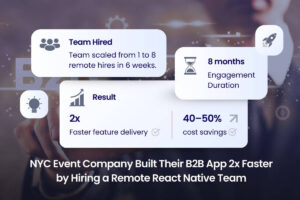
NYC Event Company Built Their B2B App 2x Faster by Hiring a Remote React Native Team

US SaaS Platform Cut Manual Ops by 70% After Hiring WeblineGlobal’s n8n Automation Pod