Table of Contents

Landing that first seven-figure contract with a global enterprise is a watershed moment for any Boston-based technology company. Whether your new client is a massive pharmaceutical firm in Cambridge or a financial powerhouse in the Seaport District, the celebratory mood often masks a looming operational crisis. The engineering culture, processes, and team structure that successfully delivered a nimble Minimum Viable Product (MVP) are rarely the same ones required to sustain a high-stakes enterprise partnership. Transitioning from a high-growth startup mindset to an enterprise-grade service provider requires a fundamental shift in how you think about your technical debt, security protocols, and overall team composition.
Most leadership teams realize too late that enterprise clients do not just buy your software; they buy your reliability and your process. The pressure to maintain ninety-nine point nine percent uptime while simultaneously shipping new features can paralyze a small, locally based team. This is the exact moment when founders and CTOs begin to look at how to restructure engineering Boston to accommodate these new, more rigorous demands. It is not just about adding more developers; it is about re-architecting the human side of the engineering organization to ensure that the promises made during the sales cycle are actually delivered by the product team. To navigate this pivot, many leaders find they need to hire IT consultants who have lived through these specific scaling challenges before.
The Post-Win Reality: Why the MVP Team Breaks
In the early days of a Boston startup, speed is the only currency that matters. Your engineering team is likely composed of generalists who can wear multiple hats, jumping from frontend tweaks to database optimization in a single afternoon. However, the moment an enterprise contract is signed, the requirements change from flexibility to predictability. Enterprise clients demand SOC2 compliance, rigorous penetration testing, and ironclad Service Level Agreements (SLAs) that your current team might not be equipped to handle. This shift often forces a decision to restructure engineering Boston to create dedicated roles for stability and support.
The Trap of Technical Debt
When you are building for the first ten customers, you take shortcuts. You use “quick and dirty” code to test features. But for an enterprise client, those shortcuts represent significant delivery risks. The internal pressure to fix these issues while maintaining the roadmap can lead to burnout. To solve this, savvy leaders often hire enterprise developers who specialize in hardening systems and refactoring legacy code without disrupting the user experience.
SLA Compliance and Support Cycles
Enterprise clients expect twenty-four-seven support or at least rapid response times that a lean local team cannot provide without sacrificing their daylight hours for innovation. If your core team is spent fixing bugs for one big client, you stop building for the next five. This is where the decision to schedule a consultation regarding remote engineering pods becomes a strategic necessity for maintaining growth.
Uptime vs Innovation
The conflict between keeping the lights on for a massive client and continuing to innovate for the rest of the market is the primary driver for team restructuring. You cannot have your best architects spending half their day on support tickets if you want to remain competitive in the Boston tech ecosystem.
Bridging the Gap: Why Companies Hire IT Consultants Boston
The talent war in Massachusetts is fierce. Trying to find specialized roles like DevOps engineers, security experts, or enterprise architects locally can take months and cost a fortune in recruiter fees and bloated salaries. When time is of the essence following a major win, the ability to hire IT consultants Boston provides a bridge. These consultants offer the high-level strategic oversight required to design a new organizational chart, while allowing the core team to focus on the product vision.
External Perspective on Internal Bottlenecks
Internal teams are often too close to the code to see the structural flaws. An outside consultant can objectively assess where the delivery risks lie. They help identify if the bottleneck is in the QA process, the deployment pipeline, or simply a lack of specialized knowledge in cloud infrastructure. By choosing to hire IT consultants, you gain access to a repository of best practices that have been proven in other enterprise environments.
Strategic Resource Allocation
Restructuring is not just about who you hire, but where they are located. A hybrid model, combining a local core team with a dedicated offshore pod, is often the most cost effective way to scale. WeblineGlobal has helped many firms navigate this by providing vetted developers who integrate directly into existing workflows, allowing the Boston based leadership to maintain full project control while reducing costs by forty to sixty percent.
Scaling the QA Function
One of the first things to break under enterprise pressure is quality assurance. What worked with manual testing for a few hundred users will fail miserably under the load of an enterprise rollout. Restructuring often involves moving toward automated QA frameworks managed by dedicated remote teams.
The Infrastructure of Trust: Security and Compliance
For a Boston firm working in biotech, fintech, or healthcare, security is not a feature, it is a prerequisite. Enterprise wins often come with a massive security audit that can take weeks to complete. If your engineering team is not structured to handle these audits, your contract could be at risk before the first invoice is paid. This is a common reason why organizations choose to restructure engineering Boston to include dedicated security and compliance roles.
Meeting SOC2 and HIPAA Standards
Implementing the necessary controls for SOC2 or HIPAA compliance requires a disciplined approach to engineering that many startups lack. You need to hire enterprise developers who understand how to build secure data pipelines and manage access controls without slowing down the development cycle. These are specialized skills that are often easier to find through a dedicated staffing partner than on the open market in Boston.
Data Governance and Privacy
As you scale, how you handle client data becomes a legal liability. Enterprise clients will demand to know exactly where their data is stored, who has access to it, and how it is encrypted. If your team structure does not include a data architect or a dedicated security lead, you are flying blind. Many firms choose to restructure engineering specifically to centralize data governance under a single point of accountability.
IP Protection and Vendor Security
When working with remote teams to support your enterprise growth, security remains paramount. Using models like RelyShore℠ ensures that IP protection and NDAs are handled with US based assurance, even if the execution happens offshore. This provides the peace of mind that enterprise legal departments require during their vendor due diligence.
Strategic Team Composition: Beyond the Local Talent War
One of the biggest mistakes Boston leaders make is assuming they must hire every new engineer locally. With the cost of living and salary expectations in Massachusetts continuing to rise, building a fifty-person engineering team entirely in the city is financially unsustainable for many mid-market firms. To restructure engineering Boston effectively, you must think globally. A hub and spoke model, where your architects and product owners are in Boston but your execution pods are remote, offers the best balance of speed and cost.
The Dedicated Pod Model
Instead of hiring individual freelancers, enterprise-ready companies are moving toward dedicated pods. These are pre-configured teams that include developers, a QA tester, and a scrum master. This structure allows you to hire IT consultants to lead the pod while the heavy lifting is done by remote experts. This minimizes the management overhead for your local CTO and ensures that the team has a consistent velocity from day one.
Evaluating Skill Sets for Enterprise Scale
When you hire enterprise developers, you are looking for more than just coding ability. You need people who understand version control at scale, CI/CD pipelines, and microservices architecture. Evaluating these skills requires a rigorous vetting process that many internal HR teams are not equipped to handle, which is why partnering with a firm like WeblineGlobal can shorten the hiring window to as little as forty-eight hours.
Month-to-Month Flexibility
The beauty of a restructured, hybrid team is the flexibility it provides. Enterprise needs can fluctuate. Having the ability to scale your team up or down on a month to month basis without the legal and emotional burden of local layoffs is a significant strategic advantage for any CFO or founder.
Navigating the Restructure: Avoiding Productivity Death Spirals
Changing your team structure while trying to deliver on a major contract is like trying to change the tires on a car while it is going sixty miles per hour. If handled poorly, the decision to restructure engineering Boston can lead to attrition, missed deadlines, and a loss of trust with your new enterprise client. The key is to manage the transition incrementally rather than through a single, disruptive overhaul. This is where you might schedule a consultation to plan a phased integration of new resources.
Maintaining Culture During Growth
The original engineering team often feels threatened when you bring in outside help or hire IT consultants Boston. It is vital to communicate that these changes are designed to offload the “toil” and allow the core team to focus on high-value innovation. When you restructure engineering, the goal should be to empower your local talent, not replace them.
Role Clarity and Ownership
In a restructured team, the lines of ownership must be clear. Who is responsible for the enterprise SLA? Who owns the new feature roadmap? By defining these roles early, you prevent the friction that usually accompanies growth. Utilizing remote pods for maintenance and support often provides the clearest line of demarcation for the internal team.
Continuous Feedback Loops
Successful restructuring requires constant communication. Whether your team is in a Boston office or based in India, daily standups and transparent project management tools are non-negotiable. This level of rigor is exactly what enterprise clients expect to see when they audit your processes.
Choosing the Right Partner for Your Boston Team
Restructuring your engineering organization is a high-stakes move that requires more than just a recruitment agency. It requires a partner who understands the nuances of the Boston tech market and the demands of global enterprise. Whether you need to hire enterprise developers to harden your infrastructure or you need to hire IT consultants Boston to guide your strategic roadmap, the goal is the same: sustainable, scalable growth. WeblineGlobal has been facilitating this transition for over twenty years, providing the technical expertise and delivery assurance that CXOs need to sleep soundly after a big win.
Social Hashtags
#StartupScaling #EngineeringManagement #TechLeadership #EnterpriseSoftware #DevOps #SoftwareDevelopment #BostonTech #TechHiring #DigitalTransformation #SaaS
Ready to Scale? Schedule a consultation today to see how we can help you restructure your engineering team for enterprise success.
Frequently Asked Questions
While the initial strategic shift can happen in weeks, a full restructure usually takes three to six months to stabilize. By using pre-vetted remote pods, you can often see productivity gains within the first thirty days.
Most Boston-based companies see a reduction in engineering overhead of forty to sixty percent by shifting execution and support tasks to offshore teams while keeping core architecture local.
Yes, provided you have the right security protocols, IP protection, and a transparent delivery model like RelyShore℠ in place. Most global enterprises already use similar models for their own internal engineering.
Success depends on having a clear technical lead or consultant who bridges the gap. By choosing to hire IT consultants who act as the primary interface, the business context is maintained while the execution is scaled globally.
The month-to-month flexibility of a dedicated remote team allows you to pivot your resources far faster than you could with a purely local team, where hiring and firing cycles are much longer and more expensive.




Success Stories That Inspire
See how our team takes complex business challenges and turns them into powerful, scalable digital solutions. From custom software and web applications to automation, integrations, and cloud-ready systems, each project reflects our commitment to innovation, performance, and long-term value.
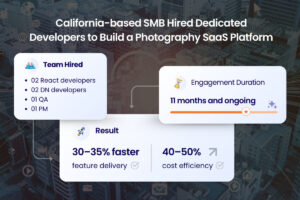
California-based SMB Hired Dedicated Developers to Build a Photography SaaS Platform
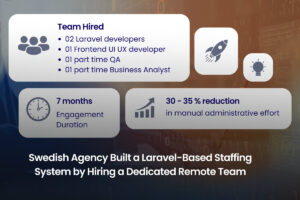
Swedish Agency Built a Laravel-Based Staffing System by Hiring a Dedicated Remote Team