Table of Contents

Seattle remains a global epicenter for cloud innovation, yet the competition for engineering talent has created a volatile environment for growing firms. For CTOs and VPs of Engineering at mid-market companies and scaling startups, the pressure to expand infrastructure often leads to a dangerous cycle of aggressive recruitment followed by operational bloat. When you need to scale cloud without hiring spikes, the traditional local recruitment model often fails to provide the necessary speed or fiscal flexibility required in today’s market. Many leaders find themselves caught between the need for rapid deployment and the reality of a talent pool that is both scarce and prohibitively expensive.
The challenge lies in building a resilient cloud strategy that adapts to workload fluctuations without the long-term liability of fixed overhead. By shifting the focus from high-friction local hiring to an elastic delivery model, companies can maintain their competitive edge in the PNW tech scene. This article examines the strategic trade-offs of hiring locally versus utilizing dedicated remote pods and provides a roadmap for decision-makers looking to optimize their cloud operations. If your goal is to hire IT consultants who understand the nuances of scalable architecture, you must first address the structural inefficiencies of your current hiring pipeline.
The Seattle Talent Paradox: Scaling Cloud Without the Local Hiring Friction
Seattle tech leaders operate in one of the most competitive markets in the world. With giants like Amazon and Microsoft setting the baseline for compensation and benefits, mid-sized firms often struggle to attract the same level of expertise without overextending their budgets. This environment makes it difficult to hire cloud engineers Seattle because the demand consistently outstrips the supply. When a company experiences a sudden need to scale, the immediate reaction is often to open multiple local requisitions, which leads to significant delays and high recruitment fees.
Identifying the Hidden Costs of Local PNW Recruitment
Recruiting locally in the Pacific Northwest involves more than just salary. You must account for signing bonuses, equity grants, relocation packages, and the extensive time-to-hire, which can often stretch into several months. For a cloud migration or a major infrastructure overhaul, a three-month delay in hiring is not just an HR issue; it is a product roadmap failure. When you hire cloud & devops engineers through traditional channels, you are also inheriting the risk of high attrition as engineers are frequently poached by neighboring tech giants.
Why Traditional Hiring Spikes Jeopardize Long-Term ROI
Hiring spikes are often a reactive response to technical debt or sudden growth. However, once the initial project phase concludes, companies are left with a massive payroll that may no longer align with the operational requirements. This lack of elasticity is the primary reason why many organizations struggle to maintain profitability while scaling. To scale cloud without hiring spikes, leaders must adopt a more modular approach to human capital, treating engineering capacity as a variable resource rather than a fixed asset. This allows for rapid expansion during peak demand while maintaining a lean core team during maintenance phases.
Struggling to scale cloud operations without overloading your hiring pipeline? Discover how top Seattle companies are building elastic engineering teams without costly hiring spikes. Get expert guidance tailored to your infrastructure goals and growth plans.
Architecting Elastic Engineering Teams for Cloud Resilience
Success in modern cloud operations requires a team structure that is as scalable as the infrastructure itself. Instead of relying solely on local full-time hires, savvy CTOs are moving toward a hybrid model that blends core internal leadership with dedicated remote pods. This approach allows you to scale cloud sustainably by tapping into global talent pools that offer specialized skills without the Seattle-area price tag. These pods are not just individual contractors but cohesive units that integrate directly into your existing workflows and culture.
Moving from Fixed Overhead to Variable Talent Models
The traditional staffing model is often too rigid for the fast-paced cloud environment. A variable talent model allows you to ramp up or down based on specific project milestones. For instance, during a massive Kubernetes migration or a transition to serverless architecture, you might need a surge in engineering capacity. Once the architecture is stabilized, the team can be scaled back to a maintenance level. This flexibility is essential for maintaining a healthy balance sheet while ensuring that technical delivery never stalls due to a lack of manpower.
Evaluating Dedicated Cloud Pods vs. Individual Contractors
Individual contractors can fill immediate gaps, but they often lack the collective knowledge and standardized processes of a dedicated pod. A pod, such as those provided by WeblineGlobal, comes pre-assembled with a balance of senior architects and execution-focused engineers. This reduces the management overhead for your local VPs of Engineering. When you choose to review ops capacity through a pod-based lens, you gain the benefit of a team that has already worked together, significantly reducing the “storming and norming” phases of team development.
The RelyShore℠ Advantage in Remote Delivery
At WeblineGlobal, we utilize the RelyShore℠ model to bridge the gap between US-based leadership and the technical scale of India-based development. This model ensures that while the execution happens offshore to manage costs, the delivery standards, communication protocols, and project oversight align with US business expectations. This is particularly crucial for Seattle firms that require high-velocity output without sacrificing the quality or security of their cloud infrastructure.
Strategizing the Transition: When to Hire Cloud Engineers Seattle and When to Augment
The decision to hire cloud engineers Seattle versus augmenting with a remote team should be based on the criticality and nature of the work. Internal hires are best suited for roles that require deep institutional knowledge or represent the core intellectual property of the company. On the other hand, infrastructure management, automation, CI/CD pipeline optimization, and 24/7 cloud monitoring are prime candidates for augmentation. This strategic division allows your local team to focus on innovation while the remote pod handles the heavy lifting of operational scaling.
Assessing Your Internal DevOps Maturity
Before expanding your team, it is vital to evaluate your current DevOps maturity. Are your processes documented? Is your infrastructure managed as code? If these foundations are missing, simply adding more people, whether local or remote, will only lead to more chaos. To hire IT consultants who can guide this assessment is often the first step toward a successful scaling strategy. They can help identify the bottlenecks in your delivery pipeline and recommend the right mix of local and remote talent to address them.
Bridging the Skills Gap in AWS, Azure, and GCP
Cloud expertise is highly specialized. A generalist engineer may not have the depth required for complex security configurations or cost-optimization strategies within specific platforms like AWS or Azure. When you look to hire cloud & devops engineers, you are often looking for specific certifications and hands-on experience with niche tools. Remote augmentation provides access to these specialists immediately, without the long lead times associated with finding such specific profiles in the local Seattle market.
Scaling Without Sacrificing Security or Compliance
A common concern for Seattle-based companies when hiring remote teams is security. However, by establishing strict access controls, utilizing secure VPNs, and ensuring all remote developers adhere to the same SOC2 or ISO standards as the internal team, these risks can be mitigated. The goal is to scale cloud sustainably by extending your security perimeter to include your remote engineering pods. WeblineGlobal emphasizes IP protection and NDAs to ensure that your proprietary configurations and data remain secure throughout the engagement.
Not sure whether to hire locally or augment with remote DevOps experts? Let our specialists assess your current cloud setup and recommend the most cost-efficient, scalable talent model for your needs.
Financial Predictability in Cloud Scaling
The financial impact of a hiring spike can be devastating to a company’s runway. Beyond the obvious salary costs, the administrative burden of onboarding and managing a large local team adds significant hidden expenses. By choosing to review ops capacity and opting for a remote team in India, Seattle companies can achieve a 40 to 60 percent reduction in operational costs. This capital can then be reinvested into product development or market expansion, providing a significant competitive advantage.
Comparing Seattle Base Salaries with Remote Augmentation
A senior cloud engineer in Seattle can easily command a base salary exceeding $180,000, not including benefits and taxes. In contrast, a high-performing dedicated pod from India provides the same level of technical expertise at a fraction of the cost. When you hire cloud engineers Seattle, you are paying a premium for geography. By decoupling talent from location, you can scale cloud without hiring spikes that would otherwise drain your treasury. This allows for a more aggressive growth trajectory without the associated financial risk.
Flexibility in Month-to-Month Engagement
One of the greatest advantages of the staff augmentation model is the ability to work on a month-to-month basis. Traditional hiring creates a permanent commitment that is difficult to reverse if market conditions change. Remote pods offer the flexibility to adjust team size as needed. This agility is particularly valuable for startups and mid-market companies that must remain lean and responsive to shift in the tech landscape. It allows you to hire cloud & devops engineers for the exact duration they are needed, optimizing your burn rate.
Risk Management in Offshore Cloud Operations
The success of remote cloud operations depends heavily on the vendor’s ability to manage delivery risk. Seattle companies need partners who understand the importance of uptime, latency, and system reliability. When looking to hire IT consultants or remote teams, look for a proven track record of delivering complex enterprise projects. WeblineGlobal, with over 25 years of experience, has delivered thousands of projects by focusing on clear communication and rigorous quality assurance protocols.
Managing Time Zones and Communication for Seattle Teams
While India is several time zones away, this can be turned into an operational advantage. A “follow-the-sun” model allows for continuous development and monitoring. While your Seattle team sleeps, the India-based pod can be performing updates, running tests, or managing backups. This ensures that when your local team starts their day, the infrastructure is optimized and ready. To scale cloud sustainably, you must leverage this 24/7 cycle to accelerate your deployment timelines and improve system availability.
Ensuring Cultural and Technical Alignment
The “soft skills” of a remote team are just as important as their technical proficiency. Effective communication, proactive problem-solving, and a collaborative mindset are essential for integrating a remote pod into a Seattle-based engineering culture. Vetting candidates for these traits is a core part of the hiring process. When you review ops capacity, ensure the engineers possess the English proficiency and professional maturity to participate in stand-ups and contribute meaningfully to architectural discussions.
Evaluating Your Next Move in Cloud Infrastructure
For Seattle organizations, the path to successful scaling is not found in the traditional local hiring grind. Contact us now to find it in the strategic orchestration of diverse talent pools. By deciding to hire cloud engineers Seattle only for the most critical core roles and augmenting the rest with dedicated remote pods, you create a scalable, cost-effective, and resilient engineering organization. This approach mitigates the risks associated with hiring spikes and provides the technical agility required to lead in a crowded market.
As you evaluate your roadmap for the coming quarters, consider where your current hiring model is creating friction. Are you struggling to find qualified local talent? Are your infrastructure costs scaling faster than your revenue? If the answer is yes, it is time to explore an alternative delivery model. WeblineGlobal offers the expertise and the scale to help you hire cloud & devops engineers who can transform your infrastructure into a growth engine. By leveraging our RelyShore℠ model, you gain the benefits of India’s technical scale with the assurance of US-based standards, ensuring your cloud operations are built for the long term.
Social Hashtags
#CloudComputing #DevOps #CloudScaling #TechLeadership #StartupGrowth #RemoteTeams #StaffAugmentation #SeattleTech #CloudStrategy #DigitalTransformation
Ready to scale cloud without hiring spikes? Access pre-vetted cloud and DevOps engineers who can integrate seamlessly into your team and start delivering immediately—without long hiring cycles.
Frequently Asked Questions
We typically provide a curated shortlist of pre-vetted cloud engineering profiles within 48 hours. Our goal is to significantly reduce the time-to-hire compared to local Seattle recruitment, allowing your projects to stay on schedule.
No, we offer month-to-month hiring flexibility. This allows you to scale your team up or down based on your specific project needs and budget constraints, which is essential to scale cloud without hiring spikes.
Every engineer undergoes a rigorous vetting process that includes technical assessments, communication evaluations, and cultural fit interviews. Our RelyShore℠ model provides an additional layer of delivery assurance and oversight to maintain high standards.
Yes, our developers are accustomed to working as an extension of our clients' teams. They integrate directly into your existing project management tools, communication channels, and CI/CD pipelines to ensure seamless collaboration.
We maintain strict security protocols, including comprehensive NDAs, secure access controls, and IP protection clauses in all our contracts. Your proprietary code and infrastructure configurations remain your exclusive property throughout the engagement.


Success Stories That Inspire
See how our team takes complex business challenges and turns them into powerful, scalable digital solutions. From custom software and web applications to automation, integrations, and cloud-ready systems, each project reflects our commitment to innovation, performance, and long-term value.
California-based SMB Hired Dedicated Developers to Build a Photography SaaS Platform
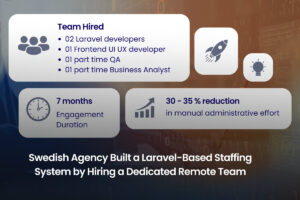
Swedish Agency Built a Laravel-Based Staffing System by Hiring a Dedicated Remote Team