
Table of Contents

This is the tightrope software engineering leadership walks today, balancing product pace against cost predictability. CTOs are under tremendous pressure to produce feature-rich mobile applications rapidly. When the market changes, a bloated permanent overhead is a financial danger. This strategy guide looks at how IT leaders may take advantage of flexible engagement models to accelerate mobile delivery and protect core capital.
Why Scaling React Native Development Doesn’t Always Require More Full-Time Hires
The conventional corporate mentality is that to grow software productivity you need to grow permanent staff, office space and legacy HR liabilities proportionately. But today’s corporate engineering calls for outstanding agility.
Now, technology executives know that product lifecycles have sharp peaks and predictable troughs, and that they can escape the monotonous, costly cycle of full-time recruiting without ever compromising application performance, code quality, or time-to-market milestones.
- A large permanent internal workforce is a significant financial risk in unstable markets, where unexpected economic crises or sharp fluctuations in the client project pipeline can quickly exhaust operating capital.
- The traditional hiring process for specialised mobile expertise is often time-consuming, delaying crucial product roadmap milestones. To overcome these challenges, organisations can consider hiring dedicated React Native developers to accelerate mobile product delivery without relying exclusively on permanent recruitment.
- Alternative execution frameworks allow companies to access specialist skills and build a scalable mobile app development team when complex technical challenges arise, while aligning labour costs with project requirements and workloads.
- Engineering directors must make difficult decisions about full-time personnel when demand is low; elastic staffing models naturally absorb market shocks without damaging organisational morale.
- Strategic workforce elasticity diminishes the weariness that core team members would otherwise bear as the brunt of compressed deadlines, ongoing firefighting, and aggressive enterprise feature rollout timescales.
- Agile workforce models allow tech leaders to experiment with specific tech stacks without the commitment of long-term employment contracts or costly redundancy payments.
Need to Scale Your React Native Team Without Adding Fixed Headcount?
When has Your Existing React Native Team Reached its Capacity?
Knowing precisely where an internal engineering team is bottlenecked can be important to preventing burnout, technological debt, and missed deployments. Capacity constraints rarely declare themselves with a loud, evident bang. Instead, they manifest as minor operational friction points in daily sprint planning, code review cycles, and backlog grooming sessions. We recommend that CTOs keep an eye on KPIs, so they know when they’re really maxed out on bandwidth.
- The team is progressing at a steady rate, but the sprint velocity is consistently flat or declining, which indicates that engineers are spending too much time on maintenance, bug fixes, and technical debt and not enough time on new additions.
- Code review backlogs linger for days. This creates developer bottlenecks when pull requests sit idle. Ultimately, you see that it impedes continuous integration pipelines and reduces overall team morale.
- The core developers are engaged in the firefighting cycle of keeping previous production builds stable, which means that big architectural decisions or other essential refactoring work is postponed indefinitely.
- Product roadmap milestones continue to slip quarter over quarter, forcing executive leadership to repeatedly push back planned feature rollouts, marketing campaigns, and crucial enterprise client integrations.
- Developers are getting more dissatisfied with context switching. They have to juggle urgent production support issues with complex feature development without adequate time to spend coding.
- An increasing number of customer support tickets relating to application failures or UI lag suggests that the in-house engineering staff is too small to meet demanding quality assurance requirements.
- Senior engineers spend over half their time on administrative coordination and onboarding, not actual architecture and code.
Dedicated Team, Staff Augmentation, or In-House Hiring: Which Model Fits Your Growth?
The right engagement framework is about fit of external skills to your core engineering culture. A dedicated React Native team is a single, end-to-end, self-contained execution unit. It keeps the internal workflow itself, which is good for various product lines.
Conversely, React Native staff augmentation provides specialist engineers straight into your existing management structure with granular control over the day-to-day job assignments and architectural needs.
- In-house hiring is the best long-term match for culture and institutional knowledge retention, but it comes at a high price of recruitment, a large benefit package, and extended onboarding process.
- Partnering with a remote React Native development team or an offshore React Native development team, you may access global talent pools. You also lower hourly operational costs dramatically and construct 24/7 development cycles across many time zones.
- React Native staff augmentation and dedicated React Native team augmentation services let CTOs plug specific skill gaps rapidly (e.g., native bridge optimisation or advanced state management) without altering permanent corporate workers.
- Management overhead is relative to the complexity of the specific product project, by knowing when a dedicated React Native development team is the correct match and when an integrated staff augmentation approach is the perfect fit.
Ultimately, assessing organisational readiness helps technology executives partner at the right level, balancing independence, communication overhead and long-term strategy fit. Also, your current leadership capacity will determine whether you want a self-managing unit or individual contributors who can drop directly into your existing agile rituals and sprint boards. However, to remove friction, model selection must seamlessly transition from MVP development to enterprise-level feature expansion by evaluating long-term scalability metrics.
Comparing Cost, Speed, Flexibility, and Control Across React Native Hiring Models
A multi-dimensional assessment of financial impact, deployment velocity, organisational flexibility, and governance overhead helps CTOs evaluate different flexible engagement models and select the right sourcing approach.
A conventional React Native mobile development team established locally gives you the highest administrative control but is expensive and doesn’t provide a lot of flexibility in terms of scalability. For a deeper comparison of workforce flexibility, recruitment costs, and delivery control, explore the differences between staff augmentation and dedicated hiring to make informed decisions about your engineering team structure.
- Large differences in financial spend: internal staff incur continuing salaries, payroll taxes, and overhead, while a React Native development team in another country is retained through flexible service agreements based on deliverables.
- Professional React Native staff augmentation is the fastest way to deployment — pre-vetted senior devs may be deployed inside current sprints in days, instead of months with regular recruitment pipelines.
- One of the main advantages of a scalable React Native team model is operational flexibility. It allows businesses to increase or decrease engineering capacity by 50% or more to meet the quarterly needs of the project.
- Engineering control: Different models have different levels of engineering control. Staff augmentation is fully managed in-house, and a dedicated React Native development team has implemented milestone management and technical lead monitoring to ensure adherence to architecture.
- How hybrid staffing models can drastically lower total cost of ownership (TCO) by eliminating termination risks, bench costs, and recruiting agency fees – as revealed in a long-term capital spend analysis.
- The level of administrative overhead may vary somewhat based on whether your HR department needs to manage international compliance, payroll and local tax requirements for a dispersed workforce.
- Consistency of quality is largely based on the rigour of the vetting of your external partner. This highlights the need to select established providers with proven technical testing procedures.
Is Your React Native Roadmap Outgrowing Your Current Team’s Capacity?
How to Add External React Native Talent Without Losing Engineering Control
Incorporating outside developers into an existing code base is a disciplined process that requires solid documentation and tight quality assurance standards. Bringing in outside contributors without clear boundaries and common protocols might result in architectural fragmentation, diverse coding styles, and costly merge conflicts.
CTOs should establish very rigid onboarding frameworks that enforce existing linting norms, testing standards, and continuous integration pipelines from day one.
- Have complete documentation of architectural patterns, state management strategies, and API contracts, which will allow external developers to quickly familiarise themselves and minimise the need to frequently disturb core team members.
- Enforce a strict code review process to guarantee that staff-created pull requests are approved by the internal tech lead to maintain company security and quality standards.
- Implemented CI/CD pipelines, local dev environments running in containers, and robust test suites to catch regressions and style violations early, reducing the amount of manual review needed.
- Establish simple lines of communication and daily sync routines using current collaboration technologies to enable distributed engineering squads to overcome geographical distances and maintain absolute transparency.
- Pair programming sessions in the first weeks for building cultural cohesion, transferring institutional knowledge, and aligning external developers to internal coding norms.
- Define clear rules of code ownership and boundaries of modular design. This way, other teams can build on top of individual feature modules without putting the core product at risk.
In addition, you also need to conduct bi-weekly code quality audits and architecture reviews to prevent potential technological debt hidden deep in your primary mobile repo. Experts also advise that you need to set explicit, measurable criteria to objectively monitor performance around code output speed, bug rates, and pull request response times.
What CTOs Should Evaluate Before Scaling Their React Native Team
Technology executives need to complete their due diligence on the codebase, the maturity of the project, and the operational readiness before any external scaling approach is decided upon.
Now, there are times you go into external partnerships with weak architecture guidance or poorly specified acceptance criteria and end up with misaligned expectations and sub-optimal deliverables. Evaluating critical technical and cultural readiness elements can assist ensure that the entrance of foreign talent results in the highest productivity and sustained value.
- Consider the architecture of your codebase: If your navigation, native modules, and bridges are all untidy or poorly documented, external developers will struggle to build on top of them.
- Before expanding your engineering capacity, understanding the process of hiring React Native developers can help you evaluate technical expertise, communication skills, and long-term project compatibility. Define clear project scopes, deliverables, and KPIs to determine whether you need a dedicated React Native team or a flexible staff augmentation model.
- Ensure potential augmentation partners conform to enterprise-class standards of intellectual property protection and regulatory compliance in terms of security, compliance and data privacy.
- Evaluate your internal management capacity. Do you have adequate senior technical leadership to teach, coach, and assess the output of a more scattered engineering workforce?
- Evaluate communication toolchains, project management boards and time zone overlap to enable daily interaction between internal leads and external specialists.
It is also recommended to review current technical debt and test coverage to determine whether external developers will require dedicated refactoring sprints before new product features can be launched.
For better outcomes, use historical budget fluctuations and cash flow patterns to develop sustainable financial metrics for continuous staff augmentation and team expansion activities.
Summing Up: Scale React Native Delivery Without Adding Long-Term Headcount
There’s no need for painful set headcounts or depleting recruitment processes to successfully increase mobile engineering output. React Native staff augmentation services through flexible engagement models offer better agility, cost predictability, and time-to-market.
If you are searching for a reliable partner to create a scalable React Native team without extending your permanent payroll, WeblineGlobal is the top IT staff augmentation firm in the US to assist organisations in building their team for all kinds and sizes of IT solutions.
We offer skilled technical talent tailored to your roadmap needs. Here is what we help you with:
- Consolidating your mobile delivery approach with flexible talent models helps you continue to innovate without the cost dangers of an overblown permanent payroll.
- Collaborate with experienced vendors such as WeblineGlobal to bridge the gap between aggressive product roadmaps and internal bandwidth and provide the highest quality of technical delivery from day one.
- With modern staff augmentation, CTOs can be flexible to the changing market demands, staying ahead of the curve and operating in excellence with every mobile release cycle.
- Internal technical executives may focus on core product vision, strategic architecture, and long-term corporate success with external engineering alliances.
We offer flexible development resources that allow you access to talent without the lengthy hiring procedure. Hence, your firm can capitalise on emerging market opportunities faster than competitors locked into inflexible employment structures.
Social Hashtags
#ReactNative #ReactNativeDevelopment #StaffAugmentation #ITStaffAugmentation #DedicatedDevelopmentTeam #ScaleDevelopmentTeam #CTOStrategy #TechLeadership #MobileAppDevelopment #RemoteDevelopmentTeam #FlexibleHiring #EngineeringScalability #SoftwareDevelopment #TechTalent #CostOptimization
Want More React Native Capacity Without Losing Engineering Control?
Frequently Asked Questions
When you have temporary product increases, tight deadlines, or unique talent gaps, turn to external help. Such flexibility avoids persistent payroll inflation, structural overhead, and the months-long, grinding recruitment cycles of full-time staff.
The best way to scale is a blend of deep documentation, automated CI/CD quality controls, and trusted staffing models. Hire pre-vetted senior cross-platform specialists and plug them straight into your existing process so you can scale fast without compromising engineering control or code standards.
Staff Augmentation implies you get senior individual engineers embedded into your existing organization structure and reporting lines and reporting to you. Instead, you have a whole outsourced team which is self-sufficient and takes care of the entire project delivery with minimal internal administration.
A typical ideal cross-functional React Native squad contains four to seven developers, including a tech lead, UI/UX specialists, and QA engineers. This lean design leads to agile communication, eliminates coordination bloat, and drives daily sprint speed effectively.
Yes, remote devs are an excellent fit with good, transparent communication technology, daily standups, and rigorous code review processes. A collaborative remote culture helps your remote contributors become a seamless, coherent extension of your core in-house team.
You get good code quality with strict TypeScript types, ESLint configs, and automated testing suites. Mandatory architectural review gates for native bridge changes help ensure your cross-platform codebase remains clean, performant, and fully scalable.
Offshore teams can also save on the costs of development by not having to pay for local wage inflation, recruitment agency fees, healthcare benefits, and workspace overhead. This money efficiency allows IT leaders to redirect resources into product creation and effective marketing strategies.


Success Stories That Inspire
See how our team takes complex business challenges and turns them into powerful, scalable digital solutions. From custom software and web applications to automation, integrations, and cloud-ready systems, each project reflects our commitment to innovation, performance, and long-term value.
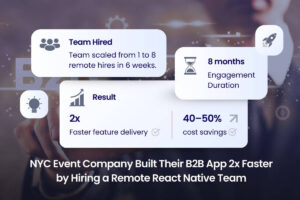
NYC Event Company Built Their B2B App 2x Faster by Hiring a Remote React Native Team

California-based SMB Hired Dedicated Developers to Build a Photography SaaS Platform