Table of Contents

Austin has long been a hub for rapid innovation, where the push to automate everything often outpaces the structural integrity of the systems being built. For many engineering leaders in Central Texas, the pressure to scale and reduce manual overhead results in a race to implement tools without a cohesive architectural strategy. This urgency frequently leads to a tipping point where automation stops being a force multiplier and starts becoming a source of operational friction. When logic becomes brittle and integrations begin to fail under load, the very efficiency your team sought to achieve evaporates, leaving you with a complex web of technical debt that is difficult to untangle.
The core issue is rarely the choice of software, but rather the speed of implementation versus the depth of technical oversight. Scaling automation Austin requires a delicate balance between aggressive deployment and defensive engineering. When teams prioritize speed over robustness, they overlook the edge cases and data dependencies that only surface when volume increases. This article serves as a briefing for CTOs and VPs of Engineering who are witnessing these cracks in their infrastructure and are evaluating the strategic need to hire automation developers who can stabilize and scale their operations without compromising quality or security.
The Fragility of Brittle Logic in Rapidly Scaling Systems
Most automation projects start as small, localized scripts or simple workflows designed to solve a specific pain point. In the early stages, these solutions work perfectly because the data sets are manageable and the variables are controlled. However, as an organization grows, these local solutions are often stretched to cover enterprise level demands. This is where brittle logic begins to fail, as the original parameters were never intended to handle the diversity of data or the concurrency of modern business operations.
Logic Collisions and Race Conditions
When multiple automated processes trigger simultaneously or rely on the same shifting data points, logic collisions occur. In an environment focused on scaling automation Austin, these collisions often manifest as duplicate records, missed notifications, or data overwrites. These are not just minor bugs, they are systemic risks that can lead to significant financial or reputational damage. When hiring, you need experts who understand concurrency and can design systems that handle simultaneous triggers without data corruption.
The Consequences of Neglecting State Management
One of the first things to break when scaling too fast is state management. If an automation sequence does not accurately track where a process stands, it cannot resume correctly after a failure. This leads to manual intervention, which defeats the purpose of the automation in the first place. Engineering leaders must look for teams that prioritize stateful design over simple stateless triggers to ensure continuity during high traffic periods.
Why Experience Matters in State Handling
Handling state effectively requires a deep understanding of database interactions and API response handling. It is a specialized skill that separates junior scripters from senior automation architects. To address these complexities, many firms find it necessary to hire automation developers who have experience in high volume environments where precision is non-negotiable.
Before moving deeper into technical pitfalls, consider how your current team structure supports these complex requirements. If you find your senior engineers spend more time fixing broken workflows than building new features, it may be time to augment your capacity. You can Request Developer Profiles to see how specialized remote talent can bridge this gap and provide the stability your Austin based team needs.
Scaling automation shouldn’t break your systems.
If brittle workflows, API failures, or automation bottlenecks are slowing your Austin engineering team, the right architecture and expertise can stabilize your infrastructure before issues escalate.
Get expert guidance on fixing automation failures and designing systems that scale reliably.
Identifying Common Workflow Failures Under Pressure
As traffic grows, the cracks in your automation strategy become visible. These workflow failures are often the first sign that your infrastructure is struggling to keep up with the demands of scaling automation Austin. Identifying these failures early is critical to preventing a total system collapse. Often, the issue is not the tool itself, such as n8n or Python scripts, but how the tool is being used to bridge disparate systems that were never designed to talk to one another at scale.
Data Integrity and Syncing Issues
Automation is only as good as the data it moves. When systems scale, the frequency of API calls increases, and the likelihood of partial data transfers grows. If your team does not have a robust strategy for data validation at every step, you will inevitably face data integrity issues. This is particularly common in CRM and ERP integrations where a single missing field can break downstream processes. Ensuring that you fix automation bottlenecks related to data sync is a priority for any growth stage company.
The Risk of API Rate Limiting
Many Austin startups overlook the limitations of the third-party platforms they rely on. As you scale, you hit API rate limits faster than expected. Without sophisticated queuing and retry logic, your workflows will simply stop, often without notifying the relevant stakeholders. This creates a silent failure that can persist for days before discovery, leading to massive backlogs and lost opportunities.
Implementing Resilient Retries and Backoffs
Building resilience involves more than just setting a “retry on failure” flag. It requires exponential backoff strategies and circuit breaker patterns to protect your own systems while respecting the limits of your partners. This level of sophistication is exactly why companies hire n8n developers who specialize in building resilient, enterprise grade workflows that can weather API instability and rate limiting challenges.
When these failures begin to impact your bottom line, the speed of your response determines the long-term health of your platform. Rather than letting your internal team get bogged down in reactive maintenance, you can Hire Remote Developers to implement proactive monitoring and self-healing logic into your existing workflows.
The Strategic Advantage of Choosing the Right Talent
The decision to hire automation developers Austin involves more than just finding someone who can write code. It requires finding a partner who understands the business context of your scaling challenges. In Austin, the talent market is highly competitive, and the cost of hiring local senior developers is at an all-time high. This often leads companies to hire junior talent locally, which can exacerbate the technical debt issues previously mentioned.
Local vs. Remote Talent Trade-offs
While having a local team in Austin provides cultural alignment and easy collaboration, the overhead and scarcity of specialized skills can slow you down. By looking at offshore or dedicated pod models, you can access a larger pool of talent that specializes in exactly the tools you use, such as n8n, Python, or Zapier, at a fraction of the cost. This allows you to scale your engineering team without the massive budget bloat associated with local Central Texas hiring.
The Importance of Vetted Skills and Communication
The risk with remote hiring is always communication and delivery quality. This is why a vetted model is essential. When you look to hire automation developers, you are not just looking for a resume, you are looking for a track record of delivered projects. High-quality remote developers should be able to jump into an existing codebase, identify workflow failures, and provide a roadmap for stabilization within days, not weeks.
Reducing Delivery Risk with Managed Pods
Managed pods provide a middle ground between individual contractors and full-scale outsourcing. They offer a cohesive team that includes a project manager or lead who ensures that the developers are aligned with your Austin based leadership. This structure minimizes the management overhead for your CTO and allows for faster delivery of complex automation features.
Evaluating your current vendor or hiring strategy is a key part of leadership. If your current approach is not delivering the stability you need, it might be time to Schedule a Consultation to discuss how a dedicated team can take over your automation backlog and allow your core team to focus on high-level product innovation.
Is your team spending more time fixing workflows than building features?
When automation starts breaking under scale, it’s often a sign that your systems need experienced automation architects. Our vetted developers specialize in stabilizing complex automation environments built with tools like n8n, Python, and modern APIs.
Explore pre-vetted experts who can strengthen your automation infrastructure and accelerate delivery.
Why n8n and Modern Tools Break Without Architects
Tools like n8n have democratized automation, allowing teams to build complex workflows quickly. However, the ease of use is a double-edged sword. When scaling automation Austin, it is easy to build a “spaghetti” of workflows that are impossible to document or maintain. Without a senior architect overseeing the implementation, these low-code and pro-code tools can become a liability.
The Pitfall of “Low-Code” Overconfidence
Business units often start building their own automations because tools like n8n are accessible. While this empowers departments, it creates a “shadow IT” environment where dozens of unmonitored workflows are running against production databases. When something breaks, the central engineering team is left to clean up the mess without knowing how the logic was constructed. This is why you must hire n8n developers who understand governance and architectural standards.
Centralizing Automation Governance
To scale successfully, you must centralize the governance of your automated systems. This means creating reusable modules, standardized error handling, and a clear audit trail for every data movement. A senior developer can help you review rollout approach strategies to ensure that departmental speed does not compromise systemic security or stability.
Standardizing Integration Protocols
Standardization is the enemy of technical debt. By creating a unified way to handle authentication, logging, and error reporting across all workflows, you make your system significantly easier to troubleshoot. This proactive approach saves hundreds of hours in developer time over the course of a year and ensures that scaling automation Austin remains a smooth process.
As you plan your next quarter, consider if your current workflows are built for today or for where you plan to be in twelve months. If you are unsure, you can Schedule Developer Interviews to find specialists who can audit your current n8n or Python environments and provide a path forward that supports 10x growth.
Cost and Scalability Implications of Rapid Growth
Scaling too quickly has direct financial implications beyond just the payroll. When workflows fail, they consume cloud resources, trigger redundant API charges, and require expensive emergency fixes. To hire automation developers Austin means making an investment in cost avoidance as much as it is an investment in feature development.
The Hidden Costs of Technical Debt
Technical debt in automation is expensive because it compounds. Every new workflow built on a shaky foundation requires more effort to maintain than the one before it. Eventually, your team spends 80 percent of their time on maintenance and only 20 percent on new value. This ratio is a clear indicator that your process for scaling automation Austin has become unsustainable and requires a strategic pivot.
ROI Justification for Specialized Automation Teams
Justifying the cost of a dedicated automation team is simple when you look at the reduction in manual errors and the increase in process throughput. A well-built automation system can replace the manual work of dozens of employees, allowing them to focus on higher-value tasks. The ROI is not just in saved hours, but in the speed at which your business can respond to market changes. When you hire automation developers, you are buying the ability to move faster than your competitors.
Optimizing Infrastructure Spend
Efficient automation code runs faster and uses fewer resources. Experienced developers can optimize your workflows to minimize memory usage and execution time, which directly lowers your monthly cloud bills from AWS, Azure, or Google Cloud. This optimization is often overlooked by less experienced teams who are only focused on making the workflow “work” rather than making it efficient.
Managing the financial aspect of engineering is a core responsibility for any CXO. If your infrastructure costs are spiraling out of control due to inefficient automation, you can fix automation bottlenecks by bringing in experts who prioritize performance and cost-efficiency. Request Developer Profiles today to see how we can help you optimize your spend while increasing your capacity.
Building a Resilient Automation Culture
Success in scaling automation Austin is as much about culture as it is about code. It requires a shift from a “build fast and break things” mentality to a “build for scale” philosophy. This involves training your team to think about error states, data validation, and long-term maintainability from day one. It also means recognizing when you need outside expertise to help you reach the next level of maturity.
Transitioning from Tactical to Strategic Automation
Tactical automation solves a problem for today. Strategic automation builds a platform for tomorrow. To make this transition, you need leaders who can look across the entire organization and identify the core data flows that drive value. By deciding to hire automation developers with a strategic mindset, you ensure that your automation efforts align with your long-term business objectives.
The Role of Documentation and Knowledge Transfer
One of the biggest workflow failures in Austin tech companies is the lack of documentation. When the developer who built a complex workflow leaves, the knowledge leaves with them. A resilient culture prioritizes documentation and knowledge transfer, ensuring that the system remains maintainable regardless of individual team changes. This is a hallmark of the RelyShore℠ model used by WeblineGlobal to ensure continuity for our clients.
Fostering Cross-Departmental Collaboration
Automation does not live in a vacuum. It touches sales, marketing, finance, and operations. A successful automation leader facilitates collaboration between these departments to ensure that workflows are solving the right problems and that data is being shared correctly across the entire ecosystem. This collaborative approach is vital for any company looking to review rollout approach methodologies and improve internal efficiency.
If you are ready to stop fighting fires and start building a scalable future, we are here to help. You can Hire Developers who understand the unique challenges of the Austin market and have the technical depth to solve your most complex automation hurdles. Let us help you turn your automation from a bottleneck into a competitive advantage.
Strategic Next Steps for Austin Engineering Leaders
Scaling automation does not have to result in broken workflows and late-night debugging sessions. By recognizing the warning signs of brittle logic and data integrity issues early, you can take proactive steps to stabilize your environment. Whether you choose to hire automation developers Austin locally or leverage a high-performing remote team, the key is to prioritize architectural integrity and long-term scalability over short-term speed.
Contact us and we help you with the right team composition that can transform a struggling automation project into a high-octane growth engine. Our experience in helping companies fix automation bottlenecks and scale their operations through our RelyShore℠ model allows us to provide the expertise and stability that Austin’s fast-growing companies need. Do not wait for your systems to break before you take action. Hire Remote Developers today and ensure your path to scale is built on a solid foundation.
Ready to turn automation into a competitive advantage instead of a bottleneck?
Our dedicated automation developers help Austin engineering teams fix brittle workflows, optimize integrations, and build resilient automation systems designed for long-term scale.
Let’s discuss how the right team can help you stabilize your infrastructure and accelerate growth.
Frequently Asked Questions
The most common cause is a lack of robust error handling and state management. When volume increases, unexpected data inputs and API timeouts occur more frequently. If the system is not designed to handle these gracefully, it leads to cascading failures and data corruption.
Specialized developers reduce the long-term cost of ownership by building systems that require less maintenance and run more efficiently on cloud infrastructure. They also minimize the risk of expensive manual errors and allow your core product team to stay focused on high-value features rather than fixing broken workflows.
While local developers offer proximity, remote talent often provides a more cost-effective way to access niche skills in tools like n8n or Python. A hybrid model, where you have local leadership and a dedicated remote pod for execution, often provides the best balance of speed, cost, and quality for scaling companies.
The timeline depends on the complexity of the existing technical debt. However, a senior automation team can typically identify major bottlenecks and implement critical stability fixes within 2 to 4 weeks. A full architectural overhaul for long-term scaling may take 3 to 6 months depending on the number of integrations involved.
The primary risks are a lack of governance and the creation of "spaghetti" logic that is difficult to audit or maintain. Without a professional developer to implement coding standards, version control, and centralized logging, low-code tools can become a liability as the number of workflows grows.




Success Stories That Inspire
See how our team takes complex business challenges and turns them into powerful, scalable digital solutions. From custom software and web applications to automation, integrations, and cloud-ready systems, each project reflects our commitment to innovation, performance, and long-term value.
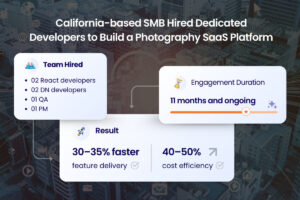
California-based SMB Hired Dedicated Developers to Build a Photography SaaS Platform
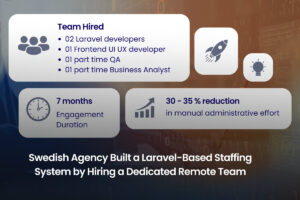
Swedish Agency Built a Laravel-Based Staffing System by Hiring a Dedicated Remote Team