Table of Contents

Toronto has rapidly evolved into one of North America’s premier technology hubs, attracting massive investments in artificial intelligence, fintech, and enterprise SaaS. As companies in the Greater Toronto Area move beyond initial product-market fit, the technical challenges shift from basic feature development to the complex realities of data infrastructure. For many CTOs and VPs of Engineering, this phase is marked by the struggle to manage high-volume data workflows that were never designed for the scale they now face.
The decision to scale Python pipelines is rarely just a matter of writing better code. It is an operational challenge that tests the limits of your team composition, your hiring strategy, and your infrastructure budget. In a city where the competition for local talent is fierce, understanding how to effectively hire Python developers who understand the nuances of distributed systems is critical. This guide examines the operational lessons learned from scaling these environments and provides a framework for leaders to make informed hiring decisions that balance performance with cost-efficiency.
Establishing the Decision Context for Scaling Python Pipelines Toronto
Scaling data infrastructure in a high-growth environment requires a clear understanding of where the bottlenecks reside. Often, leadership teams mistake a resource problem for a code problem, or vice versa. When you look to scale Python pipelines, you are essentially managing the trade-offs between execution speed, developer productivity, and infrastructure overhead. In the Toronto market, where engineering salaries are high and the talent pool is frequently scouted by global tech giants, making the wrong hiring move can lead to significant technical debt.
The Local Talent Reality in the GTA
Toronto’s tech scene is a double-edged sword. While the city produces world-class talent from institutions like the University of Toronto and Waterloo, the demand far outstrips the supply. When you attempt to hire Python developers Toronto, you are competing against the aggressive recruitment cycles of major banks and established US-based tech firms. This creates a scenario where the cost of local senior talent can become a barrier to rapid scaling. Decision-makers must evaluate whether their project requires a 100% local team or if a hybrid pod model can deliver better ROI.
Analyzing the Cost of Speed
Time-to-market is the primary driver for many engineering leaders. However, speed often comes at a high price when hiring exclusively within Toronto. A typical senior developer in the city commands a premium salary, and the recruitment cycle can take months. By contrast, leveraging pre-vetted remote pods can reduce the time-to-hire from months to just 48 hours. This allows you to review data workflows and begin implementation almost immediately, rather than waiting for local recruitment to catch up with your roadmap requirements.
Operational Complexity vs. Language Flexibility
Python is the language of choice for data engineering due to its vast ecosystem, but its simplicity can be deceptive. As pipelines grow in complexity, the operational overhead of managing memory, concurrency, and environment consistency increases. When you hire Python developers Toronto, you must look for individuals who can think beyond the syntax. They need to understand how Python interacts with lower-level system resources and how to optimize those interactions to prevent runaway cloud costs.
Struggling to scale Python pipelines without increasing costs or delays? Get expert guidance on building high-performance data teams tailored to your growth stage.
Technical Evaluation Criteria for High-Performance Python Teams
When scaling is the goal, the interview process must evolve. You are no longer looking for someone who can just build an API; you need engineers who can architect systems for resilience. The operational lessons from Toronto’s top engineering teams suggest that the most successful hires are those with a deep understanding of data orchestration and asynchronous processing. These skills are vital when you need to hire data analytics experts to transform raw data into actionable business intelligence.
Evaluating Distributed Systems Knowledge
A common mistake in hiring for Python pipelines is focusing too heavily on library-specific knowledge. While knowing pandas or scikit-learn is helpful, it is secondary to understanding how to distribute workloads across a cluster. When you hire Python developers Toronto, ask candidates to describe how they have managed state in a distributed environment or how they handled data loss during a pipeline failure. These are the scenarios that define the success of a scaling project.
The Role of Concurrency and Parallelism
Python’s Global Interpreter Lock (GIL) is a well-known hurdle for scaling. Experienced developers know how to work around it using multiprocessing, threading, or specialized libraries like Celery and Dramatiq. During your technical evaluation, prioritize candidates who can explain the trade-offs between these approaches. This expertise ensures that as you scale Pythonpipelines Toronto, your systems remain performant under heavy loads without requiring a complete rewrite in a different language.
Assessing Integration Capabilities
Pipelines do not exist in a vacuum. They must integrate with cloud providers, message brokers, and database layers. A developer who can bridge the gap between Python and DevOps is worth their weight in gold. When you hire Python developers, ensure they have experience with containerization and CI/CD practices. This operational grounding prevents the “it works on my machine” syndrome that can derail a project during deployment.
Operational Bottlenecks and How to Hire Against Them
Scale introduces friction. What worked for a few thousand records will likely fail when processing millions. The operational lessons from the field show that most Python pipelines fail due to poor memory management or unoptimized I/O operations. To mitigate these risks, your team must include engineers who are obsessed with observability and performance monitoring. This is where you might need to review data workflows to identify specific points of failure before they impact your users.
The Importance of Observability in Scaled Pipelines
You cannot manage what you cannot measure. Scaled Python pipelines require robust logging, monitoring, and alerting. When you hire Python developers Toronto, look for those who have experience with tools like Prometheus, Grafana, or Datadog. An engineer who builds a pipeline without observability is creating a black box that will eventually become a maintenance nightmare. Operational excellence is built on the ability to see exactly where a process is slowing down in real-time.
Memory Management at Scale
Python is known for its high memory consumption. In a pipeline environment, this can lead to frequent crashes and high infrastructure bills. Hiring developers who understand memory-efficient data structures and generators is essential. This expertise is a key differentiator when you’re scaling Python pipelines Toronto. It allows your team to process larger datasets on smaller, more cost-effective instances, directly impacting the project’s bottom line.
Managing Technical Debt During Rapid Growth
Rapidly scaling a team often leads to a “move fast and break things” mentality that results in crippling technical debt. To avoid this, engineering leaders must balance the need for speed with the discipline of code quality. This is why many Toronto-based firms are turning to dedicated pods. These teams come with established workflows and peer-review processes, ensuring that the code being produced is both scalable and maintainable. When you hire Python developers through a structured delivery model like RelyShore, you gain the benefit of pre-vetted standards.
Not sure whether to hire locally or leverage remote engineering pods? Explore pre-vetted Python experts who can help you scale faster, reduce costs, and optimize performance from day one.
Choosing the Right Delivery Model: Local vs. Offshore vs. Pods
One of the most significant decisions a CTO will make is the composition of their engineering team. While having a local presence in Toronto offers certain advantages in terms of timezone alignment and culture, it is often not the most scalable or cost-effective route. The operational lesson here is that a hybrid approach often yields the best results. You can maintain a core leadership team in Toronto while you hire Python developers Toronto as part of a managed remote pod to handle the heavy lifting of pipeline development.
The Benefits of Managed Engineering Pods
Managed pods offer a level of stability that traditional staff augmentation cannot match. Unlike individual contractors, a pod is a cohesive unit that includes a lead developer, backend engineers, and QA experts. This structure is ideal when you need to scaling Python pipelines Toronto because the team already knows how to work together. This reduces the onboarding friction and allows the team to hit the ground running, often delivering results much faster than a newly formed local team.
Cost Efficiency Without Quality Sacrifice
The cost of living in Toronto is reflected in the high salary expectations of local developers. By looking beyond the city limits and hiring from talent hubs like India, companies can realize 40 to 60 percent savings on their engineering spend. This does not mean sacrificing quality. When you partner with an organization like WeblineGlobal, you are accessing a pool of developers who have worked on thousands of projects for global clients. This allows you to hire data analytics experts who bring world-class expertise to your Toronto-based project at a fraction of the cost.
Risk Mitigation through the RelyShore Model
Hiring remote developers often comes with concerns about communication, delivery, and IP protection. The RelyShore model addresses these concerns by providing a US-based assurance layer over an India-based delivery engine. This ensures that you have the local accountability you need while benefiting from the scale and cost-efficiency of offshore talent. When you scale Python pipelines using this model, you are protected by transparent pricing, month-to-month flexibility, and rigorous security protocols.
Strategic Vendor Selection: What to Look For
Not all hiring partners are created equal. When your goal is to scaling Python pipelines Toronto, you need a partner who understands the specific technical challenges of the language and the operational demands of your industry. A generic staffing agency will not have the depth of knowledge required to vet a high-performance Python engineer. You need a partner that acts as a technical advisor, not just a resume mill.
Questions Every CTO Should Ask
Before you decide to hire Python developers from a vendor, ask them about their vetting process. How do they test for algorithmic efficiency? How do they evaluate a developer’s ability to work with asynchronous code? Do they provide ongoing training to their engineers on the latest Python enhancements? The answers to these questions will tell you if the vendor is invested in the long-term success of your project or if they are simply looking to fill a seat.
Transparency in Pricing and Delivery
Avoid vendors who are vague about their pricing or who try to lock you into long-term contracts without a trial period. A reputable partner will offer transparent pricing guidelines and the flexibility to scale your team up or down as your needs change. This flexibility is crucial in the volatile tech market of Toronto, where project scopes can shift overnight. When you hire Python developers Toronto through a flexible model, you protect your budget while maintaining the ability to execute on your roadmap.
Evaluating Proven Track Records
Look for vendors who have a history of working with major brands and delivering complex projects. Experience with companies like Siemens, LG, or ICICI demonstrates that a vendor can handle the security and compliance requirements of an enterprise environment. This level of experience is invaluable when you review data workflows for high-stakes applications in fintech or healthcare, where data integrity is non-negotiable.
The Long-Term Impact of Smart Hiring Decisions
The operational lessons from scaling Python pipelines are clear: the quality of your team is the single most important factor in your success. By focusing on deep technical expertise, operational observability, and a flexible hiring model, you can overcome the challenges of the Toronto talent market. Whether you choose to hire entirely local or leverage the power of managed pods, the goal remains the same: a resilient, scalable, and cost-effective data infrastructure.
Investing the time to hire Python developers Toronto who truly understand the complexities of the language will pay dividends in reduced technical debt and faster feature delivery. As you look to the future, remember that scaling is an ongoing process of refinement. Partnering with the right experts today will ensure that your pipelines are ready for the challenges of tomorrow, no matter how much data you need to process.
Social Hashtags
#Python #DataEngineering #TechLeadership #ScalableSystems #BigData #TorontoTech #AIInfrastructure #DevOps #HiringTechTalent #SoftwareEngineering
Ready to scale your Python pipelines with the right team? Talk to our experts and get a tailored hiring and execution plan aligned with your business goals.
Frequently Asked Questions
The most common mistake is focusing solely on library knowledge rather than foundational systems engineering. Many leaders hire developers who can write Python but don't understand how to manage memory, handle concurrency, or optimize I/O operations. This leads to pipelines that are fragile and expensive to run at scale.
If your project requires physical presence for security or extreme timezone synchronization, local hiring might be necessary. However, for most data engineering tasks, a managed remote pod offers better scalability, a faster hiring cycle, and significant cost savings. Evaluate your project’s budget and timeline to see which model aligns better with your business goals.
Essential skills include proficiency in asynchronous programming (AsyncIO), multiprocessing, and an understanding of Python’s memory management. Additionally, developers should have experience with distributed task queues like Celery and containerization tools like Docker, as these are critical for maintaining consistency across scaled environments.
The RelyShore model combines the cost benefits of offshore development in India with the accountability and quality assurance of a US-based presence. This model provides the scale needed to build complex pipelines while ensuring that delivery risks are managed through rigorous vetting and transparent communication, making it an ideal choice for Toronto-based companies.
Yes, remote developers can integrate seamlessly into your existing workflows. By using modern collaboration tools and adopting agile methodologies, remote pods can function as an extension of your local team. The key is to establish clear communication channels and defined roles from the outset to ensure everyone is aligned on the project objectives.




Success Stories That Inspire
See how our team takes complex business challenges and turns them into powerful, scalable digital solutions. From custom software and web applications to automation, integrations, and cloud-ready systems, each project reflects our commitment to innovation, performance, and long-term value.
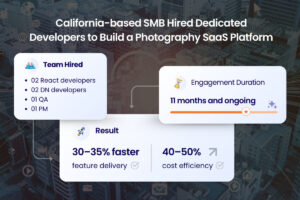
California-based SMB Hired Dedicated Developers to Build a Photography SaaS Platform
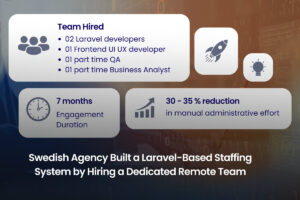
Swedish Agency Built a Laravel-Based Staffing System by Hiring a Dedicated Remote Team