

Table of Contents

“Too much is too bad” has been an adage that everyone knows. Software overengineering is designing a product that has more complexity than required. Though it is rarely intentional, it won’t show up as a mistake. Rather, you would find that your dedicated development team did it because you needed a scalable, future-proof, and ambitious product; however, behind the scenes, overengineered software risks will invite unnecessary expenses, delays, and digress from your original business objectives.
Let’s delve into what software overengineering is, overengineered software risks, the lean software development approach, and how MVP vs overengineering wins.
Is your dedicated software team adding more complexity than your product needs?
What is software overengineering?
Wikipedia defines overengineering, or what is also known as overkill, as the act of building a product or providing a software solution to a problem in an overly complex manner. Where a simpler solution under a lean software development approach would have worked better, dedicated software development teams may accidentally adapt software overengineering that would simply create an unnecessary burden.
Pawel Glogowski calls it: code or design that solves problems you don’t have!
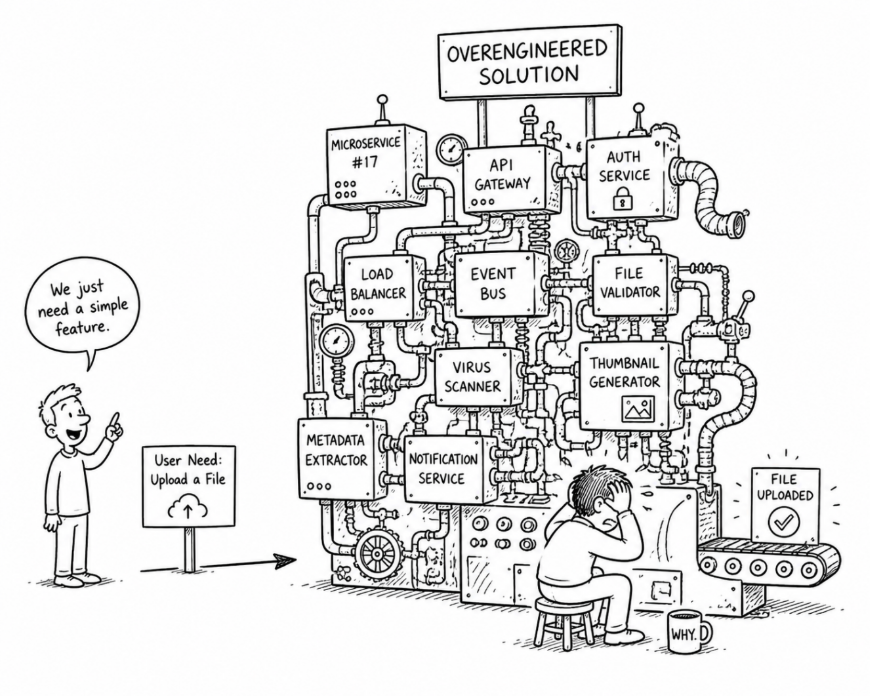
The topic of overengineering is not new; Reddit had it a few years back, and it showed great engagement among everyone, with nearly three thousand upvotes and more than a hundred comments. Each one of us has seen overengineering before – consider a two-person team utilizing more than ten microservices and getting obsessed over trivial performance tweaks that actually don’t matter.
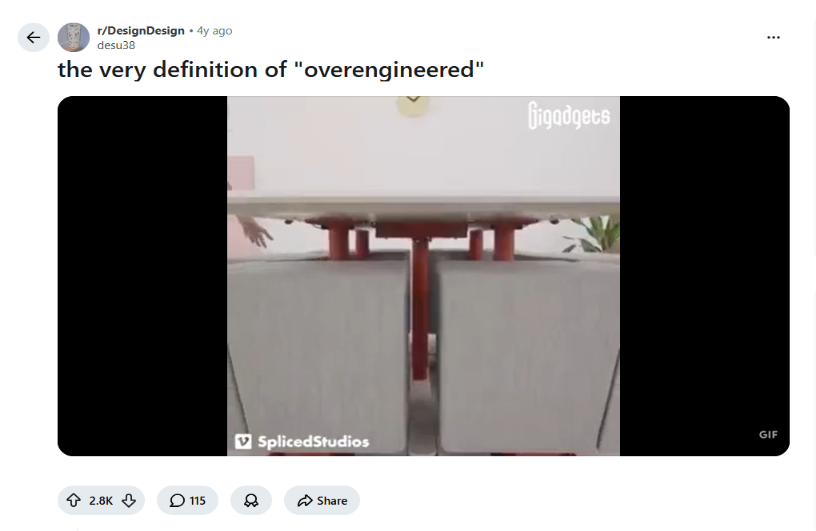
Source: Reddit
Why does software overengineering happen?
A dedicated software development team at your company has no intention to walk that extra mile. Why would they add unnecessary features or layers to a system that does not require it? But then, software overengineering happens. Here are the reasons:
- Desire to build an impressive tool: One of the major reasons why a dedicated software team quietly overengineers a software product is to make it super impressive. Clients, peers, or management – they are all the ones to please. Sleek designs, new architectural patterns, and advanced technologies are used freehand, which ultimately brings complexity.
- Changing/unclear scope: When requirements from clients or stakeholders keep changing, the dedicated software development team often gets into more complexity in order to anticipate every possible escalation. In the race of ‘covering everything’ from the predefined scope, overengineering software takes place.
- Temptation to stay abreast: While it is essential to stay updated and meet the market needs, there is a temptation to incorporate everything latest. Regardless of actual needs, software engineers keep adding complexity.
An article in the International Journal of Project Management explains over-requirement in software development projects through an experimental investigation of behavioral effects. As found on ScienceDirect, a few highlights are essential to keep in mind in regard to overengineering software products:
- Over-requirement is a major risk in software development projects.
- Developers’ emotional involvement was a source of over-requirement.
- The endowment, I-designed-it-myself, and IKEA behaviors were manipulated.
- The ultimate result was that behavioral effects influence the software feature valuation.
The hidden cost of software overengineering
Overengineering of software does not fail loudly; rather, it fails slowly and takes away your time and money. It is essential that your dedicated software development team is aware of every nuance of such a loss and avoid getting into it. Here are the consequences of software overengineering:
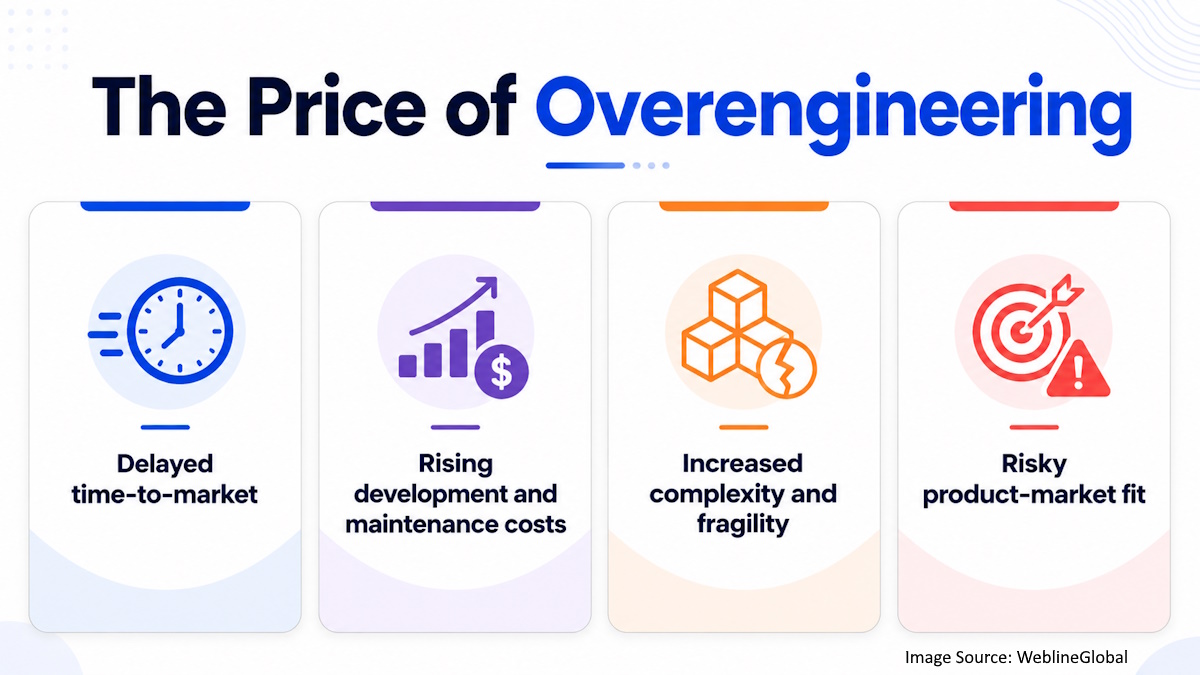
Delayed time-to-market
Adding unnecessary features remarkably brings down the pace of the software development cycle and releases. Teams spend months before validating anything, only adding hurdles to your project’s completion.
Rising development and maintenance costs
When you don’t adopt a lean software development approach, you fall into software overengineering that raises development costs and maintenance because more code means more engineers, more infrastructure, and more testing and support. Costs, for this reason, compound rapidly.
Increased complexity and fragility
An overengineered software product has more complexity, and therefore it is more fragile. Complex systems are harder to debug and take longer to troubleshoot. Also, there is increased long-term technical debt.
Risky product-market fit
When your dedicated software team quietly builds an overengineered product, they often miss the mark because they solve too many problems without a concrete solution. Also, instead of solving one problem well, the product tries to justify multiple issues. An article on ResearchGate indicates that excessive feature development is one of the top contributors to product failure, as it mismatches with real user requirements.
What are the signs of overengineered software risks?
How do you know that your dedicated software team is quietly overengineering software products? Well, software overengineering is not something that you can catch instantly. However, there are some key factors, or you may call them warning signs, that help you understand that your team is going too far:
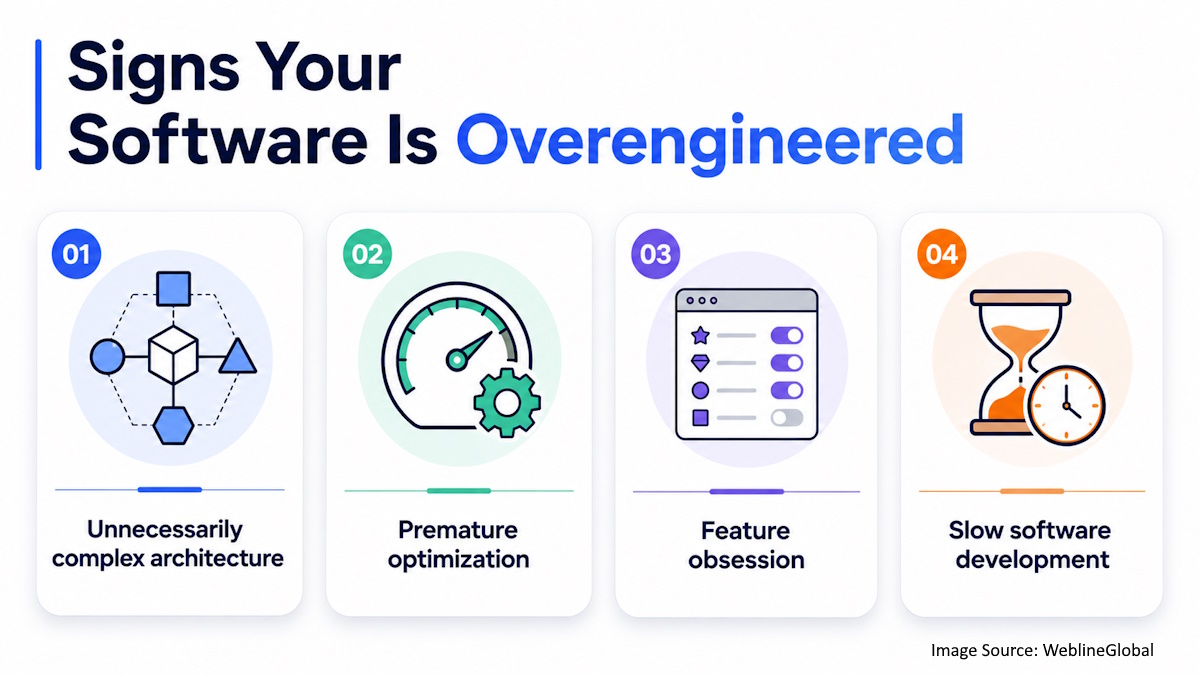
Unnecessarily complex architecture
One of the easiest indicators that point toward overengineered software risks is having layering of abstraction upon abstraction. You will clearly see that more services are built than required. There are obvious tiers of communication where a direct solution seems like a better option.
Premature optimization
Another indication of overengineered software risk is premature optimization, wherein your dedicated software development team optimizes a software tool without knowing any bottlenecks. For them, it is fun to optimize the system, but without proper data or profiling, it becomes a waste of effort.
Feature obsession
Experts call it feature creep, which happens when new features are loaded onto a system without any requirement. It happens only because it was a nice-to-have feature. At times, your dedicated software development team simply pushes it because stakeholders (who are not fully aware of the impact of those additions) asked for it.
Slow software development
The software development sprint witnesses delays, which is another sign of overengineering software risk. It is obvious because the software development team spends more time on unnecessary features only to make the system complex.
What is the way out of overengineering software?
You must understand and make your team understand MVP versus overengineering, as it is a key to avoiding this trap. An MVP team prepares minimum viable product: a version of a product that enables maximum output with minimum effort.
However, you should stay away from the general belief that an MVP is a low-quality product, a partial product, or merely a prototype. It is a learning tool that helps you build a better product, validate real user needs, and reduce operational risk before scaling.
The lean software development approach is your antidote
Want to avoid overengineering and launch a lean MVP faster?
Lean software development approach
Opposite to overengineering software is the lean software development approach that exists particularly to counter any unnecessary complexity in building a digital solution.
Lean software development borrows lean start principles:
- Build
- Measure
- Learn
And not …
- Plan
- Build everything
- Hope
An agile or lean software development approach means you build the smallest testable unit by focusing on the minimum set of features. Such a product will help you validate your core hypothesis. Your software development team needs to prioritize validated learning, and they should see that every feature should answer: what are we learning from this?
The lean software development approach also eliminates waste such as unused features, over-designed architecture, premature scaling, and additional layers from your architecture. Ultimately, short feedback cycles reduce the risk of building the wrong thing, and you are on the right track, bypassing overengineering software.
Prevent overengineering in dedicated teams
Following a few steps will help your dedicated software developers get into overengineering. You need to involve your team in day-to-day activities to explain every initiative, metric, and vision. Here are the factors you need to keep in mind:
- Redefine success metrics: you need to shift from features delivered to insights gained.
- Enforce MVP discipline: you need to define the core problem and a couple of critical features. Everything else comes in Phase 2.
- Introduce feedback early: introducing early feedback loops enables your software development team to launch products faster and iterate based on real usage.
- Challenge almost every feature: your dedicated software development team needs to ask themselves, ‘What happens if we remove this or don’t include it?’
- Align stakeholders: you may keep clients or stakeholders in the loop to learn, not for perfection. This is where most projects fail – misaligned expectations leading to escalations.
Ensure no overengineering software risks, build pitch-perfect
Software overengineering is not a technical flaw; rather, it is a strategic misalignment. Professional and experienced dedicated software teams know exactly what your product needs and save you time and money. Our engineers don’t build more; they just build enough to learn faster than everyone else.
WeblineGlobal helps in IT staff augmentation with veteran engineers for a lean software development approach. Get rid of overengineering software risks and validate market demand before achieving technical perfection: we are here to build to scale as needed for faster time-to-market.
Need experienced developers who build scalable software without unnecessary complexity?
Frequently Asked Questions
Software overengineering happens when a dedicated software team adds unnecessary complexity, abstractions, and features that are more than needed. It generally results in bloated systems harder to run, maintain, and slower to deliver.
Overengineered software risks include delayed delivery, wasted resources, higher maintenance costs, and reduced performance. It can also alienate users as it prioritizes technical glory over usability, leading to undermining business goals and product adoption.
Development teams often fall into software overengineering in the race to make a product perfect and fear of future changes. Also, it happens because of the desire to show technical skills. The mindset leads to unnecessary and overly complex software architecture.
Dedicated software teams can spot overengineering by keeping their eyes on scope creep, excessive features, and abstractions. Regular reviews, a customer feedback loop, and lean practices can help teams to avoid software overengineering.
User feedback makes it sure that software development aligns with real user requirements. Dedicated teams can avoid building unnecessary functionalities by validating features early. They can also keep products lean, relevant, and in line with solving real problems.
Agile emphasizes an iterative approach, collaboration, adaptation, and delivery. Aile brings down the risks of software overengineering by breaking work into smaller milestones and prioritizing customer value. It also keeps teams focused on delivering practical results.
Lean software development approach emphasizes simplicity, user value, and efficiency. It ensures the team builds only what is needed by focusing on removing waste, continuous feedback, and rapid iteration. It also reduces risks of overengineering and improves adaptability.
An MVP – minimum viable product delivers needed features that validate the business objectives. On the other hand, software overengineering adds unnecessary complexity. MVP prioritizes learning and user feedback; overengineering software delays progress and misaligns with user needs.



Success Stories That Inspire
See how our team takes complex business challenges and turns them into powerful, scalable digital solutions. From custom software and web applications to automation, integrations, and cloud-ready systems, each project reflects our commitment to innovation, performance, and long-term value.

Hospitality Review Intelligence Product Development with Offshore AI Team
Government Liaison Operations Digitization with Dedicated Offshore Team