
Table of Contents

How did we discover cross-domain AD failures in our PHP and SQL application?
During a recent enterprise integration project for a global logistics provider, we encountered a fascinating infrastructure hurdle. The organization had undergone half a dozen mergers and acquisitions, resulting in an environment with over six separate Active Directory (AD) domains. Because consolidating these domains was a multi-year IT initiative, they needed an interim solution: an internal PHP-based administrative portal to dynamically provision user access and manage databases across the enterprise network.
While working on the user-provisioning module, we realized that the application was failing to create SQL Server Windows logins for users originating from roughly half of the Active Directory domains. The workflow was simple: an administrator selects a user from a unified directory, and the PHP application executes a T-SQL script to provision their Windows login on the centralized SQL Server. However, the system kept throwing errors for specific domains, completely halting the automated onboarding process.
As an engineering team that companies trust when they need to hire software developer experts for complex integrations, we immediately knew this was more than a simple code bug. It was an environmental context mismatch. This challenge inspired this article, aiming to help technical leaders and architects understand the nuances of cross-domain authentication before they impact production environments.
Why was the web server failing to create Windows logins for specific domains?
The business use case required the central administration portal to map existing Windows identities to SQL Server databases. The architecture consisted of a frontend portal, a PHP backend running on IIS, and a backend Microsoft SQL Server acting as the source of truth for the legacy ERP systems.
The issue surfaced unpredictably depending on the environment. When our engineers ran the application locally on their development machines, the provisioning scripts worked flawlessly across all six domains. Similarly, executing the exact same T-SQL commands directly through SQL Server Management Studio (SSMS) yielded successful results. But the moment the code was executed from the production web server, SQL Server rejected the accounts from the newly acquired domains.
What causes SQL Server to reject Active Directory accounts from trusted domains?
To diagnose the bottleneck, we examined the SQL Server application logs and intercepted the exact error returned to the PHP application:
Active Directory account or group 'DOMAIN_Bjdoe' does not exist. Searched for username: 'jdoe'. Please verify spelling and ensure account exists in Active Directory.Because the account definitely existed, this symptom pointed directly to an identity context issue. When an engineer executes a query in SSMS or runs the app locally, the connection to SQL Server is made using the engineer’s highly privileged Windows credentials. The engineer’s account possessed the necessary cross-forest permissions to query all trusted Active Directory domains.
However, when the PHP application ran on the web server, it connected to the SQL Server using either a specific SQL Authentication account or an IIS Application Pool Service Account. When SQL Server executes the CREATE LOGIN … FROM WINDOWS command, the SQL Server Engine service account must reach out to the Active Directory Domain Controller of the target domain to validate the user and retrieve their Security Identifier (SID). If the SQL Server Service Account lacks read permissions in those specific remote domains, or if cross-forest trusts are strictly filtered, the Active Directory lookup fails, resulting in the “account does not exist” error.
How do you diagnose and resolve SQL Server AD lookup failures?
Identifying the root cause of an infrastructure-level identity failure requires exploring multiple architectural avenues. We evaluated several approaches to bypass the cross-domain restriction. This level of architectural troubleshooting is exactly why enterprise CTOs look to hire php developers for enterprise modernization who understand the underlying infrastructure, not just the code.
Did we consider using SQL Authentication for the web connection?
Our first diagnostic step was verifying the connection string. If the web server connected via standard SQL Authentication (e.g., a “sa” or application-specific user), the T-SQL command to validate the AD user would fall back to the identity of the account running the SQL Server Service itself. We verified that the SQL Service account was running as a local Virtual Account rather than a Domain Account, effectively severing its ability to query domains outside its immediate trust boundary.
Did we consider adjusting Active Directory Forest Trusts?
We considered asking the infrastructure team to configure two-way forest trusts with Forest-Wide Authentication enabled. However, adjusting enterprise-wide security boundaries simply to accommodate a PHP application is an architectural anti-pattern. The security team correctly pushed back against flattening the trust models of the newly acquired subsidiaries.
Did we consider implementing Kerberos Constrained Delegation?
If the web application was using Windows Authentication to connect to SQL Server (the “double-hop” scenario), we would need to configure Service Principal Names (SPNs) and enable Kerberos Constrained Delegation. This would allow the web server to pass the end-user’s credentials to the SQL Server. However, since the portal used a centralized service account to provision other users, delegation wasn’t the right fit.
How did we configure the service accounts for multi-domain SQL logins?
The ultimate solution required a two-part fix: modernizing the PHP application’s query execution to enforce strict parameterization, and correcting the Active Directory service account topology.
First, we transitioned the SQL Server Service to run under a dedicated Active Directory Managed Service Account (gMSA). We then worked with the infrastructure team to grant this gMSA “Read-Only” directory browsing access across the six different domain controllers via localized security groups. This ensured that when SQL Server attempted to validate an account from ‘DOMAIN_C’, the service possessed the right to resolve the SID.
Second, we refactored the legacy PHP code. The original snippet utilized string concatenation, which poses a severe security risk, even with T-SQL’s QUOTENAME() function.
Here is the modernized, sanitized implementation utilizing PHP Data Objects (PDO) for secure execution:
// Securely connecting and validating the domain format
$domainUser = validateAndFormatDomainUser($userInput); // Ensure DOMAINUser format
$tsql = "
IF NOT EXISTS (SELECT loginname FROM master.dbo.syslogins WHERE name = :username)
BEGIN
   DECLARE @SqlStatement NVARCHAR(500);
   -- QUOTENAME is still used within dynamic SQL to safely bracket the identifier
   SET @SqlStatement = N'CREATE LOGIN ' + QUOTENAME(@RequestedUser) + N' FROM WINDOWS WITH DEFAULT_DATABASE=[master]';

   -- Execute safely using sp_executesql with defined parameters
   EXEC sp_executesql @SqlStatement, N'@RequestedUser NVARCHAR(128)', @RequestedUser = :executeUser;

   SELECT 'Success' AS rtnStatus;
END
ELSE
BEGIN
   SELECT 'The login already exists' AS rtnStatus;
END";
try {
    $stmt = $pdo->prepare($tsql);
    // Bind parameters securely to prevent injection vulnerabilities
    $stmt->bindValue(':username', $domainUser, PDO::PARAM_STR);
    $stmt->bindValue(':executeUser', $domainUser, PDO::PARAM_STR);
    $stmt->execute();

    $result = $stmt->fetch(PDO::FETCH_ASSOC);
    logProvisioningStatus($result['rtnStatus']);

} catch (PDOException $e) {
    handleProvisioningError($e);
}
By securing the code and aligning the infrastructure permissions, the application successfully queried SIDs across all subsidiary domains without compromising security boundaries. If you need to hire backend developers to orchestrate complex identity access, ensuring they understand these layers is critical.
What can technical leaders learn from multi-domain Active Directory integrations?
When orchestrating internal systems across disparate networks, pure code logic is never enough. Understanding infrastructure context is paramount. Here are actionable insights engineering teams should apply:
- Identify Execution Contexts Early: Code that executes perfectly in local development or SSMS operates under the developer’s identity. Always test identity-bound features using the exact service account identity that production will use.
- Audit Service Accounts Periodically: Default virtual accounts (like NT SERVICEMSSQLSERVER) cannot resolve SIDs across complex forest trusts. Provision dedicated Group Managed Service Accounts (gMSA) for database engines interacting with Active Directory.
- Never Concatenate Identifiers: Even when utilizing T-SQL functions like
QUOTENAME(), passing raw user input directly into executable SQL strings within PHP is a vulnerability. Always use PDO parameterization or sqlsrv parameterized queries. - Isolate Domain Lookups: If security policies prohibit cross-forest reads by the database engine, consider an asynchronous worker queue where a highly privileged domain microservice provisions the user, rather than the web application.
- Log the Context, Not Just the Error: When logging AD errors, capture the identity of the executing process (e.g., using
SUSER_SNAME()in SQL). This immediately highlights permission mismatches during debugging.
How can resolving these infrastructure challenges improve enterprise scalability?
Resolving multi-domain Active Directory constraints goes far beyond fixing a single error message; it establishes a scalable foundation for future mergers, acquisitions, and IT consolidations. By correctly aligning service account permissions and securing legacy code, we enabled the logistics provider to automatically onboard thousands of employees without manual DBA intervention. Building seamless integrations across complex network boundaries is a testament to the value of experienced engineering.
If your organization is navigating complex system integrations or architectural challenges and needs to scale its engineering capabilities, contact us to see how you can hire sql developers for scalable data systems and dedicated engineering teams tailored to your enterprise goals.
Social Hashtags
#SQLServer #ActiveDirectory #WindowsAuthentication #DatabaseAdministration #SQLTips #MicrosoftSQLServer #CyberSecurity #EnterpriseIT #PHPDevelopment #DatabaseSecurity #DevOps #SystemAdministration #Infrastructure #IdentityManagement #gMSA
Frequently Asked Questions
SSMS uses the interactive Windows credentials of the logged-in user running the application. Web applications utilize the identity of the Application Pool or the SQL Authentication account defined in the connection string, which often lacks the elevated cross-network permissions of a database administrator.
SQL Authentication validates a username and password strictly within the SQL Server engine. Windows Authentication delegates the validation to Active Directory. When a web application creates an AD login using SQL Authentication, the SQL Server service account itself must perform the Active Directory lookup.
The QUOTENAME() function adds valid SQL Server delimiters (usually square brackets) around an input string and escapes existing delimiters within the string. While effective for object names, it should always be combined with strict application-side parameterization for robust security.
Yes, but it requires configuring the Microsoft ODBC Driver for SQL Server on Linux, ensuring Kerberos ticket-granting tickets (TGT) are appropriately configured via kinit, and establishing correct Service Principal Names (SPNs) on the domain controller.

Success Stories That Inspire
See how our team takes complex business challenges and turns them into powerful, scalable digital solutions. From custom software and web applications to automation, integrations, and cloud-ready systems, each project reflects our commitment to innovation, performance, and long-term value.
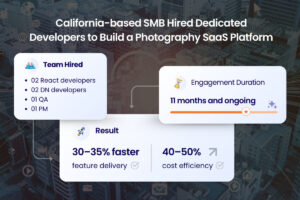
California-based SMB Hired Dedicated Developers to Build a Photography SaaS Platform
Swedish Agency Built a Laravel-Based Staffing System by Hiring a Dedicated Remote Team