Table of Contents

In the early stages of product development, the freelancer model offers a seductive level of speed and low overhead. For a Dallas-based startup or a lean product team in Toronto, hiring a solo contractor to build a proof of concept feels like the most efficient path. However, as AI projects move from experimentation to core infrastructure, the limitations of the “hero developer” approach become painfully clear. The transition from a loose collection of freelancers to a structured engineering pod is not just a change in headcount; it is a fundamental shift in how a business manages delivery risk and technical debt.
The complexity of modern AI implementation, which involves data pipelines, model tuning, and seamless API integrations, eventually outgrows the capacity of a single individual. Senior decision-makers are now realizing that to truly compete, they need more than just code; they need a cohesive delivery unit that functions as an extension of their internal team. When organizations look to hire AI developers, they are increasingly seeking the stability of structured teams over the fragmented nature of the gig economy.
Scaling Beyond the Freelance Ceiling
Freelancers are excellent for specialized, short-term tasks. They can bridge a gap or solve a very specific problem. But for a product leader in Dallas or Toronto responsible for a long-term AI roadmap, relying on solo contractors introduces significant business continuity risks. If a freelancer leaves, they take the institutional knowledge of your AI architecture with them. This creates a single point of failure that can stall a product launch for months.
The Problem of Fragmented Ownership
When you work with multiple freelancers, ownership is often siloed. One person handles the frontend, another manages the Python backend, and perhaps a third is brought in to hire AI agent developers for a specific automation feature. Without a unified lead or a structured team framework, these individuals often work in vacuums. This lack of synchronization leads to integration friction, inconsistent documentation, and a lack of accountability for the end-to-end user experience.
Managing the Overhead of Coordination
As you add more freelancers, the management burden on the CTO or Product Manager increases exponentially. Instead of focusing on strategy, leaders find themselves acting as traffic controllers, trying to sync schedules and resolve technical disputes between contractors who have no shared history. This is often the point where leaders realize they need to plan flexible AI teams that come pre-integrated and ready to produce from day one.
For those looking to avoid headcount lock-in while still achieving team cohesion, the pod model offers a middle ground. It provides the reliability of a full-time team without the long-term liability of traditional local hiring. This is especially relevant for teams in high-cost tech hubs like Toronto or Dallas.
Seeking Stability in High-Growth Markets
In competitive markets, the hunt for talent is relentless. When companies look to hire AI developers Toronto, they often find themselves in a bidding war for local talent that may not stay for the duration of the project. A structured team, particularly one provided by a partner like WeblineGlobal, offers a level of retention and commitment that freelancers simply cannot match. The team is managed as a unit, ensuring that even if an individual moves on, the project knowledge remains within the pod.
Build Your AI Product With a Dedicated Engineering Pod
Stop relying on fragmented freelancers for critical AI development. Work with a structured team of vetted AI engineers, QA specialists, and technical leads who deliver faster, more reliable results for your product roadmap.
Start with a small pod and scale as your AI platform grows.
The Structural Advantages of Dedicated AI Pods
A structured team, often referred to as an engineering pod, consists of a balanced mix of roles designed to support each other. Instead of just “hiring a developer,” you are investing in a delivery system. This system typically includes a lead developer, supporting engineers, and QA specialists who work in a unified environment with established workflows.
Cross-Functional Expertise and Knowledge Sharing
AI development is rarely a standalone activity. It requires a deep understanding of cloud infrastructure, data security, and frontend integration. A structured team brings this cross-functional expertise to the table. When you hire AI developers through a structured model, you benefit from the collective wisdom of the entire organization. At WeblineGlobal, for instance, our developers have access to a vast internal knowledge base and peer reviews that a freelancer simply doesn’t have.
Mitigating Technical Debt
Freelancers are often incentivized to move fast, which can sometimes lead to shortcuts in code quality or documentation. A structured team follows standardized coding practices and peer review processes. This ensures that the code being written today won’t become an expensive legacy problem for you next year. When you plan flexible AI teams, you are essentially buying a higher standard of engineering governance.
Ensuring Documentation Standards
One of the most overlooked aspects of hiring is the quality of documentation. In a structured team, documentation is part of the “Definition of Done.” This ensures that your intellectual property is well-documented and transferable, which is vital for any company looking to exit or raise further funding eventually.
Flexibility Without the Friction
One of the main reasons leaders stick with freelancers for too long is the fear of being locked into a large team. However, modern engagement models allow for flexible AI hiring. You can start with a small core pod and scale it up or down as the product requirements change. This allows you to avoid headcount lock-in while still enjoying the benefits of a dedicated, reliable team structure.
Evaluating the Cost and ROI of Structured Teams
At first glance, the hourly rate of a freelancer might seem lower than that of a managed team. However, a senior leader must look at the total cost of ownership. The time spent managing freelancers, the cost of delays due to lack of coordination, and the expense of fixing poor-quality code often make the freelancer model more expensive in the long run.
The True Cost of Management
If your CTO is spending 10 hours a week managing three freelancers, that is 10 hours of high-value strategic time lost. A structured team comes with its own internal lead who manages the day-to-day tasks, reporting back to your leadership. This allows your internal team to focus on high-level product strategy rather than micromanaging task lists. This shift is essential when you decide to hire AI agent developers to build complex automation tools.
Predictable Delivery vs. Variable Results
Structured teams operate on sprints with clear deliverables and predictable velocity. This predictability is worth a premium for product leaders who have board deadlines or client commitments. When you hire AI developers through a structured model, you are paying for the certainty of delivery as much as the code itself.
For organizations looking to hire AI developers Toronto, the ability to predict costs and timelines is a significant competitive advantage. It allows for better budgeting and more accurate forecasting of when new AI features will be ready for the market. This financial clarity is a major reason why many Dallas firms are moving away from the “black box” of freelance billing.
Leveraging Offshore Efficiency
By shifting to an offshore structured team in India, companies can often achieve 40 to 60 percent cost savings compared to local hiring in Toronto or Dallas. This isn’t just about lower rates, it is about the ability to hire more talent for the same budget. You can plan flexible AI teams that include specialists in niche areas of machine learning that might be prohibitively expensive to hire locally.
See the AI Developers Who Could Build Your Product
Review profiles of experienced AI engineers skilled in machine learning, LLMs, automation agents, and scalable AI infrastructure. Our structured teams integrate seamlessly with your product roadmap and deliver predictable results.
No long-term lock-ins. Just reliable AI expertise ready to start.
Transitioning Your Strategy: From Freelancer to Pod
The move to a structured team requires a change in mindset. It involves moving from a “task-based” management style to an “outcome-based” one. Instead of telling a developer exactly what to do, you provide the team with the business objective and let their collective expertise find the best technical solution.
Phasing the Transition
You don’t have to replace your entire freelance network overnight. Many successful Dallas and Toronto companies start by bringing in a structured pod to handle a new, discrete AI feature. This allows them to test the integration and see the difference in quality and speed before moving more of their core product development to the team. This gradual approach is a great way to avoid headcount lock-in while upgrading your engineering capacity.
Defining Clear Success Metrics
When you hire AI developers in a pod format, define what success looks like beyond just “lines of code written.” Look at sprint velocity, code quality metrics, and the speed of integration. A structured team should be able to demonstrate continuous improvement in these areas as they become more familiar with your product and business goals.
The RelyShore model used by WeblineGlobal is specifically designed for this transition. It combines the cost-efficiency of offshore talent with the delivery assurance that US-based businesses expect. This reduces the risk of the transition and ensures that the structured team integrates seamlessly with your existing culture and processes.
Communicating the Shift to Stakeholders
Investors and board members generally prefer structured teams over freelancers. A team represents a scalable asset, while a freelancer is a temporary fix. Highlighting that you have a strategy to plan flexible AI teams shows that you are thinking about the long-term sustainability of the product, which can be a key factor in funding and valuation discussions.
Selecting the Right Partner for Your AI Team
Not all vendors are created equal. When moving away from freelancers, the goal is to find a partner that can offer more than just bodies. You need a partner that understands the nuances of AI, from data privacy to the latest LLM frameworks. If you are looking to hire AI agent developers, you need a vendor with a proven track record of delivering autonomous systems, not just simple scripts.
Vetting for Technical and Cultural Fit
The technical skills are only half the battle. The team must be able to communicate effectively and work within your time zone as needed. At WeblineGlobal, we ensure that our developers are not only vetted for their technical proficiency but also for their communication skills. This ensures that when you hire AI developers Toronto or Dallas, the “distance” of an offshore team is effectively neutralized by high-quality interaction.
IP Protection and Security
For AI products, your data and your models are your most valuable assets. A freelancer might be working on multiple projects on their personal machine, creating a security nightmare. A structured vendor like WeblineGlobal provides a secure, controlled environment with strict NDAs and access controls. This level of professional security is non-negotiable for enterprise-level AI development.
When you hire AI developers, ask about their internal security protocols. Do they have ISO certifications? How do they handle data privacy? A professional, structured team will have clear, documented answers to these questions, giving you the peace of mind that your intellectual property is safe.
The Month-to-Month Flexibility Factor
One of the biggest advantages of working with a partner like WeblineGlobal is the flexibility. While you get the benefits of a structured team, you aren’t tied into a rigid long-term contract. This flexible AI hiring approach allows you to scale the team as your roadmap evolves. If you need to avoid headcount lock-in due to market uncertainty, this model provides the ultimate safety net.
Building a Future-Proof AI Engineering Engine
The shift from freelancers to structured teams is a sign of organizational maturity. It shows that your Dallas or Toronto product team is ready to move beyond the experimental phase and build a robust, scalable AI engine. WeblineGlobal offers you a structured pod over a fragmented freelance model; contact us now if you want to invest in the stability, quality, and long-term success of your product.
The choice to hire AI developers through a managed partner allows you to focus on what you do best, which is innovating and growing your business. While freelancers may have helped you get off the ground, a structured team will be the one to help you reach the next level. As you look to plan flexible AI teams, prioritize partners who can grow with you and provide the engineering excellence your vision deserves.
Social Hashtags
#AIDevelopment #HireAIDevelopers #AIEngineering #TechHiring #ProductDevelopment #SoftwareDevelopment #AIStartups #EngineeringTeams #AIInfrastructure #DevTeams #TechLeadership #StartupScaling #AIProductDevelopment #DedicatedDevelopmentTeam #OffshoreDevelopment
Ready to Replace Freelancers With a Scalable AI Team?
Move beyond the risks of solo contractors and build your AI product with a dedicated engineering pod. Our structured AI teams help Dallas and Toronto companies accelerate development, reduce technical debt, and scale faster.
Let’s discuss your AI roadmap and assemble the right team for your product.
Frequently Asked Questions
Structured teams typically overlap their working hours with the North American workday to ensure daily syncs and real-time collaboration. This managed overlap allows for seamless communication while the team continues to produce overnight, creating a 24-hour development cycle.
At WeblineGlobal, we can typically provide a shortlist of pre-vetted developer profiles within about 48 hours. Once the selection is made, the onboarding process for a structured pod is streamlined to ensure they can begin contributing to your codebase almost immediately.
Yes, many companies use a hybrid model. The structured team often takes over the core architecture and high-priority features, while freelancers may be kept on for specialized, infrequent tasks. Over time, many find it more efficient to consolidate all work into the pod.
Hiring an AI engineer locally in Toronto or Dallas can be incredibly expensive due to high salaries and overhead. A structured offshore team can reduce these costs by 40 to 60 percent, allowing you to hire a larger, more capable team for the same investment.
Unlike the freelance model, where a departure can derail a project, a structured vendor manages the replacement process. We ensure that a new developer is vetted and briefed on the project context before they start, minimizing any impact on your delivery timelines.


Success Stories That Inspire
See how our team takes complex business challenges and turns them into powerful, scalable digital solutions. From custom software and web applications to automation, integrations, and cloud-ready systems, each project reflects our commitment to innovation, performance, and long-term value.
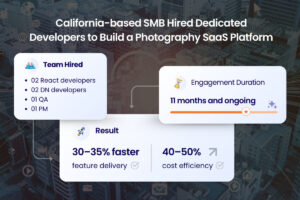
California-based SMB Hired Dedicated Developers to Build a Photography SaaS Platform
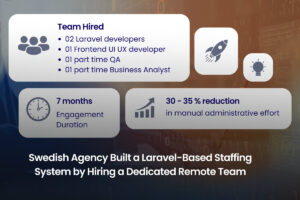
Swedish Agency Built a Laravel-Based Staffing System by Hiring a Dedicated Remote Team