

Table of Contents

To answer what is structured and unstructured data? Let us get it straight from IBM’s Think Topics: structured data is organized in a predefined and clearly understandable format. Because it is standardized and structured, data is easy for data analytics tools, ML algorithms, and human users to decipher. Unstructured data, on the other hand, has no predefined format. They are typically large (think of petabytes or terabytes of data) and built from 90% of all enterprise-generated data, which is both textual and non-textual. Every action made by AI has only one pillar: data, information fed in a format it can understand.
A report prepared by the Digital Curation Center at the School of Informatics, the University of Edinburgh, states that products and services with AI are evolving quickly and moving beyond simple pattern recognition and insight generation. Expanding access to data and improving its use are essential steps in myriad noble causes, sectors, or works (European Commission, 2020:2-3).
Hence, if you are into making your business solution powered by AI, it is essential to know structured vs unstructured data in AI.
Want to Build AI Solutions Using Your Business Data?
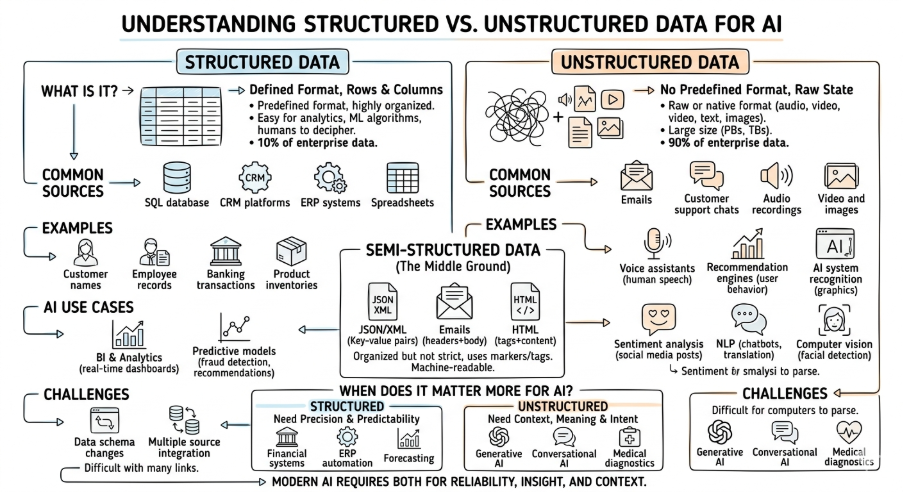
What is structured data in AI?
The information that is highly organized and stored in a predefined environment is structured data. Arranged in rows and columns, structured data in AI is easy for systems to understand, retrieve, and process with efficiency.
Common places for structured data in AI
- SQL database
- CRM platforms
- ERP systems
- Spreadsheets
- Financial management software
Some examples of structured data in AI
- Customer names/contact details
- Employee records
- Banking transactions
- Product inventories
- Sales performance report
AI use cases for structured data
- BI and analytics: real-time dashboards depend on structured data to solve patterns in sales, customer engagement, and inventory.
- Blockchain systems: structured registries decode smart contracts to have clear and verifiable information points.
- Predictive models: these models help detect any fraudulent access or transactions. Recommendation engines also verify structured records and make reliable outputs.
What is unstructured data in AI?
MongoDB defines unstructured data as information with no predefined schema. Such data is stored in its raw format or native format, such as audio, video, text, or images. Unstructured data does not follow any consistent layout from one record to the next. Though unstructured, it plays a crucial role in modern analytics and AI because it makes up around 80-90% of all enterprise data today.
Unstructured data is commonly found in
- Emails
- Customer support chats
- Audio recordings
- Video and images
- Medical notes
- Social media posts
- PDFs and documents
Unstructured data examples in AI
- Voice assistants that understand human speech
- Recommendation engines that interpret user behavior
- AI systems that recognize graphics
- Generative AI models that process Internet content
AI use cases for unstructured data
- Sentiment analysis: social media monitoring systems are able to analyze unstructured posts and identify public opinion/mood.
- Natural language processing: NLPs like voice assistants, chatbots, and translation tools depend on unstructured data and speech.
- Computer vision: facial detection and image recognition is possible for systems to process AV content.
Challenges of structured vs unstructured data in AI
According to Amazon Web Services (AWS), the challenges of using structured and unstructured data in Artificial Intelligence are that structured data is minimal compared to unstructured data. It’s because computers, programming languages, and data structures cannot easily parse unstructured data, which can also increase the risk of data type errors. However, structured data will be difficult to manage in any organization when it has many links between data points and databases, because it will be difficult to build queries for the data and maintain consistency across different data types.
Challenges of structured data
- Data schema changes
- Multiple structured data source integration
- Real-world associated data marking and fitting into a structural format
Challenges of unstructured data
- Analysis due to complexity
- Storage because it’s larger than structured data
The concept of semi-structured data
There is another categorisation that is in the struggle of structured data vs unstructured data in AI — semi-structured data. It has some organisational qualities that veer towards structured data (free from text), but it doesn’t fit the strict criteria that makes it unstructured data. Semi-structured data in AI often contributes to messy data in AI projects because it contains markers, tags, and other metadata grouped in a partial structure to be machine-readable.
Examples of semi-structured data in AI
Artificial Intelligence systems may use several types of semi-structured data depending on the case.
- JSON and XML files: they contain key-value pairs and hierarchical structure; however, they have different schemas
- Email messages: certain email messages have structured headers such as from/to/date/subject, but unstructured body content
- HTML webpages: they contain structural tags like headings/paragraphs/links, but inside, they do not have content
- Log files: they are timestamped recordings with a defined format, but variable content.
- CSV files: they are tabular structures with no strict schema validation or data types
Need Experts to Turn Complex Data into AI Insights?
What matters more: structured vs. unstructured data for AI
The decision between structured and unstructured data for AI initially appears to be that one is more significant than the other. In fact, current Artificial Intelligence needs both structured data that provides reliability, precision and consistency and unstructured data for its context, deeper insights and meaning.
Let’s make it clear:
When structured data matters more
Structured data is essential in environments where precision and predictability are critical. Since the data is organized and standardized, AI systems can process it quickly and efficiently.
Common use cases include:
- Financial systems and fraud detection
- ERP automation
- Business forecasting
- Reporting dashboards
- Banking and insurance analytics
- Risk-sensitive industries
When unstructured data matters more
Unstructured data is more helpful when AI needs to comprehend human behaviour, language, pictures, or intent.
Key AI applications include
- Generative AI systems
- Conversational AI and chatbots
- Content recommendation engines
- Customer experience analysis
- Medical diagnostics
- Legal document intelligence
Summarizing table: Structured data vs. semi-structured data vs. unstructured data for AI
| Aspect | Structured Data | Semi-Structured Data | Unstructured Data |
| Definition | Data organized in a fixed schema with clearly defined fields | Data that does not follow a rigid schema but contains tags, metadata, or organizational markers | Data with no predefined structure or consistent format |
| Format | Rows and columns | Flexible structure with hierarchical elements | Free-form content |
| AI Readability | Easily readable by traditional AI and analytics systems | Partially machine-readable | Requires advanced AI models to interpret |
| Storage Method | SQL databases, spreadsheets, ERP systems | JSON, XML, NoSQL databases | Data lakes, cloud storage, multimedia repositories |
| Processing Complexity | Low | Medium | High |
| Querying Method | SQL queries | Metadata-based queries, NoSQL queries | NLP, computer vision, embeddings, semantic search |
| Common AI Technologies Used | Machine learning, predictive analytics, BI tools | APIs, event-driven AI systems, hybrid ML pipelines | NLP, deep learning, generative AI, computer vision |
| Examples in AI | Customer records, transaction logs, inventory data | Emails, JSON API responses, IoT logs, XML files | Videos, images, social media posts, PDFs, audio recordings |
| Speed of Analysis | Fast and efficient | Moderate | Slower due to preprocessing requirements |
| Scalability | Limited by predefined schema | More scalable and flexible | Highly scalable but infrastructure-intensive |
| Data Flexibility | Low flexibility | Moderate flexibility | Extremely flexible |
| Human Context and Meaning | Limited contextual depth | Moderate contextual information | Rich contextual and behavioral insights |
| AI Use Cases | Fraud detection, forecasting, reporting dashboards | Cloud applications, real-time systems, integration workflows | Chatbots, recommendation systems, medical imaging, generative AI |
| Infrastructure Requirements | Traditional databases and analytics tools | NoSQL systems and hybrid storage architectures | GPUs, vector databases, AI orchestration systems |
| Cost of Processing | Lower | Moderate | Higher due to storage and AI computation needs |
| Accuracy and Consistency | Highly accurate and standardized | Partially standardized | Often noisy and inconsistent |
| Best Suited For | Structured business operations and analytics | Modern cloud-native and API-driven ecosystems | Context-aware and human-centric AI systems |
| Main Limitation | Limited contextual understanding | Inconsistent formatting across systems | Difficult preprocessing and governance challenges |
So, finally,
The AI strategy that will win for you
Leading organizations combine both data types through:
- Unified data architectures
- Data lakes and warehouses
- Hybrid AI pipelines
- Retrieval-augmented generation (RAG) systems
The future belongs to contextual AI, where connected data ecosystems outperform isolated datasets and enable AI developers and systems to make more intelligent decisions.
Struggling to Prepare Structured and Unstructured Data for AI?
Frequently Asked Questions
Structured data is information that is organised and follows a specific format, such as rows and columns. This organization makes it easy to store and analyse. Unstructured data is data that doesn’t have a fixed format, such as videos, emails, photographs, and social media posts, which require AI technology to process.
Semi-structured data is somewhere in between structured and unstructured data. It doesn't follow a strict schema, but has tags or metadata that help organise information. Common examples are JSON files, XML documents, and emails.
Unstructured data is rich in context, language, feelings and images and behavioural patterns. Unstructured data is an important part of the training and decision-making process for modern AI systems, notably generative AI and conversational AI.
They are both crucial. Structured data gives accuracy and consistency; unstructured data provides context and insight. The greatest AI systems use both sorts of data to perform better.
Examples include customer databases, transaction records, inventory data, health care records, financial statements and sales reports utilised in predictive analytics and forecasting models.
Common examples are movies, photos, PDFs, customer interactions, audio recordings, emails, medical notes and social media content handled by AI systems.
AI uses technologies including natural language processing (NLP), computer vision, deep learning, speech recognition, and vector embeddings to analyse and understand unstructured data.
Databases, analytics platforms, and machine learning algorithms can quickly search, filter and process information because structured data is so well organised.
Both forms of data are being integrated by more and more sectors including healthcare, banking, retail, manufacturing, legal services and customer support to develop sophisticated AI systems.
The future of AI is unified and contextual data ecosystems where structured, semi-structured and unstructured data play well together through technologies such as hybrid AI pipelines, vector databases and retrieval-augmented generation (RAG).
Success Stories That Inspire
See how our team takes complex business challenges and turns them into powerful, scalable digital solutions. From custom software and web applications to automation, integrations, and cloud-ready systems, each project reflects our commitment to innovation, performance, and long-term value.

Hospitality Review Intelligence Product Development with Offshore AI Team
Government Liaison Operations Digitization with Dedicated Offshore Team