Table of Contents

Texas has firmly established itself as a global technology powerhouse, with hubs in Austin, Dallas, and Houston rivaling the traditional dominance of Silicon Valley. For enterprise leaders in the Lone Star State, the challenge is no longer just about maintaining existing systems, but about how to rapidly modernize legacy infrastructure to stay competitive in a digital first economy. This pressure to evolve requires a significant surge in engineering throughput, often exceeding what local talent markets can provide within reasonable budgets or timelines.
When the decision is made to accelerate digital transformation, the immediate bottleneck is usually human capital. Texas enterprises are competing for the same pool of senior talent, driving up costs and lengthening recruitment cycles to several months. To overcome this, forward thinking CTOs are looking beyond local borders to hire enterprise developers who can integrate seamlessly into their existing workflows. This approach allows organizations to expand their modernization capacity Texas without the overhead of long term local headcount increases, providing the agility needed to execute complex roadmaps.
The Engineering Constraint in the Texas Modernization Landscape
Modernization is not a single event but a continuous process of upgrading architectures, migrating to the cloud, and integrating emerging technologies like AI. For many Texas based firms in sectors like energy, healthcare, and finance, the complexity of these tasks is immense. The local demand to hire enterprise developers Texas has created a seller market where senior engineers often have multiple competing offers. This makes it difficult for companies to scale teams quickly enough to meet quarterly board objectives.
Why Local Recruitment Fails the Speed Test
Traditional hiring in major Texas cities often takes 60 to 90 days from the initial job posting to the first day of work. In the context of a modernization sprint, three months of delay can result in missed market opportunities or prolonged exposure to security risks inherent in legacy systems. Furthermore, the attrition rate in high growth tech hubs like Austin is significantly higher, often leading to project instability just as a modernization initiative gains momentum.
The Hidden Costs of Local Scaling
Beyond the base salary, Texas enterprises must account for benefits, office space, recruitment fees, and the long term liabilities of full time employment. When you factor in these costs, the actual expense of a local senior developer can be nearly double their stated salary. This financial burden often forces engineering leaders to make compromises on team size or project scope, which ultimately undermines the success of the modernization effort.
Addressing the Talent Gap with Strategic Partnerships
To mitigate these risks, many organizations are shifting toward a hybrid model where a core local team manages strategy and architecture, while a dedicated offshore pod handles the heavy lifting of development and testing. By choosing to hire .NET developers or specialized cloud engineers from regions with deeper talent pools, Texas firms can maintain their momentum. This strategic balance ensures that the internal team is not burnt out by the sheer volume of work required during a transition phase.
Request Developer Profiles to see how quickly your team can scale without the delays of local recruitment.
Evaluating Modernization Capacity Texas in the Global Market
When looking to expand modernization capacity Texas, decision makers must look beyond simple labor arbitrage. The goal is to find a partner that understands the nuances of enterprise grade software development. This includes familiarity with rigorous security protocols, compliance requirements like HIPAA or SOC2, and the ability to work within established CI/CD pipelines. The value of an offshore team is measured by their output quality and their ability to reduce the technical debt that often plagues modernization projects.
Identifying High Value Engineering Skills
Modernization often involves moving from monolithic architectures to microservices. This requires a specific set of skills that are often scarce. For instance, if your enterprise relies heavily on Microsoft stacks, you may need to hire .NET developers who have specific experience in containerization and cloud native development. Evaluating these skills goes beyond a technical interview; it requires looking at past performance in similar enterprise environments where scale and reliability were paramount.
The Importance of Communication and Cultural Alignment
A common pitfall in hiring remote developers is underestimating the impact of communication styles. Texas enterprises thrive on a collaborative, results oriented culture. When you hire enterprise developers Texas via an offshore model, it is critical that the vendor provides professionals who are not only technically proficient but also articulate and proactive. They should be able to challenge assumptions and offer better ways to solve problems, rather than just taking tickets and writing code in a vacuum.
Risk Mitigation in Remote Staffing
The primary concern for many CTOs is delivery risk. Will the remote team understand the business logic? Will they be available during critical windows? WeblineGlobal addresses these concerns through a US based assurance model combined with the scale of Indian engineering. This approach provides the security and oversight of a local partner while delivering the cost advantages of an offshore team. This ensures that when you expand modernization capacity, you are doing so with a layer of professional accountability that protects your investment.
Schedule a Consultation to discuss your specific modernization roadmap and team requirements.
Strategic Team Composition for Modernization Projects
Successful modernization is rarely the result of adding a few individual contractors to a team. It typically requires a structured approach, often referred to as pod based hiring. A pod is a self contained unit of developers, QA engineers, and a project lead who can take ownership of a specific module or service. This structure is particularly effective for Texas enterprises that need to hire enterprise developers to tackle large, complex migrations without micro managing every task.
The Role of Dedicated Development Pods
Pods are designed for autonomy. For a Texas based financial services firm, a pod might be tasked with migrating a legacy payment processing system to a modern cloud architecture. Because the pod includes its own QA and leadership, the internal CTO can focus on high level strategy while the pod delivers tested, production ready code. This significantly increases the modernization capacity Texas by removing the management burden from the internal engineering leadership.
Scalability and month to month Flexibility
One of the greatest advantages of using a dedicated pod model is the ability to scale up or down based on the project phase. During the peak of a migration, you may need twelve developers, but once the system is stable, you might only need four for ongoing maintenance. Traditional hiring makes this level of flexibility impossible. By choosing to review enterprise needs periodically with a flexible vendor, Texas businesses can optimize their spend and avoid the painful process of layoffs when a project concludes.
Integrating Remote Pods into Agile Workflows
Most Texas enterprises use some form of Agile or Scrum. A well integrated remote team should participate in daily standups, sprint planning, and retrospectives. The time difference between Texas and India can actually be used as an advantage, creating a follow the sun development cycle. Issues identified during the Texas work day can be addressed by the offshore team overnight, ensuring that the local team starts every morning with progress already made. This effectively doubles the speed of the modernization cycle.
Hire Developers today to build a dedicated pod that fits your technical requirements and culture.
Security and IP Protection in Offshore Partnerships
For any enterprise, especially those in highly regulated industries, the protection of intellectual property and data is non negotiable. When you hire enterprise developers Texas through a remote model, you must ensure that the vendor has robust security frameworks in place. This includes physical security at their development centers, secure network access, and strict NDAs that are enforceable. The goal is to make the remote team an extension of your own secure environment.
Enforcing Enterprise Grade Compliance
A reliable partner will have established protocols for data handling and code access. This is essential when you expand modernization capacity in sectors like healthcare or defense. You should look for vendors who provide dedicated machines for their developers, use secure VPNs, and implement multi factor authentication for all systems. Furthermore, the contract should clearly state that all intellectual property created during the engagement belongs solely to the client.
The RelyShore Model of Delivery
WeblineGlobal utilizes the RelyShore delivery model, which is specifically designed to meet the high standards of global enterprises. This model focuses on transparency, accountability, and reliability. It ensures that the developers you hire are working in a managed environment with proper oversight. This mitigates the “rogue developer” risk that can sometimes occur with unmanaged freelance platforms. By providing a structured environment, the RelyShore model allows Texas firms to hire enterprise developers with the same confidence they would have in a local hire.
Maintaining Audit Trails and Transparency
Transparency is the foundation of trust in a remote hiring relationship. This involves regular reporting, access to code repositories, and clear visibility into the hours worked. Modern project management tools like Jira and Azure DevOps provide the necessary audit trails. When you review enterprise needs, make sure your partner is willing to integrate fully into your chosen tools, providing a single source of truth for all project activities.
Schedule Developer Interviews to vet the security awareness and technical expertise of our engineering teams.
Comparing the Costs: Local vs. India Based Engineering
The financial justification for offshore development is compelling, but it must be calculated accurately. While the hourly rate for an offshore developer is significantly lower, the true ROI comes from the total cost of ownership over the project lifecycle. For a Texas enterprise, hiring an offshore team can often lead to a 40 to 60 percent reduction in engineering costs without sacrificing quality or speed.
Calculating the Total Cost of Ownership
To understand the savings, one must look at the recruitment cost, onboarding time, infrastructure, and ongoing management. A local senior developer in Houston or Dallas might command a salary of 150,000 to 180,000 USD plus benefits. In contrast, when you hire .NET developers from a reputable offshore partner, you pay a flat monthly fee that covers everything. This predictable cost structure makes it much easier for VPs of Engineering to manage their budgets and justify modernization initiatives to the CFO.
Speed to Market as a Financial Metric
Cost savings are not just about lower salaries; they are about the value of time. If an offshore team allows you to launch a modernized platform six months earlier than a local team could, the additional revenue or cost savings generated by that platform often far outweigh the development costs. This “time to value” is a critical metric for Texas enterprises looking to expand modernization capacity and capture market share in competitive industries.
Avoiding the Cheap Talent Trap
It is important to distinguish between low cost freelancers and enterprise grade offshore partners. Choosing the cheapest option often leads to poor code quality, missed deadlines, and eventually, the need to rewrite the software. A high quality partner like WeblineGlobal provides vetted, experienced professionals who understand enterprise standards. The goal is not to find the lowest price, but to find the best value that minimizes delivery risk while maximizing modernization capacity Texas.
Finalizing Your Strategy to Hire Enterprise Developers Texas
Expanding your engineering capacity is a strategic decision that requires a balance of technical expertise, cultural fit, and financial logic. For Texas enterprises, the path to successful modernization lies in embracing a global talent model that provides the flexibility and scale required by today’s fast paced market. Contact us if you want an IT agency that understands the local Texas business context and provides high quality offshore execution. Thus, you can overcome the talent shortage and achieve your digital transformation goals.
The decision to hire enterprise developers should be based on a thorough evaluation of their technical skills, their ability to integrate into your workflows, and their commitment to security. Whether you need to hire .NET developers for a specific cloud migration or build a full scale engineering pod, the right partner will act as an extension of your own team, sharing your goals and your commitment to excellence. As you move forward, focus on building a sustainable, scalable engineering engine that can support your enterprise’s growth for years to come.
Social Hashtags
#DigitalTransformation #SoftwareDevelopment #OffshoreDevelopment #HireDevelopers #EnterpriseIT #CloudMigration #EngineeringTeams #ITOutsourcing #AgileDevelopment #TechLeadership #TechHiring
Hire Remote Developers with WeblineGlobal to bridge your talent gap and accelerate your enterprise modernization journey today.
Frequently Asked Questions
In most cases, we can provide a shortlist of pre-vetted developer profiles within 48 hours. Depending on the complexity of your requirements and the interview process, a team can typically be onboarded and productive within two weeks, which is significantly faster than local Texas hiring cycles.
We look for developers who have prior experience in your specific industry, whether it is fintech, healthcare, or retail. During the onboarding phase, we encourage a knowledge transfer period where the developers learn your specific business logic and project goals to ensure alignment from day one.
Our model is designed for long term partnership and flexibility. While our developers are based in India, we work with you to ensure that the knowledge they build stays within your organization. This makes it easier for your internal team to take over or for the remote team to continue providing scalable support as your needs evolve.
We typically establish a four to five hour overlap window during the Texas morning. This time is used for standups, meetings, and collaboration. The rest of the Indian work day is spent on heads down development, providing a productive cycle where work continues while your local team is offline.
We offer a month to month hiring model that allows you to evaluate performance without long term commitment. If a developer does not meet your expectations, we provide a replacement quickly to ensure your project timeline remains on track, minimizing any disruption to your modernization capacity Texas.




Success Stories That Inspire
See how our team takes complex business challenges and turns them into powerful, scalable digital solutions. From custom software and web applications to automation, integrations, and cloud-ready systems, each project reflects our commitment to innovation, performance, and long-term value.
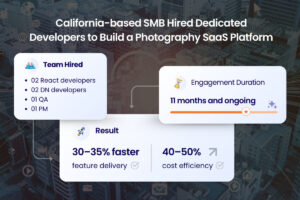
California-based SMB Hired Dedicated Developers to Build a Photography SaaS Platform
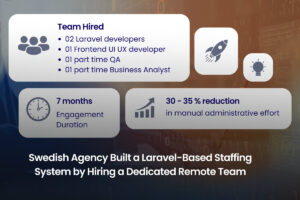
Swedish Agency Built a Laravel-Based Staffing System by Hiring a Dedicated Remote Team