
Table of Contents

Vector databases store more information in the form of high dimensional vectors (these are nothing but numerical representations of audio, text, images and video locations across dimensions. These high dimensional data points are used by ML (Machine Learning) models to fetch meaning and save the context. AI models need all sorts of data, and they generate vector embeddings from that data, making a vector database more effective. This process employs myriad features and attributes to model different dimensions of data to capture the context.
Let’s learn why vector databases are an essential part of modern Artificial Intelligence and their associated solutions in industry verticals.
What is a vector database?
To understand this, you have to learn how computers have traditionally viewed information and how modern-day AI-enabled systems view it. A vector database is a specialized type of storage system designed to store and index vector embeddings—high-dimensional numerical arrays representing features or unstructured data in the form of audio, text, or images. Standard databases are good at matching names or prices, but not good at matching an image that looks like an early morning or a paragraph that looks like a legal matter.
This is where the AI vector database shines, as it treats data points as coordinates on a multi-dimensional map. It gathers all the items with similar meaning together and physically places them near one another.
Want to build AI applications powered by vector databases?
What are the core components of a vector database for AI?
Before we get into mechanics, let’s see how these systems are built. They are based on three factors: embeddings, indexing, and similarity search. Each factor has a specific purpose to ensure AI can get the right information at the right time.
- Vector embeddings: these are numerical representations of raw data. A Machine Learning model takes some content and converts it into a long list of numbers.
- High-dimensional space: It is a mathematical world in which there are vectors. Visualize a 3D graph, but instead of just 3 axes, there are an infinite number of different axes.
- Metadata storage: Most vector databases also store descriptive data like dates, tags, or categories, together with the vectors for advanced filtering.
How does a vector database for AI work?
The magic of the vector database for AI is a well-structured pipeline that converts raw data into actionable chunks. Imagine encoding data, putting it into a complex structure, and then querying it using a mathematical distance formula, rather than any keyword matching.
When a user interacts with an AI system, the query is transformed to a vector, and the database also searches its multi-dimensional map for the nearest items to the query vector. All this process is not only about comparing each other but also a highly optimized search through billions of data points to get the most suitable results in a fraction of a second.
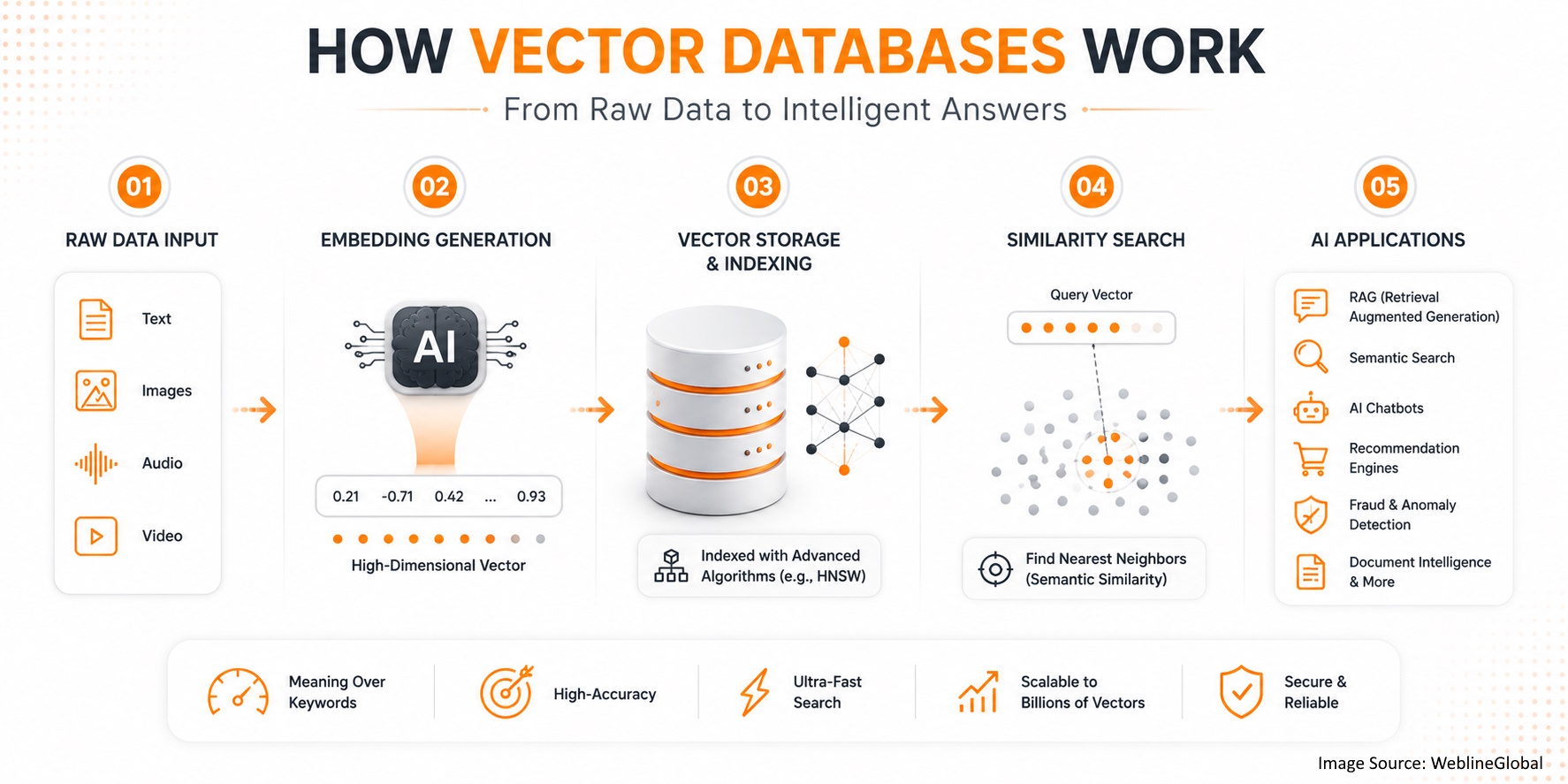
The lifecycle of a vector query
The best vector databases for AI are a series of ultrasonic speed events that occur within the database every time you ask AI anything. It therefore provides an appropriate and precise answer. Even if the size of the dataset increases to billions of records, the lifecycle makes the systems very fast and accurate.
- Indexing: algorithms such as Hierarchical Navigable Small World (HNSW) are used by databases to create a map of the data. It helps the systems to zoom in on the right neighbour by skipping the irrelevant.
- Distance metrics: the systems measure the distance between vectors by an equation such as Euclidean Distance or Cosine Similarity. The closer the distances, the more alike.
- ANN (Approximate Nearest Neighbour): It takes too long to compare the query to every vector, so databases use ANN algorithms to find a suitable match with a small sacrifice of mathematical accuracy for speed.
- Post filtering: once the similar vectors are retrieved, the database filters on the metadata, for example, only the last year. This makes the output even more polished.
Key Differences at a Glance
The selection of the right tool depends completely on the data and the expected result. For transactional integrity and accounting, traditional databases still reign supreme, but for discovery and context-aware retrieval, vector databases have no competition.
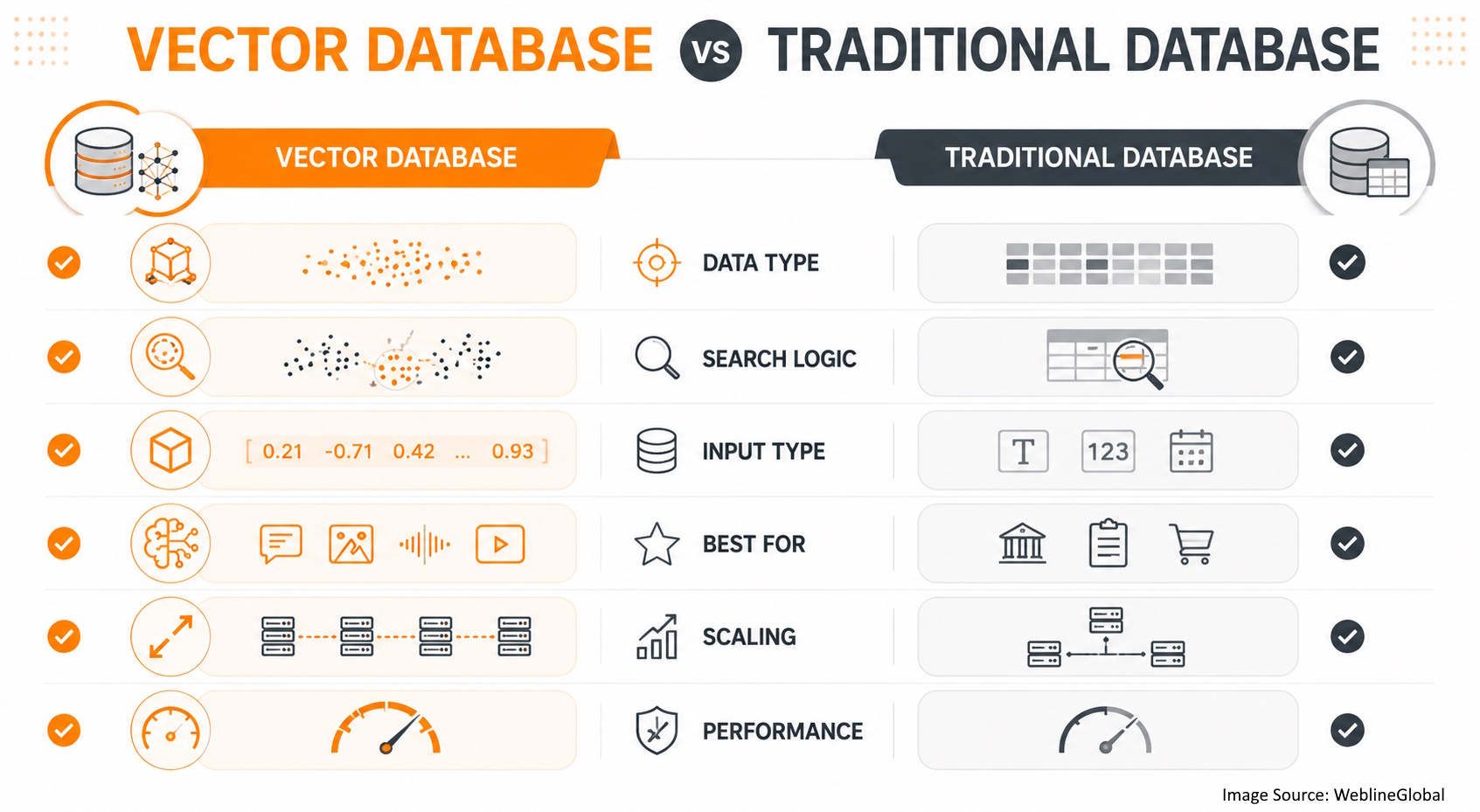
| Feature | Vector Database | Traditional Database (SQL/NoSQL) |
| Data Type | Unstructured (Embeddings of Text, Images) | Structured (Tables, Rows, Columns) |
| Search Logic | Semantic Similarity | Exact Keyword Match |
| Input Type | High-Dimensional Vectors | Strings, Numbers, Dates |
| Best For | RAG, Semantic Search, Recommendation Engines | Banking, ERP, Inventory Management |
| Scaling | Horizontal (distributed nodes) | Vertical/Horizontal (sharding) |
Common use of vector databases for AI
You can build a huge range of intelligent tools and systems under Artificial Intelligence innovation using vector databases. Here are some of the popular vector databases for AI use cases.
LLMs and NLP
Large language models (LLMs) such as GPTs and BERT produce vector embeddings of text, which capture semantic similarities. These embeddings are stored in vector databases, which speed up similarity searches to retrieve contextually relevant information. By combining the LLM’s NLP capabilities with the vector nearest neighbour search database, they can interpret human language queries and even generate text. Hence, vector databases are the backbone for chatbots, question answer forums, text classification, or even sentiment analytics.
Retrieval-augmented generation (RAG)
RAG depends on an LLM’s ability to retrieve information from an external knowledge base. RAG uses high-dimensional vector data to ensure that AI model deployments can give accurate, contextual, and up-to-date answers, directly from relevant sources, such as a company’s internal document base. Storing high-dimensional vectors of current factual data in vector databases improves the trustworthiness of the LLM’s responses by reducing hallucinations and provides speed and scalability, which are crucial for applications such as customer support agents, legal document analyzers, and talent management systems.
Recommendation engines
For e-commerce sites, media streaming platforms, and social media feeds, the vector databases can store user behavior such as past purchases, product, and content features as vector embeddings. When a user asks for recommendations, the system can query the vector database to find items that are similar to the user’s preferences, which are represented as vectors. This allows for personalization that goes beyond collaborative filtering.
Semantic search
Vector databases turn multimodal data into high-dimensional vectors, which represent the semantic relationships between elements. This means they capture the meaning, user intent, and context of data and cluster together similar data points. This means that they can understand natural language and give results that are most similar to your query, not just results that contain the keyword you searched for. For example, when you search “best beach vacation spots,” you may also see some results for “summer vacation spots” or “tropical island vacation ideas.” These are not exact keyword matches, but they are contextually similar.
Fraud and anomaly detection
When vector databases store normal behavioral data (like transactions and login patterns) as vectors, it becomes easy to find abnormal patterns that don’t fit into the similarity clusters you’ve created. This makes vector databases relevant for real-time fraud detection, network security monitoring and manufacturing quality control.
Looking for scalable vector database implementation support?
Best Vector Databases for AI in 2026
The market for specialized data storage has boomed, with a spectrum of solutions from fully managed cloud services to lightweight open-source libraries. Your choice of vector database for AI will depend on your scale, budget, and development ecosystem as each platform has unique advantages for different use cases.
The picture is starting to come into focus with a few clear leaders for 2026. Whether you’re a solo dev creating a prototype or a global enterprise managing petabytes of data, there’s a specialized solution ready for your performance and security needs.
Top Managed and Open-Source Options
The following platforms represent the cutting edge of vector storage technology. They are widely used in production environments to power the most advanced AI applications currently available on the market.
- Pinecone: Often considered the industry standard for serverless vector search. It is highly popular because it requires zero infrastructure management, making it the top choice for teams that want to scale rapidly without hiring specialized DevOps engineers.
- Milvus & Zilliz: Milvus is a powerful open-source choice for massive, billion-scale deployments. Zilliz is its managed cloud counterpart, offering enhanced performance and enterprise-grade security for organizations with the most demanding workloads.
- Weaviate: A specialized database that excels in multimodal search. It can handle text, images, and even 3D objects natively, and its built-in modules for vectorization make it a favorite for complex RAG pipelines.
- Qdrant: Written in Rust, this database is prized for its extreme efficiency and memory safety. It offers some of the lowest latency numbers in the industry and is highly effective for filtering metadata alongside vector searches.
- Chroma: The go-to for researchers and Python developers. It is incredibly easy to set up and integrates seamlessly with popular AI frameworks like LangChain, making it the perfect playground for rapid prototyping.
- pgvector: This is an extension for PostgreSQL. It is the best choice for teams already using Postgres who want to add vector capabilities without introducing a completely new database into their architecture.
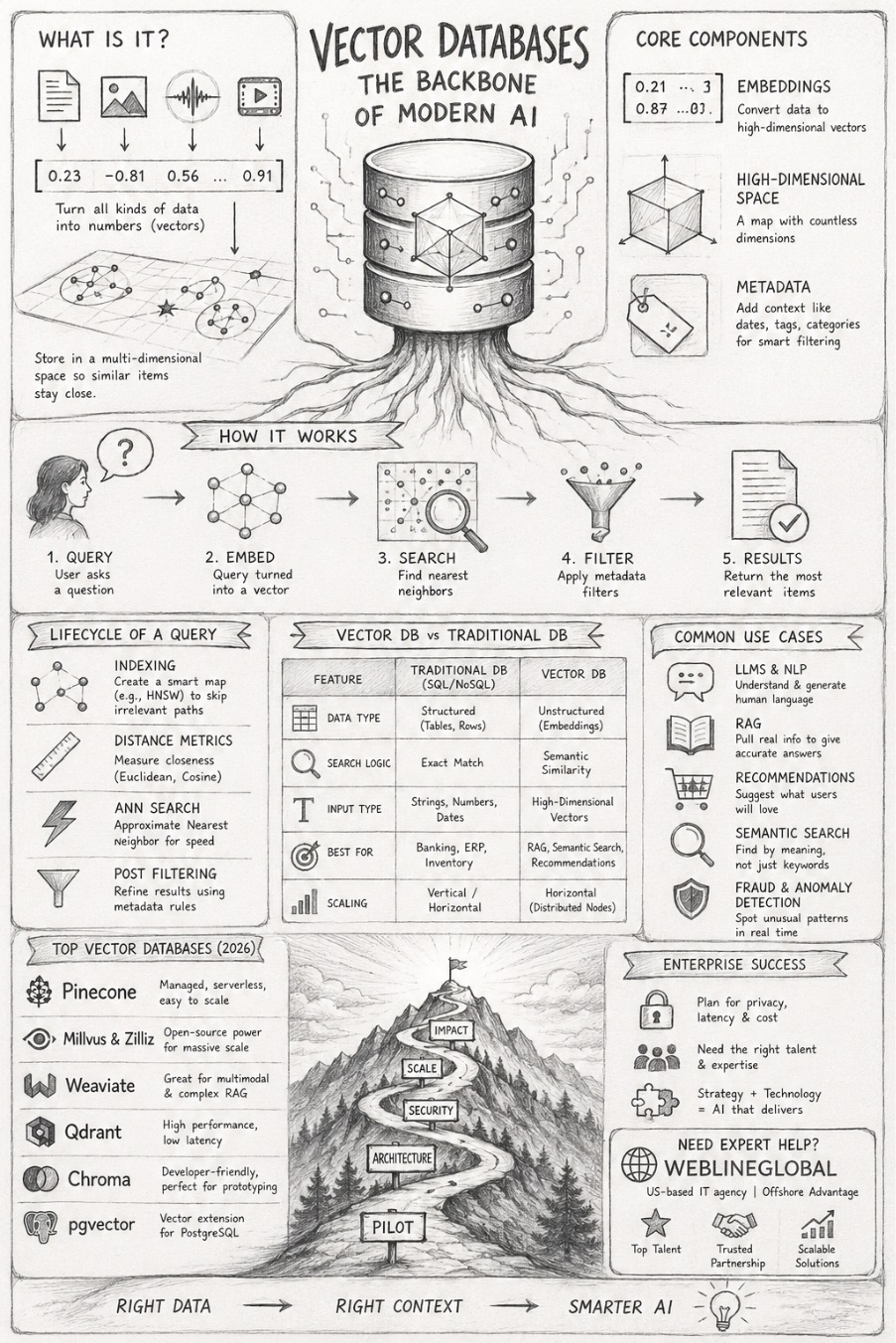
Implementing Vector Databases in the Enterprise
Going from a pilot project to a production-ready AI solution is not just a matter of picking a database; it is about taking a strategic approach to data architecture. Enterprises need to consider data privacy, cost of embedding generation, and latency of the retrieval pipeline to deliver a seamless user experience.The lifecycle of a vector query
The need for specialized talent is clear as organizations embed a vector database for AI into their core activities. Building and maintaining these systems requires not only an understanding of machine learning workflows, but also database optimization and cloud infrastructure. For many companies, the quickest path to success is to partner with experts who understand the nuances of this particular technology.
Staffing for Success with WeblineGlobal
If your organization is ready to tap into the power of vector databases but lacks the in-house bandwidth to execute, WeblineGlobal is your ideal partner. We are a US-based IT agency specializing in bridging the gap between high-end architectural needs and cost-effective development.
Looking for professional IT staff augmentation for a vector database for AI? WeblineGlobal can help. With our sophisticated offshore development hub, we provide dedicated development teams who understand the intricacies of RAG, embedding pipelines, and high-dimensional search.
WeblineGlobal combines the best of both worlds for enterprises: US-based quality, communication, and project management standards at highly competitive offshore prices. From building a recommendation engine from scratch to optimizing an existing AI pipeline, our AI developers make sure your infrastructure is scalable, secure, and ready for the future of intelligence.
Social Hashtags
#VectorDatabase #ArtificialIntelligence #AI #MachineLearning #GenerativeAI #RAG #LLM #SemanticSearch #DataEngineering #AIDevelopment #VectorEmbeddings #AIApplications #EnterpriseAI #MLOps #AIInfrastructure #Chatbots #DataScience #TechTrends #WeblineGlobal
Ready to add semantic search or RAG to your product?
Frequently Asked Questions
A vector database acts as the long-term memory for artificial intelligence. It is primarily used to store and retrieve vector embeddings, which are numerical representations of data like text, images, and audio. This allows AI models to perform semantic searches, build recommendation engines, and implement Retrieval-Augmented Generation (RAG) to provide accurate, context-aware answers.
To understand how vector databases work, imagine turning every piece of information into a specific set of coordinates on a massive, multi-dimensional map. When you search for something, the database doesn't look for matching words; it looks for the closest physical points on that map. This mathematical proximity represents a similarity in meaning, allowing the AI to find relevant content even if the exact keywords are missing.
The primary difference in a vector database vs traditional database comparison is the search logic. Traditional databases use exact matches for rows and columns (e.g., finding an ID number). Vector databases use similarity search to find data that is contextually related. While a SQL database is perfect for structured accounting data, a vector database is essential for unstructured data like natural language or visual patterns.
The landscape of the best vector databases for AI includes several specialized leaders. Pinecone is the top choice for managed, serverless deployments, while Milvus and Qdrant are preferred for high-performance, open-source needs. For those already in the PostgreSQL ecosystem, pgvector is an excellent extension. Other popular options include Weaviate for multimodal data and Chroma for rapid prototyping and local development.
RAG is a technique that connects an LLM to a vector database to provide it with real-time or private information. It is important because it prevents the AI from hallucinating by grounding its responses in actual data retrieved from the database. This makes AI applications much more reliable and useful for enterprise tasks like customer support or internal knowledge management.
Yes, you can use traditional databases with extensions like pgvector for PostgreSQL. While purpose-built vector databases are often faster at a massive scale (billions of vectors), using an extension is a great way for enterprises to add AI capabilities to their existing infrastructure without the complexity of managing a separate database system.
Vector embeddings are the bridge between human information and machine understanding. They are long lists of numbers generated by machine learning models that encode the meaning and context of a piece of data. For example, the embeddings for the words king and queen would be mathematically closer to each other than the embedding for the word apple.
The cost of a vector database for AI depends on the volume of data and the frequency of queries. Cloud-native options like Pinecone offer pay-as-you-go pricing, while self-hosted options like Milvus require infrastructure costs. The primary expense often comes from the high RAM requirements needed to keep vector indexes fast and accessible for real-time searches.
Scaling a vector database usually involves horizontal scaling, which means spreading the data across multiple server nodes. Because vector searches are computationally intensive, modern databases use sharding and replication to ensure that the system can handle millions of concurrent users without a significant increase in latency.
Implementing these systems requires a blend of data science and database engineering. WeblineGlobal is a leading US-based IT agency that provides professional IT staff augmentation specifically for vector database for AI projects. By utilizing our offshore development hub, you can access world-class experts who can build, optimize, and scale your AI infrastructure at highly competitive prices.
Success Stories That Inspire
See how our team takes complex business challenges and turns them into powerful, scalable digital solutions. From custom software and web applications to automation, integrations, and cloud-ready systems, each project reflects our commitment to innovation, performance, and long-term value.

Hospitality Review Intelligence Product Development with Offshore AI Team

Government Liaison Operations Digitization with Dedicated Offshore Team