Table of Contents

INTRODUCTION
While working on a customer support automation platform for a global logistics provider, our engineering team was tasked with integrating the WhatsApp Business API to handle real-time shipment inquiries. The architecture utilized n8n as the orchestration layer to route messages between Meta’s cloud infrastructure and the client’s internal CRM.
During the setup phase, we encountered a blocking issue that halted development: the “Callback URL not validated” error in the Meta Developer Dashboard. Despite the webhook URL appearing correct and the server being reachable, Meta refused to verify the connection. This issue prevented the system from receiving incoming message events, effectively stalling the project.
This validation failure is a common hurdle when decoupling messaging services from backend logic. We realized that the issue was not a connectivity failure but a misunderstanding of the specific handshake protocol Meta requires before delivering payloads. This article outlines how we diagnosed the handshake failure and established a stable, secure connection, ensuring reliable message delivery for the client.
PROBLEM CONTEXT
The client required a scalable, low-code middleware solution to process high volumes of inbound WhatsApp messages. We selected n8n for its flexibility in handling JSON payloads and its ability to integrate with legacy ERP systems via REST APIs.
The architecture was designed as follows:
- Source: WhatsApp Business API (Meta Cloud).
- Ingress: An n8n webhook node configured to listen for incoming message events.
- Processing: Logic to parse the message, query shipment status, and return a response.
For this flow to work, Meta requires a one-time verification step. When you register a webhook URL, Meta sends a GET request containing a random challenge string and a verify token. The receiving server (n8n) must validate the token and strictly return the challenge string to confirm ownership of the endpoint. If this handshake fails, the webhook is rejected, and no POST data (actual messages) will ever be sent.
WHAT WENT WRONG
The error “Callback URL not validated” indicates that the Meta server did not receive the expected response during the verification attempt. Upon analyzing the server logs and the configuration, we identified three distinct issues contributing to the failure:
- Protocol Mismatch: The team initially focused on the
POSTlogic for handling messages, overlooking that the verification request is aGETrequest. The endpoint was rejecting the method or failing to process the query parameters. - Token Discrepancy: The “Verify Token” string entered in the Meta Dashboard did not match the configuration within the n8n credential store. Even a whitespace mismatch causes an immediate rejection.
- Workflow State: In n8n, workflows must be active (or the test webhook must be listening) to respond to external requests. Since the workflow was in a “stopped” state during configuration, the webhook endpoint returned a 404 or 502 error to Meta, causing the validation to fail instantly.
This scenario highlighted the importance of precise configuration when you hire n8n developers to manage API integrations, as subtle protocol requirements often cause significant delays.
HOW WE APPROACHED THE SOLUTION
To resolve the issue, we broke down the HTTP transaction into its component parts. We needed to ensure that our n8n instance was not just receiving the request but explicitly parsing the hub.challenge and hub.verify_token parameters sent by Meta.
Our diagnostic process involved:
- Verifying Reachability: We ensured the n8n instance was accessible via a public HTTPS URL. For local development, we utilized a tunneling service, but for the production environment, we verified the SSL termination at the load balancer level.
- Standardizing the Token: We generated a strong, alphanumeric string to serve as the Verify Token. This acts as a shared secret between Meta and the middleware.
- Analyzing the Handshake Logic: We reviewed how the specific n8n “WhatsApp Trigger” node handles the verification request internally versus how a generic Webhook node would require manual logic to return the
hub.challenge.
FINAL IMPLEMENTATION
The solution involved correcting the configuration within the n8n WhatsApp node and synchronizing it with the Meta Developer Portal. Below are the technical steps and logic we implemented to pass validation.
1. Configuration of the Credential Store
Within n8n, the WhatsApp Trigger node abstracts the handshake logic, but it relies on the “Webhook Secret” or “Verify Token” being set correctly in the credentials.
// Pseudo-configuration for the n8n Credential Interface
{
  "accessToken": "EAA...", // System User Token
  "clientId": "1001...",   // App ID from Meta
  "clientSecret": "eb2...", // App Secret
  "webhookPath": "generic-webhook-path",
  "verifyToken": "s3cure_v3rify_t0ken_string" // Must match Meta exactly
}
2. Activating the Listener
A critical oversight often made is attempting to verify the URL while the n8n workflow is inactive. Meta expects an immediate HTTP 200 OK response with the challenge string in the body.
- We set the workflow to Active in the production environment.
- For the staging environment, we used the “Listen for Test Event” feature immediately before clicking “Verify and Save” in the Meta dashboard.
3. Meta Dashboard Configuration
We navigated to the WhatsApp > Configuration section in the Meta dashboard and entered the following:
- Callback URL:
https://api.generic-logistics-platform.com/webhook/whatsapp-trigger(Note: Ensure this is the production webhook URL, not the test URL, unless testing specifically). - Verify Token:
s3cure_v3rify_t0ken_string(The exact string defined in step 1).
4. Validation Logic (Behind the Scenes)
If we were implementing this manually without the pre-built node, the code logic would look like this. Understanding this helps in debugging if the node fails:
// Generic representation of the verification logic
function handleWebhookVerification(request, response) {
    const mode = request.query['hub.mode'];
    const token = request.query['hub.verify_token'];
    const challenge = request.query['hub.challenge'];
    if (mode && token) {
        if (mode === 'subscribe' && token === 's3cure_v3rify_t0ken_string') {
            console.log('WEBHOOK_VERIFIED');
            // Respond with the challenge token from the request
            response.status(200).send(challenge);
        } else {
            // Responds with '403 Forbidden' if verify tokens do not match
            response.sendStatus(403);
        }
    }
}
Once we synchronized the token and ensured the workflow was active, the “Verify and Save” operation succeeded immediately. The status changed to “Connected,” and we could proceed to subscribe to specific fields like messages.
LESSONS FOR ENGINEERING TEAMS
Integrating third-party APIs requires attention to protocol details. Here are key takeaways for teams managing similar integrations:
- Understand the Handshake: Webhooks are not just one-way firehoses. Many providers (Meta, Stripe, Slack) require a verification handshake. Know the difference between the
GETverification and thePOSTpayload. - Environment Consistency: Validation errors often occur because developers try to verify a localhost URL without proper tunneling. Use tools that provide stable, public HTTPS endpoints for development.
- Token Security: Never use simple strings like “12345” for verify tokens. While it is just a handshake, it prevents unauthorized entities from spoofing your webhook endpoint.
- Logging is Critical: When validation fails, inspect the ingress logs. Seeing a 404 indicates a path error; seeing a 403 indicates a token mismatch.
- Resource Allocation: Complex integrations often benefit when you hire backend developers for API integration who specialize in middleware logic, ensuring that edge cases in connectivity are handled robustly.
WRAP UP
Resolving the “Callback URL not validated” error came down to aligning the verification token and ensuring the middleware was actively listening for the challenge request. By understanding the underlying HTTP handshake required by Meta, we established a stable communication channel for the client’s support automation. Correctly configuring these entry points is the foundation of any reliable event-driven architecture.
Social Hashtags
#n8n #WhatsAppAPI #WebhookValidation #MetaDevelopers #APITroubleshooting #WorkflowAutomation #BackendEngineering #LowCodeAutomation #EventDrivenArchitecture #WhatsAppBusinessAPI
If your team is facing challenges with API integrations, automation workflows, or building scalable backend systems, contact us to discuss how we can support your engineering goals.
Frequently Asked Questions
The Verify Token is a security measure used to ensure that the server receiving the webhook actually belongs to you. It prevents you from accidentally (or maliciously) adding a webhook URL that you do not control. It acts as a shared secret to validate the ownership of the endpoint.
Yes, but the test URL only works when the n8n UI is open and explicitly listening for an event. For a persistent connection that works 24/7, you must use the Production URL and ensure the workflow is activated.
If the token matches but validation fails, the issue is likely that your server is not returning the hub.challenge value in the response body, or it is returning it with additional HTML/JSON formatting. Meta expects the response body to contain only the challenge string.
Implement comprehensive logging at the ingress layer. Log the incoming headers, query parameters, and body of every request. This allows you to differentiate between handshake requests (GET) and data payloads (POST) and identify where the failure occurs.
Yes. While low-code tools simplify logic, understanding HTTP protocols, security headers, and scaling requirements is complex. When you hire automation developers, you ensure that the system is not just functional but resilient and secure.

Success Stories That Inspire
See how our team takes complex business challenges and turns them into powerful, scalable digital solutions. From custom software and web applications to automation, integrations, and cloud-ready systems, each project reflects our commitment to innovation, performance, and long-term value.
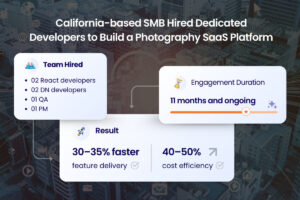
California-based SMB Hired Dedicated Developers to Build a Photography SaaS Platform
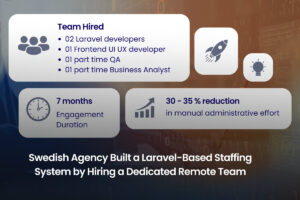
Swedish Agency Built a Laravel-Based Staffing System by Hiring a Dedicated Remote Team