
Table of Contents

Enterprises from all over the world have witnessed some remarkable changes in 2026 in Artificial Intelligence and business process automation. Global companies of all sizes and kinds have spent the last decade stockpiling information as if it were digital gold. As a result, servers are overflowing, data lakes have turned into vast oceans, and the sheer volume of logs, clicks, and transactions is staggering. Yet, despite this abundance, a massive percentage of artificial intelligence initiatives never reach production. The harsh truth is that being data-rich is not the same as being AI-ready.
According to recent industry audits published by Gartner, nearly 60% of enterprise AI projects are abandoned before they provide a return on investment. The reason is rarely a lack of computing power or a lack of sophisticated models. Instead, the failure lies in the bridge between raw information and actionable intelligence.
This blog explores the fundamental AI adoption challenges facing modern businesses and provides a roadmap for an effective AI implementation strategy that actually sticks.
Struggling to turn your business data into AI-ready systems without overloading your internal engineering team?
The Illusion of Information Abundance
The first reason why AI projects fail is the misconception that more data equals better results. For years, the mantra was to collect everything and figure it out later. This led to the creation of data swamps such as unstructured, uncleaned, and unindexed repositories that are virtually useless for machine learning.
The Difference Between Data-Rich and AI-Ready
To be data-rich means you have the raw materials. To be AI-ready means those materials are refined, labeled, and accessible. Think of it like a library. A data-rich company has a pile of a million books dumped in the middle of a room. An AI-ready company has those same books categorized, indexed, and summarized so a reader can find an answer in seconds.
Without achieving data readiness for AI, your organization is essentially trying to power a jet engine with crude oil. It might be fuel in its rawest sense, but it will clog the system and cause a catastrophic failure.
Why AI Projects Fail Due to Structural Weaknesses
Understanding why AI projects fail requires looking beyond the IT department. Most failures are systemic and rooted in a misalignment between business goals and technical execution.
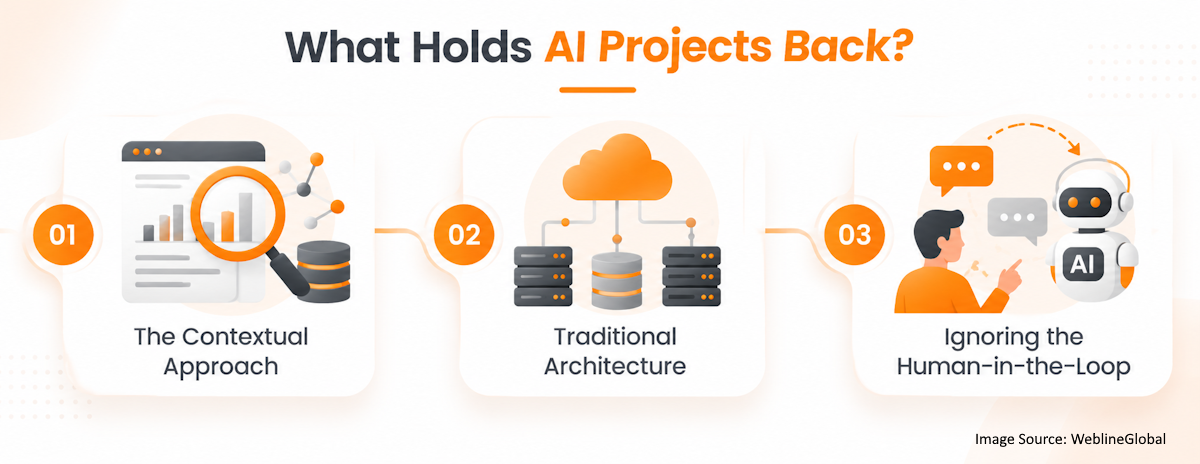
1. The Contextual Approach
Artificial Intelligence does not have common sense. If a model is fed customer purchase history but lacks the context that a global pandemic or a supply chain crisis occurred during that period, its predictions will be skewed. Most companies fail to provide this metadata and, therefore, it leads to models that perform well in a sandbox but fail in the real world.
2. Traditional Architecture
AI adoption challenges are often physical. When the marketing data lives in one cloud, sales data in another, and logistics data in an on-premise legacy server, the AI cannot see the full picture. Cross-functional intelligence requires a unified data fabric, something most enterprises are still struggling to build. Businesses can address these integration challenges by working with automation and integration specialists who can connect fragmented systems and streamline data workflows.
3. Ignoring the Human-in-the-Loop
Many leaders view AI as a replacement for human workflows rather than an augmentation. When employees feel threatened by automation, they are less likely to provide the high-quality feedback and labeling necessary to improve the model. This cultural friction is a primary reason projects stall after the pilot phase.
How to Solve Data Quality Issues in AI?
If you want to move the needle on your AI implementation strategy, you must address the elephant in the room: data quality issues in AI. Machine learning models are incredibly sensitive to noise. Even a 5% error rate in your training data can lead to a 50% drop in model reliability. Poor data quality can also increase development costs, delay deployments, and undermine business outcomes. Explore the hidden costs of messy data in AI projects to understand why clean, reliable data is essential for successful AI implementation.
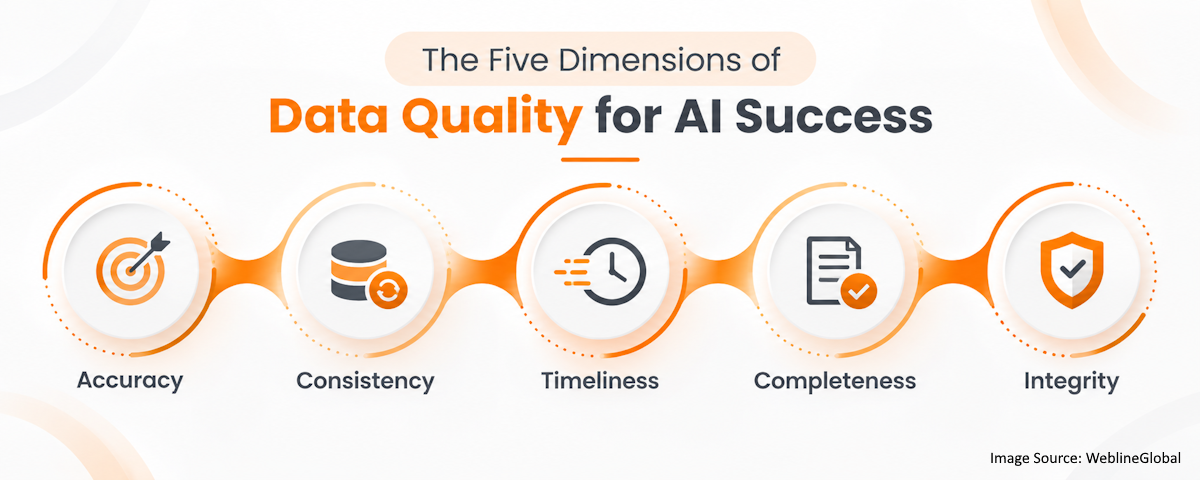
The Five Dimensions of Quality
- Accuracy: Does the digital record match the physical reality?
- Consistency: Is a customer ID the same across every touchpoint?
- Timeliness: Is the data being fed to the model in real-time, or is it a week old?
- Completeness: Are there missing fields that force the model to make dangerous assumptions?
- Integrity: Has the data been corrupted during the ETL (Extract, Transform, Load) process?
Addressing data quality issues in AI is not a one-time project. It requires automated observability tools that monitor data health 24/7. In 2026, the most successful companies are those that treat data quality as a continuous DevOps discipline.
Need experienced AI developers to overcome data quality challenges and accelerate your AI implementation roadmap?
How to Build a Robust AI Implementation Strategy?
A successful AI implementation strategy acts as a comprehensive blueprint that aligns technical capabilities with overarching business objectives. In 2026, the most resilient organizations are those that treat AI as a continuous lifecycle rather than a one-time software installation.
To build a strategy that scales, enterprises must focus on the following four pillars:
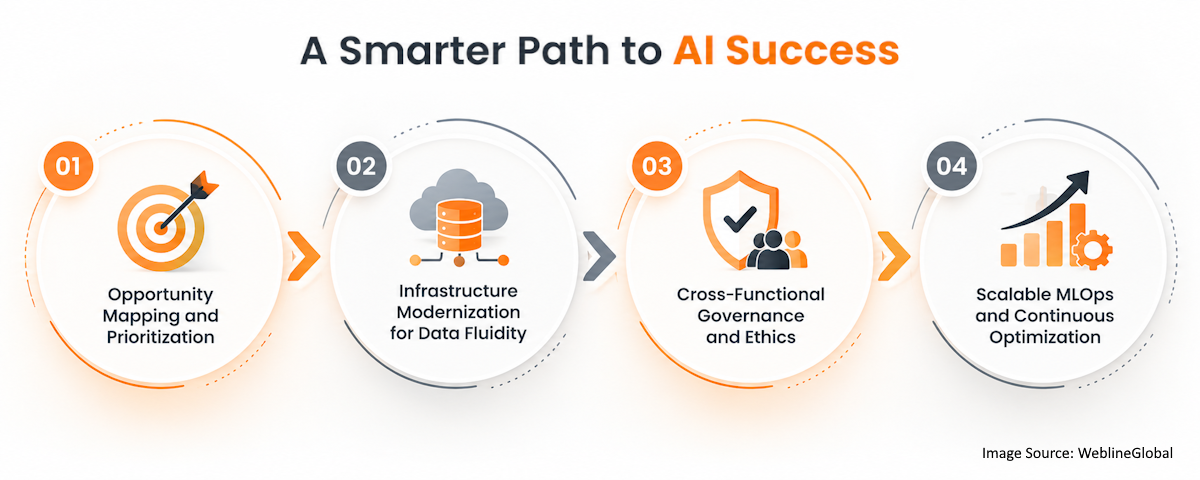
1. Opportunity Mapping and Prioritization
Instead of attempting to automate every department at once, leaders must prioritize areas where AI can solve specific, measurable problems.
- High-Impact Use Cases: Identify tasks with high volume and clear logic, such as customer support triaging or predictive maintenance.
- Feasibility Audit: Assess if the required data is accessible and if the current tech stack can support the model’s latency requirements.
- ROI Benchmarking: Define exactly how success will be measured, whether through reduced operational costs or increased customer lifetime value.
2. Infrastructure Modernization for Data Fluidity
You cannot build a modern intelligence layer on top of fragmented, siloed legacy systems. Achieving true data readiness for AI requires a shift toward a unified architecture.
- Unified Data Fabric: Implementing a layer that allows information to flow seamlessly across the enterprise, providing models with real-time context.
- Standardized Data Pipelines: Moving away from manual ETL processes to automated pipelines that ensure data is processed consistently.
- Solving Data Quality Issues in AI: Establishing rigorous validation gates to catch inaccuracies or biases before they reach the training environment.
3. Cross-Functional Governance and Ethics
As global regulations become more stringent, having built-in transparency and auditability is no longer optional; it is a prerequisite for scaling.
- Compliance Frameworks: Aligning AI initiatives with global privacy laws and industry-specific security standards.
- Bias Mitigation: Implementing regular audits to ensure models do not produce discriminatory or skewed outputs.
- Explainability Layers: Ensuring that stakeholders can understand the logic behind a model’s decision, which is crucial for internal trust and external accountability.
4. Scalable MLOps and Continuous Optimization
Deploying a model is only the halfway point. To maintain peak performance, a robust strategy must account for the long-term health of the system.
- Performance Monitoring: Using automated tools to detect model drift—where the AI becomes less accurate as real-world data patterns change.
- Continuous Training Loops: Establishing workflows to retrain models with fresh data without disrupting the production environment.
- Talent Roadmap: Upskilling the existing workforce to manage AI-augmented workflows, ensuring that humans remain effectively in the loop. Organizations can also hire AI/ML developers to strengthen model deployment, monitoring, and continuous optimization capabilities.
How to Overcome AI Adoption Challenges?
The journey to AI maturity is fraught with hurdles. Beyond the technical aspects, organizations must navigate the shifting sands of the labor market and consumer expectations.
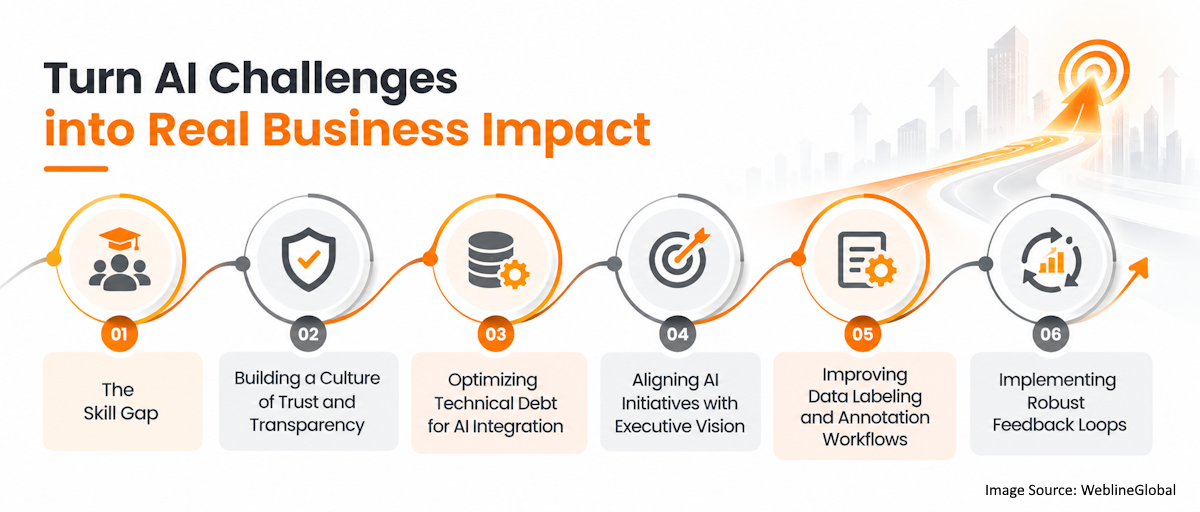
The Skill Gap
There is a massive shortage of talent that understands both the mathematical side of AI and the nuances of business operations. Companies are increasingly turning to external partners to bridge this gap, allowing them to scale quickly without waiting years to hire a full in-house team. A dedicated AI and data science team can provide specialized expertise in data engineering, machine learning, and enterprise AI development.
Building a Culture of Trust and Transparency
Resistance often stems from a lack of clarity regarding how AI makes decisions. To mitigate this specific AI adoption challenge, leadership must prioritize explainability. When employees and stakeholders can see the logic behind a model’s output, they are more likely to integrate those insights into their daily operations. Transparency reduces the black box stigma and fosters an environment where AI is seen as a dependable collaborator rather than a mysterious disruptor.
Optimizing Technical Debt for AI Integration
Many legacy systems were never built to handle the high-velocity data streams required for modern intelligence. A significant hurdle in data readiness for AI is the hidden technical debt within old databases. Overcoming this requires a strategic modernization of the core infrastructure. Decoupling data layers from rigid legacy applications, companies can create a fluid environment where AI models can ingest and process information without being hindered by outdated architecture.
Aligning AI Initiatives with Executive Vision
Even the best technical solutions will fail if they are not aligned with the overarching business strategy. A common reason why AI projects fail is the disconnect between the data science team and the C-suite. Successful adoption requires top-down advocacy where leaders clearly define how AI contributes to the bottom line. When AI goals are baked into the annual corporate objectives, it ensures that resources remain available and that departments are incentivized to cooperate with the rollout.
Improving Data Labeling and Annotation Workflows
The bridge between raw information and a working model is high-quality labeling. Many firms struggle with this because it is labor-intensive and prone to human error. To enhance data readiness for AI, organizations are increasingly adopting active learning techniques where the model identifies which data points it is most confused by. Hence, it allows humans to focus their labeling efforts where they matter most. This targeted approach saves time and significantly improves the accuracy of the final deployment.
Implementing Robust Feedback Loops
An AI model is not a set-it-and-forget-it asset. It requires constant feedback from the end-users to stay relevant. One of the most effective ways to solve AI adoption challenges is to build intuitive feedback mechanisms directly into the user interface. When an employee corrects an AI-generated suggestion, that data should be fed back into the training pipeline. This creates a virtuous cycle of continuous improvement.
The Path to Data Readiness for AI
To achieve true data readiness for AI, your organization must undergo a digital transformation that prioritizes the machine-readability of every asset.
This involves:
- Standardizing Formats: Ensuring all data follows a universal schema.
- Automating Labeling: Using smaller AI models to label data for larger, more complex models.
- Governance as Code: Building compliance checks directly into the data pipeline.
- Scalable Storage: Ensuring your infrastructure can handle the massive throughput required for deep learning training.
When data readiness for AI becomes a core competency, the speed at which you can deploy new features drops from months to days. This is the hallmark of an AI-ready organization.
What is the Economic Reality of AI Automation?
The cost of implementing these systems can be astronomical if handled inefficiently. Many US-based enterprises find themselves stuck between two extremes: hiring expensive domestic agencies that drain the budget or working with cheap offshore providers that lack the quality and strategic oversight required for mission-critical AI.
This is where a hybrid approach becomes the ultimate competitive advantage. Businesses can explore flexible IT partnership models to balance development costs, technical expertise, and project oversight while scaling enterprise AI initiatives.
Partnering for Success with WeblineGlobal
Transitioning from a data-rich environment to an AI-ready powerhouse requires more than just software. It requires a partner who understands the global tech landscape. WeblineGlobal is a premier IT agency based in the US that specializes in bridging the gap between raw data and business intelligence.
When enterprises work with WeblineGlobal, they gain access to high-level US-based strategy and project management. This ensures that your AI implementation strategy is aligned with Western market standards, security protocols, and quality benchmarks. However, we eliminate the traditional cost barriers by utilizing our world-class development hub in India, known as WeblineIndia.
This unique model allows your business to access cutting-edge AI automation for your business processes at an offshore price point, without sacrificing the US-quality standard. Whether you are struggling with data quality issues in AI or looking to overcome significant AI adoption challenges, WeblineGlobal provides the technical muscle and strategic vision to ensure your project doesn’t become another failure statistic.
The Time to Act for AI Business Process Automation is Now
The window for AI experimentation is closing. Experts opine that by 2027, the gap between those who have achieved data readiness for AI and those who are merely data-rich will be insurmountable. The leaders of tomorrow are those who are investing in their data foundations today.
Stop letting your data sit idle. Turn your information into your greatest asset by focusing on a clear AI implementation strategy and partnering with experts who know how to deliver results. The road to AI readiness is complex, but with the right approach to AI adoption challenges, the rewards are limitless. Don’t let your enterprise be part of the 60% that fail. Secure your future with WeblineGlobal and WeblineIndia, where innovation meets efficiency.
Reach out today to begin your journey toward a smarter, automated, and AI-ready business.
Detailed Analysis of AI Maturity Models
To further understand why companies struggle, we must look at the five levels of AI maturity. Most organizations currently find themselves at Level 2, struggling to reach Level 3.
5-point graphics with headings
- Level 1: Initial (Ad Hoc) – AI is used in general by individual enthusiasts. There is no central strategy.
- Level 2: Managed (Pilot Phase) – Some projects are funded, but data quality issues in AI prevent them from scaling.
- Level 3: Defined (Ready) – A clear AI implementation strategy is in place. Data is centralized and governed.
- Level 4: Quantitatively Managed (Scaling) – AI is integrated into core business processes. Performance is monitored via KPIs.
- Level 5: Optimizing (AI-First) – The organization uses AI to reinvent its business model continuously.
Most AI adoption challenges occur during the transition from Level 2 to Level 3. This is where the technical debt of the last twenty years finally comes due. Companies realize their data isn’t as clean as they thought, and their teams aren’t as agile as they hoped.
What is the Role of Synthetic Data?
One way companies are accelerating their data readiness for AI is through the use of synthetic data. When real-world data is biased, incomplete, or restricted by privacy laws, AI can be used to generate high-fidelity synthetic datasets. This allows for training models without compromising customer privacy or waiting months for more data to be collected.
However, even synthetic data requires a strong foundation. If the seed data used to generate it has issues, those issues will only be magnified. This reinforces the need for a meticulous focus on quality at the very beginning of the pipeline.
Final Thoughts on AI Readiness
Ultimately, AI is not a magic wand. It is a reflection of your organizational health. If your processes are broken, AI will automate the chaos. If your data is dirty, AI will scale the errors. But if you take the time to build a solid AI implementation strategy, solve your data quality issues in AI, and embrace the necessary cultural shifts, you will find yourself on the winning side of the digital divide.
WeblineGlobal and WeblineIndia are here to make that transition possible. With our combined strengths, your business can navigate the pitfalls of AI adoption challenges and emerge as a leader in the age of intelligence. The transition from data-rich to AI-ready is the most important journey your company will ever take. Make sure you have the right guide.
Social Hashtags
#AIReadiness #EnterpriseAI #AIAdoption #DataQuality #AITransformation #AIImplementation #AIAutomation #DigitalTransformation #AIGovernance #AITrends2026 #BusinessAutomation #DataStrategy
Want to scale your AI initiatives without increasing permanent headcount or compromising development quality?
Frequently Asked Questions
Being data-rich means an organization possesses vast quantities of raw data across various systems. However, AI readiness refers to the state where that data is cleaned, structured, labeled, and integrated into a pipeline that machine learning models can actually use. Many companies are data-rich but fail because their information is trapped in silos or lacks the quality needed for training accurate models.
The primary reasons why AI projects fail include a lack of clear business objectives, poor data quality, and cultural resistance. Many organizations attempt to implement complex technology without first establishing a solid AI implementation strategy. Without a focus on specific use cases and measurable KPIs, projects often become expensive experiments that never reach production or provide a return on investment.
Data quality issues in AI act as a bottleneck for performance. Since AI models learn patterns from historical data, any biases, inaccuracies, or missing values in the source material are amplified. This leads to model drift, hallucinations, and unreliable predictions. Ensuring high-quality data is the most critical step in achieving a successful AI adoption strategy.
Mid-sized enterprises often face AI adoption challenges such as limited budgets, a lack of specialized in-house talent, and legacy infrastructure. Balancing the high cost of US-based development with the need for high-quality output is a common struggle. Partnering with a hybrid agency like WeblineGlobal offers a US-level strategy with offshore execution. It is often the most viable solution to overcome these hurdles.
A robust AI implementation strategy should include a data audit, a clear roadmap of high-impact use cases, a governance framework for ethics and compliance, and a plan for continuous model monitoring (MLOps). It must also address the human element by outlining how employees will be upskilled to work alongside new AI tools and automated processes.
To improve data readiness for AI, organizations must move away from fragmented data storage toward a unified data fabric. This involves standardizing data formats, implementing automated cleaning protocols, and enriching raw data with metadata. Establishing a culture of data stewardship ensures that information is treated as a strategic asset from the moment it is generated.
Yes, AI automation can be highly cost-effective when using a global delivery model. By partnering with firms like WeblineGlobal, companies can access high-level US strategic consulting while utilizing the development expertise of WeblineIndia. This allows businesses to implement enterprise-grade AI solutions at an offshore price point. Ultimately, there is a faster path to ROI without sacrificing quality or security.
Success Stories That Inspire
See how our team takes complex business challenges and turns them into powerful, scalable digital solutions. From custom software and web applications to automation, integrations, and cloud-ready systems, each project reflects our commitment to innovation, performance, and long-term value.
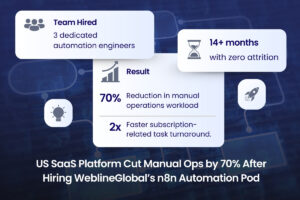
US SaaS Platform Cut Manual Ops by 70% After Hiring WeblineGlobal’s n8n Automation Pod
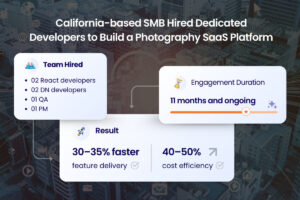
California-based SMB Hired Dedicated Developers to Build a Photography SaaS Platform