Table of Contents

The SaaS landscape in North Carolina is defined by speed, innovation, and intense competition for engineering talent. From Raleigh’s Research Triangle Park to the growing hubs of Charlotte and Asheville, firms are under constant pressure to deliver robust, scalable Minimum Viable Products (MVPs) and rapidly deploy new features without incurring massive local overhead costs.
For high-growth SaaS companies, the backend stack is not just a technical choice; it is a critical business differentiator impacting time-to-market and long-term operational costs. Increasingly, Node.js has become the de facto standard for building these modern, data-intensive, and real-time architectures. The strategic decision for engineering leaders is no longer whether to use Node.js, but rather how and where to hire Node.js developers North Carolina who possess the depth of experience required to manage enterprise-grade complexity efficiently.
The Strategic Imperative: Why Node.js Dominates North Carolina SaaS Backends
Node.js provides a unique blend of performance, productivity, and ecosystem alignment that appeals directly to the financial and technical constraints faced by scaling SaaS businesses. These advantages translate directly into faster development cycles and lower infrastructure spend, provided the implementation is managed by expert hands.
Performance and Asynchronous Advantage in Real-Time Applications
The core value proposition of Node.js lies in its non-blocking, event-driven architecture, making it exceptionally well-suited for high-throughput I/O operations common in modern SaaS—think streaming data, microservices communication, and real-time notifications. For decision-makers, this means lower latency and higher concurrent user handling without needing extensive hardware scaling, which impacts the bottom line significantly.
When you look to hire node developers, you aren’t just buying JavaScript knowledge; you are investing in performance optimization mastery. A mid-level developer might know the syntax, but only an experienced Node developer understands how to prevent event loop blocking, manage worker threads efficiently, and architect services that truly leverage asynchronous patterns. These are the skills that separate a functioning prototype from a truly scalable, production-ready SaaS platform.
Unified Language Ecosystem and Talent Velocity
A major operational benefit of Node.js is the ability to use JavaScript across the full stack. This singular ecosystem significantly reduces context switching for developers and simplifies the maintenance burden. For engineering leaders tasked with rapid scaling, this translates into flexible team composition—a full-stack developer can seamlessly contribute to both front and backend logic.
What this means for hiring: Hiring Node.js talent often means tapping into a larger, more fluid talent pool compared to specialized, less common backend languages. However, relying solely on local North Carolina talent for this unified skill set can be prohibitively expensive and slow. The ability to hire remote engineers who are already proficient in the full JavaScript ecosystem allows companies to staff up complete, cross-functional pods much faster.
Evaluating the Trade-Offs: Local vs. Remote Talent Acquisition
The primary challenge facing NC SaaS founders and CTOs is the acute scarcity of high-caliber, affordable senior engineering talent locally. The competition driven by major tech firms in Raleigh and Charlotte inflates salaries and extends the hiring cycle, threatening critical product delivery deadlines. This reality forces a critical evaluation of talent acquisition strategy.
The North Carolina Talent Crunch Reality
Attempting to exclusively fill roles for senior dedicated Node developers North Carolina often leads to a lengthy, expensive process. A search that drags on for 4–6 months means lost revenue opportunities and increased stress on existing teams. The cost of a fully burdened, local senior Node engineer can easily exceed $180,000 to $200,000 annually, resources that could otherwise be allocated to innovation or market expansion.
The business mandate is clear: maintain high quality while achieving cost efficiency and speed. This is where strategic remote hiring becomes the necessary mechanism for growth. By expanding the search internationally, particularly into proven markets known for Node.js expertise, NC firms can secure top-tier talent often within 48 hours for shortlisting and at a fraction of the cost.
Speed to Market and the Remote Solution
Every week of hiring delay is a missed opportunity for feature deployment, pilot programs, or scaling user base. SaaS growth is exponential, and bottlenecks in hiring senior staff are deadly. Remote teams, like those provided by WeblineGlobal, bypass the lengthy local recruitment process by offering pre-vetted, ready-to-integrate talent.
This approach allows NC firms to immediately scale development capacity, particularly for mission-critical components handled by dedicated Node developers. If your goal is to accelerate backend development timelines, the ability to instantly staff up an experienced Node.js team is a decisive competitive advantage. For more information on accelerating your hiring process, you can access node.js developer profiles ready for interview.
Building Resilience: Defining What ‘Dedicated’ Node Developers Means for Delivery
The concept of a ‘dedicated’ team member is fundamental to successful B2B SaaS architecture. It removes the instability associated with project-based contracting and ensures long-term architectural ownership and accountability. When searching for dedicated Node developers North Carolina, this commitment must be the foundational requirement, regardless of whether the developer is local or remote.
Staff Augmentation vs. Project Outsourcing: A CTO’s Decision
SaaS firms rarely benefit from transactional project outsourcing where a third party owns the roadmap and delivery. The preferred model, especially for backend architecture, is staff augmentation. Staff augmentation places remote, dedicated Node engineers directly under the control of the North Carolina based CTO or VP of Engineering.
This distinction is crucial: staff augmentation ensures that the remote team operates as an extension of the core internal team, adhering to the client’s existing standards, processes, and tools. This model ensures seamless integration, which is paramount when dealing with sensitive backend logic, database management, and complex system integrations handled by the Node.js layer.
Architectural Ownership and IP Protection
A core concern for any scaling SaaS firm is intellectual property (IP) and long-term architectural coherence. When developers are truly dedicated, they develop deep institutional knowledge about the codebase, preventing architectural drift and reducing technical debt. This is essential for long-term maintenance and scaling efforts.
When vetting vendors for remote talent, ask about their model for IP protection, NDAs, and access control. Firms like WeblineGlobal, operating with a US assurance model despite having India-based teams, ensure that dedicated Node developers are contractually bound and operate within a secure framework, giving peace of mind that IP is protected while benefiting from global talent access.
To ensure your backend framework is sound, it is important to hire seasoned experts. We can help you hire backend developers who specialize in architecting secure, scalable systems.
Critical Evaluation Metrics for Hiring Node.js Expertise
Hiring Node.js developers requires evaluation beyond basic coding competency. Since Node.js often forms the backbone of highly available systems, CTOs must vet for depth of experience in managing concurrency, memory, and specialized toolsets. A junior developer might inadvertently introduce blocking code that cripples a high-volume service.
Assessing Event Loop Mastery and Non-Blocking I/O
The single most important technical attribute for a senior Node.js developer is a complete understanding of the event loop. If they cannot clearly explain the difference between process.nextTick() and setImmediate(), or how CPU-bound versus I/O-bound tasks impact application throughput, they are likely unsuitable for mission-critical SaaS backends. Decision-makers must demand practical examples of how candidates have previously solved event loop blocking issues in production environments.
Managing CPU-Intensive Tasks
Since Node.js is single-threaded, performance for computation-heavy tasks is managed via clustering or worker threads. Vetting criteria must include practical experience with implementing these scaling mechanisms. This ensures the dedicated Node developers North Carolina firms hire can manage bursts in workload without disrupting the core application services.
Experience with Specific Node.js Frameworks and Ecosystem Tools
While vanilla Node.js is powerful, modern SaaS development relies heavily on robust frameworks. Proficiency in frameworks like Express.js, NestJS (for enterprise microservices), or Hapi is non-negotiable. Furthermore, experience with complementary tools is vital:
- Package Management: Deep familiarity with npm/yarn versioning strategies.
- Testing Frameworks: Expertise in Jest, Mocha, or Chai for TDD/BDD practices.
- API Architectures: Mandatory experience in building robust RESTful APIs and modern GraphQL endpoints.
- Monitoring and Observability: Knowledge of tools like Prometheus or New Relic to diagnose production issues swiftly.
Before moving forward, it is essential to plan scalable backend architecture that aligns with your anticipated user growth. This planning dictates the seniority and specific framework experience required for the Node.js hires.
Database Integration and Data Modeling Skills
Node.js developers are usually responsible for the integration layer between the application logic and the persistence layer (SQL or NoSQL). They must possess advanced data modeling skills tailored to the chosen database (PostgreSQL, MongoDB, DynamoDB, etc.). Poor data schema design, executed by an inexperienced Node developer, can lead to chronic performance issues that are expensive and difficult to refactor later.
Ensure that candidates you intend to hire Node.js developers North Carolina through remote sourcing have proven experience optimizing ORMs (like Sequelize or Prisma) and handling complex transactions under high load. This level of vetting reduces delivery risk significantly.
If your firm is ready to accelerate development using specialized and fully-vetted talent, we encourage you to access node.js developer profiles that match these advanced technical criteria immediately.
Justifying the ROI of Offshore Node.js Teams for NC Startups
For founders and CFOs in North Carolina, the decision to hire internationally is often driven purely by return on investment (ROI). The financial justification goes beyond mere salary arbitrage; it encompasses speed, scalability, and reducing significant operational friction.
Minimizing Operational Overhead
When an NC firm hires locally, the true cost includes recruitment fees, benefits, payroll taxes, physical office space, IT infrastructure, and extensive HR management. By leveraging staff augmentation services for dedicated Node developers North Carolina, firms shift much of this operational burden and cost structure to the external partner, such as WeblineGlobal.
This allows the leadership team to focus capital and time purely on product and market strategy, rather than internal HR logistics. The resulting cost efficiency often allows a startup to hire three high-caliber remote developers for the price of one local senior engineer, dramatically increasing output velocity.
The Velocity Multiplier Effect
Velocity in a SaaS environment is the key predictor of market success. Faster feature iteration, quicker response to market feedback, and rapid deployment of integrations are non-negotiable. An experienced remote Node.js team provides a velocity multiplier effect.
Instead of waiting six months for local recruitment to staff a full development pod, a remote solution can have the team operational and committing code within days or weeks. This immediate increase in engineering bandwidth ensures milestones are hit faster, proving the high ROI of strategic offshore partnerships. It allows North Carolina firms to compete on innovation speed, not just geographic location.
Strategic Hiring for Long-Term SaaS Success
Successfully scaling a SaaS company in a competitive market like North Carolina requires technical excellence combined with strategic resource management. Node.js is the right technology for speed and performance, but success hinges on securing the right talent—expert, dedicated engineers who understand complex backend architecture and work seamlessly with your existing team.
Whether you need to scale your microservices framework or accelerate feature delivery, the decision to hire node developers remotely and specifically seek dedicated teams is a pragmatic solution to the local talent squeeze. It optimizes for cost, mitigates delivery risk, and most importantly, puts world-class engineering expertise to work immediately.
If you are evaluating vendors or need to finalize your backend team composition this quarter, we recommend you schedule developer interviews today to see the difference a fully vetted, dedicated Node.js team can make to your velocity.
Frequently Asked Questions
While developers may be based internationally, successful partnerships ensure significant time overlap for key collaboration hours (core business hours in the US Eastern Time Zone). This overlap is essential for daily stand-ups, critical planning sessions, and real-time decision-making, ensuring the dedicated Node developers North Carolina firms hire remain fully aligned with the local team.
Due to our extensive vetting pipeline, WeblineGlobal can typically provide a shortlist of highly qualified, pre-vetted dedicated Node developers North Carolina firms can interview within about 48 hours of initial requirement definition. This dramatically shortens the time-to-hire compared to local recruitment cycles.
For early-stage SaaS, generalists with strong core Node.js skills and familiarity with one major framework (like Express or NestJS) are fine. As the architecture scales into a microservices pattern, you will need to hire backend developers who are highly specialized in advanced architectural patterns and performance tuning, often focusing on specific frameworks or system integrations.
Focus on complementary skills crucial for SaaS stability: proficiency in DevOps tools (Docker, Kubernetes), experience with cloud platforms (AWS, Azure), deep knowledge of microservices architecture, and expertise in securing API endpoints (OAuth, JWT management). These ancillary skills determine the team’s ability to deploy and maintain production-grade systems.




Success Stories That Inspire
See how our team takes complex business challenges and turns them into powerful, scalable digital solutions. From custom software and web applications to automation, integrations, and cloud-ready systems, each project reflects our commitment to innovation, performance, and long-term value.

California-based SMB Hired Dedicated Developers to Build a Photography SaaS Platform
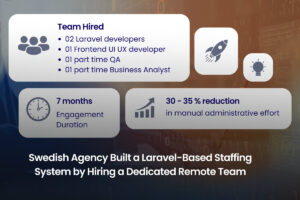
Swedish Agency Built a Laravel-Based Staffing System by Hiring a Dedicated Remote Team