
Table of Contents

How Did We Encounter the Need for a Broadcast RFQ Layer in B2B E-commerce?
While working on a large-scale B2B wholesale platform for the construction materials industry, we realized that the procurement workflow was fundamentally flawed. Buyers needed to source bulk materials like cement and steel by requesting quotes from local suppliers. However, the existing system—built on WordPress, WooCommerce, and a leading multivendor extension—only supported a strict 1-to-1 Request for Quote (RFQ) model. A buyer had to manually find a vendor, add items to a quote basket, and submit the request to that single vendor.
We encountered a situation where corporate buyers were abandoning the platform because they had to repeat this process dozens of times just to compare prices across different suppliers in their region. The business requirement was clear: we needed a 1-to-many broadcast system. A buyer should submit one RFQ, and the system should automatically route it to all vendors who stock the requested product categories and service the buyer’s delivery pincode.
In production, building a broadcast engine inside an architecture originally designed for 1-to-1 interactions introduces severe database and performance constraints. This challenge inspired this article, detailing how our team engineered a scalable, decoupled broadcast layer without compromising platform stability. If you are looking to hire software developer teams capable of handling complex platform architectures, understanding these root challenges is essential.
Why is the Default Multivendor Architecture a Bottleneck for Broadcast RFQs?
In a standard multivendor setup, the RFQ flow is linear. An RFQ is usually stored as a Custom Post Type (CPT) or a custom order entity linked directly to one vendor ID. When a customer submits an RFQ with multiple products, the system assumes a single destination.
To implement a broadcast layer, the system needs to extract the product categories and the customer’s pincode, query a subset of eligible vendors, and clone the RFQ so each vendor receives an isolated copy. The customer then requires a unified dashboard to compare the incoming quotes from these disparate child RFQs.
The core architectural conflict lies in data isolation and real-time processing. If an RFQ targets 100 vendors, generating 100 isolated quote requests synchronously during the checkout sequence creates an immense load on the database, leading to degraded user experience or outright transaction failures.
What Went Wrong When We First Attempted RFQ Broadcasting?
During our initial prototyping phase, we attempted to map the broadcast logic directly onto the standard WooCommerce checkout hooks. The symptoms of our architectural oversights surfaced almost immediately during load testing.
First, we noticed intermittent 504 Gateway Timeouts. Our logs indicated that the PHP thread was locking up while executing the vendor discovery query. We were using the standard WordPress user query API to find vendors matching specific product categories and delivery pincodes. Because pincodes were stored as serialized arrays in the user meta table, the database had to perform full table scans with wildcard matching, which crippled the database under concurrent load.
Second, we experienced severe table bloat. We attempted to clone the RFQ synchronously by creating standard custom posts for each vendor. Broadcasting one RFQ to 80 vendors generated 80 parent posts and hundreds of associated post meta rows in a matter of seconds. This not only caused the checkout process to take upwards of 15 seconds, but it also triggered race conditions where notifications were sent before the child RFQs were fully constructed in the database.
What Alternative Approaches Did We Consider for RFQ Distribution?
To resolve the bottleneck, we evaluated several architectural patterns. Decision-makers often hire php developers for custom multivendor platforms expecting them to know how to navigate these exact trade-offs.
Approach 1: Synchronous Custom Post Type Duplication
Our initial approach involved hooking into the RFQ creation action and running a synchronous loop to generate duplicate RFQ posts for each eligible vendor. While easy to implement using standard WordPress functions, this failed spectacularly at scale. Synchronous database writes for 50+ vendors resulted in unacceptable latency and transaction timeouts.
Approach 2: Single RFQ Post with Complex User Meta Access
We considered maintaining a single parent RFQ post and assigning an array of vendor IDs to it. Vendors would query this single post. However, this destroyed data isolation. If Vendor A submitted a quote, modifying the parent RFQ’s meta data to store the pricing, it became incredibly complex to prevent Vendor B from accidentally overriding or accessing Vendor A’s pricing. Data privacy for B2B quotes is non-negotiable.
Approach 3: Elasticsearch for Vendor Querying
To solve the slow vendor discovery process, we considered offloading the pincode and category matching to Elasticsearch. While highly performant, it added unnecessary infrastructure overhead for a platform that was primarily bottlenecked by the write operations (cloning), not just the read operations (searching).
Approach 4: Custom Tables and Background Processing (The Winner)
We finalized an architecture relying on a decoupled background queue using Action Scheduler, paired with custom relational tables for vendor service areas. Instead of duplicating heavy WordPress posts immediately, the system would accept the parent RFQ, instantly return a success message to the buyer, and dispatch an asynchronous background job to handle the vendor querying and RFQ cloning. This provided the exact performance and data isolation we needed.
How Do You Implement a Scalable 1-to-Many RFQ Broadcast in WooCommerce?
Here is how we built the final implementation. We bypassed the default post meta queries and synchronous hooks to create a robust, asynchronous broadcast bridge.
1. Vendor Querying via Custom Lookup Tables
Instead of storing serviceable pincodes in the user meta table, we created a custom table designed strictly for geospatial indexing. When a vendor updates their profile, the data syncs to this lookup table.
CREATE TABLE custom_vendor_coverage (
    id BIGINT UNSIGNED AUTO_INCREMENT PRIMARY KEY,
    vendor_id BIGINT UNSIGNED NOT NULL,
    pincode VARCHAR(20) NOT NULL,
    category_id BIGINT UNSIGNED NOT NULL,
    INDEX idx_pincode_cat (pincode, category_id)
);
This allowed us to execute lightning-fast vendor discovery queries using standard SQL joins, completely avoiding WordPress user meta full-table scans.
2. Asynchronous RFQ Cloning Strategy
We hooked into the initial RFQ creation event. Instead of processing the broadcast immediately, we logged the parent RFQ and queued an event using Action Scheduler. This ensures the customer experiences zero latency.
// Intercepting the parent RFQ creation
add_action('custom_rfq_created', 'dispatch_rfq_broadcast_job', 10, 1);
function dispatch_rfq_broadcast_job($parent_rfq_id) {
    if (function_exists('as_enqueue_async_action')) {
        as_enqueue_async_action('execute_rfq_vendor_broadcast', array($parent_rfq_id));
    }
}
3. The Broadcast Worker Logic
The background worker executes the heavy lifting. It queries the custom table for eligible vendors, then uses a lightweight custom database table to store the child quotes rather than bloating the main posts table.
add_action('execute_rfq_vendor_broadcast', 'process_broadcast_queue', 10, 1);
function process_broadcast_queue($parent_rfq_id) {
    $pincode = get_rfq_target_pincode($parent_rfq_id);
    $categories = get_rfq_categories($parent_rfq_id);

    // Fast lookup using custom table
    $eligible_vendors = query_eligible_vendors($pincode, $categories);

    foreach ($eligible_vendors as $vendor_id) {
        // Create lightweight child RFQ records in a custom quotes table
        insert_child_quote_record($parent_rfq_id, $vendor_id);

        // Trigger individual vendor email notifications securely
        send_vendor_rfq_notification($vendor_id, $parent_rfq_id);
    }
}
4. Enforcing Data Isolation
To ensure vendors only see their specific child RFQ, we overrode the multivendor dashboard query. We applied strict checks ensuring that the current logged-in user ID matches the vendor ID assigned to the child RFQ record. Since each vendor interacts with their own unique record in the custom quotes table, there is zero risk of cross-vendor data leakage.
What Are the Key Engineering Takeaways for Building WooCommerce Extensions?
When you hire woocommerce developers for complex workflows, ensure they understand these architectural principles. Here are the core lessons our team extracted from this deployment:
- Never perform N-tier database writes synchronously on checkout: If an action triggers multiple database inserts (like broadcasting to 50 vendors), offload it to a background queue like Action Scheduler or RabbitMQ.
- Stop abusing the user meta table for complex queries: Serialized arrays in meta tables destroy database performance. Always use custom relational tables for geospatial data like pincodes or multi-select taxonomies.
- Protect your main tables from bloat: Creating thousands of child posts in the default WordPress posts table will slow down the entire platform. Custom tables for transactional data (like individual vendor quotes) are mandatory for scale.
- Data isolation requires hard boundaries: Do not rely on front-end UI hiding to protect quote data. Enforce strict user ID vs. vendor ID validation at the database query level to prevent unauthorized access.
- Design for eventual consistency: In a broadcast system, it is acceptable if a vendor receives the RFQ 30 seconds after the customer submits it. Prioritize the customer’s synchronous checkout experience over instantaneous vendor notifications.
How Can We Help You Scale Your E-commerce Architecture?
Transitioning from a basic multivendor setup to an enterprise-grade procurement platform requires deep architectural restructuring. By moving away from restrictive 1-to-1 workflows and implementing asynchronous broadcast queues and custom data structures, we helped our client achieve a seamless, scalable B2B purchasing experience without sacrificing performance.
If your organization is facing similar scaling challenges and you need to hire software developer teams with proven expertise in enterprise architecture and multivendor platforms, contact us. We provide dedicated engineering teams capable of transforming off-the-shelf limitations into robust technical advantages.
Social Hashtags
#WooCommerce #WordPress #B2BEcommerce #RFQ #WooCommerceDevelopment #MultivendorMarketplace #PHP #SoftwareArchitecture #EnterpriseCommerce #ActionScheduler #WebDevelopment #EcommerceDevelopment #DatabaseOptimization #OpenSource
Frequently Asked Questions
Action Scheduler is designed specifically for processing large queues of tasks reliably within the WordPress ecosystem. It handles concurrency, prevents race conditions, and provides a logging interface for failed jobs, making it vastly superior to standard WP-Cron for high-volume RFQ cloning.
Yes, if your broadcast targets fewer than 5-10 vendors per request, standard post duplication might suffice. However, as your vendor base grows, the associated post meta bloat will inevitably degrade your database performance, making custom tables the safer long-term choice.
By creating isolated child RFQ records linked strictly to the individual vendor's ID. You must enforce server-side validation on every dashboard read/write request to ensure the authenticated vendor ID matches the owner ID of the specific quote record.
Because the vendor discovery query runs dynamically at the exact moment the background job is processed, it uses the most current data from the custom coverage table. Once the child RFQ is created, it acts as an immutable snapshot of that request.
Using custom tables simplifies this. You query the custom quotes table for all records sharing the parent RFQ ID. Since the data structure is uniform, you can easily render a matrix on the front-end allowing the buyer to compare pricing, shipping terms, and delivery dates side-by-side.
Success Stories That Inspire
See how our team takes complex business challenges and turns them into powerful, scalable digital solutions. From custom software and web applications to automation, integrations, and cloud-ready systems, each project reflects our commitment to innovation, performance, and long-term value.
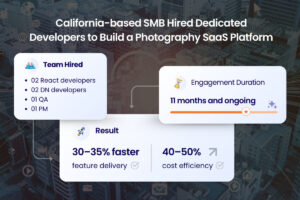
California-based SMB Hired Dedicated Developers to Build a Photography SaaS Platform
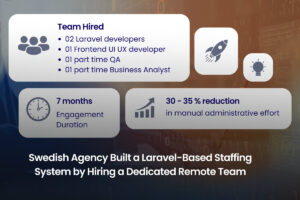
Swedish Agency Built a Laravel-Based Staffing System by Hiring a Dedicated Remote Team