
Table of Contents

How Did We Discover the wp_postmeta Bottleneck in Production?
While working on a high-traffic SaaS publishing platform, we encountered a critical performance degradation issue. The platform served as a vast repository of structured content, leveraging a WordPress backend with deeply customized data models. As the system scaled past 100,000 entries within a specific Custom Post Type (CPT), the administrative dashboard and API endpoints responsible for data retrieval ground to a halt.
During our initial monitoring phase, we realized that the root cause was not server CPU or memory exhaustion, but rather a severe database gridlock. The platform relied heavily on complex filtering across multiple custom fields. Every time an administrator or a connected microservice triggered a filtered search, the system invoked a standard WP_Query heavily loaded with meta_query arguments. The execution time for these queries spiked from mere milliseconds to over 15 seconds, eventually leading to timeouts and locked database tables.
This situation perfectly illustrates a fundamental architectural limitation in standard Content Management Systems when co-opted for enterprise-scale relational data. It is exactly the kind of challenge organizations face before they decide to hire software developer teams with deep architectural expertise. This bottleneck inspired this article, aiming to help engineering teams avoid the classic trap of treating the WordPress meta table as a fully relational database, and to explore scalable alternatives for high-frequency filtering.
What Causes Performance Issues with WordPress Meta Queries?
To understand the business use case, consider that the platform needed to allow users to filter hundreds of thousands of records based on multiple distinct attributes—such as status, region, assigned agent, and numerical thresholds. Within the WordPress architecture, these attributes are stored in the wp_postmeta table.
WordPress utilizes an Entity-Attribute-Value (EAV) data model for metadata. While highly flexible for adding arbitrary fields without altering the database schema, EAV is notoriously inefficient for complex relational queries. When a developer executes a WP_Query that filters by three different custom fields, the database engine cannot simply look up columns in a single row.
Instead, the query engine must perform multiple INNER JOIN operations back onto the same massive wp_postmeta table. For a CPT with 100,000 entries, if each entry has 20 custom fields, the meta table quickly swells to over 2 million rows. Searching for a record that matches three specific meta conditions forces the database to join a 2-million-row table against itself multiple times. Even with perfectly optimized indexes, this creates a massive overhead that chokes the database.
Why Do Multiple wp_postmeta Joins Fail at Enterprise Scale?
The symptoms began as intermittent API latency spikes during peak administrative usage. We configured our APM (Application Performance Monitoring) tools and immediately spotted the offending SQL queries. The slow query logs revealed massive Cartesian products generating temporary tables that could not fit into memory, forcing the database engine to write them to disk.
A simplified version of the generated SQL looked like this:
SELECT SQL_CALC_FOUND_ROWS wp_posts.ID
FROM wp_posts
INNER JOIN wp_postmeta ON ( wp_posts.ID = wp_postmeta.post_id )
INNER JOIN wp_postmeta AS mt1 ON ( wp_posts.ID = mt1.post_id )
INNER JOIN wp_postmeta AS mt2 ON ( wp_posts.ID = mt2.post_id )
WHERE 1=1
AND wp_posts.post_type = 'custom_entry'
AND (
  ( wp_postmeta.meta_key = 'status' AND wp_postmeta.meta_value = 'active' )
  AND ( mt1.meta_key = 'region' AND mt1.meta_value = 'north_america' )
  AND ( mt2.meta_key = 'score' AND CAST(mt2.meta_value AS SIGNED) > 85 )
)
GROUP BY wp_posts.ID
ORDER BY wp_posts.post_date DESC
LIMIT 0, 20;
The architectural oversight was relying on native CMS querying functions for high-frequency, multi-dimensional filtering. The database was spending an exorbitant amount of time scanning indexes and resolving the joins. Adding custom indexes on meta_key and meta_value provided a temporary band-aid, but as the dataset grew, the join overhead remained an immovable bottleneck.
How Did We Evaluate Solutions for WordPress Database Optimization?
Solving an EAV bottleneck requires shifting the architecture. We needed a solution that would allow fast, multi-faceted searches without bringing the primary transactional database to its knees. When organizations look to hire database architects for performance tuning, the expectation is a thorough evaluation of trade-offs. We considered the following approaches:
Should We Rely on Object Caching for High-Volume Data?
Our first consideration was implementing an in-memory datastore like Redis to cache the query results. While object caching is excellent for static, repetitive reads, it fails spectacularly for highly dynamic, faceted filtering. Because users could combine filters in thousands of unique permutations, the cache hit rate would be abysmal, and the cache invalidation logic upon updating a record would become highly complex.
Are Custom Database Tables the Best Approach?
The second option was to migrate the specific high-frequency query fields out of wp_postmeta and into a custom, flat relational table. By mapping one row per custom post, the database could filter against columns rather than joining rows. This eliminates the EAV problem entirely. However, doing so would require rewriting significant portions of the application logic, bypassing standard WordPress ORM hooks, and complicating compatibility with third-party plugins. It is a solid solution, but tightly couples the application to a specific database schema.
Is an External Search Engine Like Elasticsearch Better?
Ultimately, we evaluated decoupling the search and filtering workload entirely from the MySQL database using an inverted index engine. Solutions like Elasticsearch or Algolia are purpose-built for high-frequency, faceted filtering. By mirroring the post data to an external cluster, we could offload the heavy lifting. The primary database would only handle writes and direct primary-key lookups. This aligns with modern microservice patterns—a strategy we often recommend when clients hire PHP developers for scalable enterprise systems.
How Did We Implement the Final Highly Scalable Solution?
We chose the external search engine approach (Elasticsearch) as it offered the best scalability for high-frequency backend filtering. Our implementation strategy was divided into three phases: Data Synchronization, Query Interception, and Fallback Handling.
1. Data Synchronization via Webhooks
We created an event-driven synchronization layer. Whenever a custom post type was created, updated, or deleted, a background job was dispatched to format the data into a flat JSON document and push it to the Elasticsearch cluster.
add_action('save_post_custom_entry', 'sync_entry_to_search_cluster', 10, 3);
function sync_entry_to_search_cluster($post_id, $post, $update) {
    if (wp_is_post_revision($post_id) || wp_is_post_autosave($post_id)) {
        return;
    }
    $payload = [
        'id'     => $post_id,
        'title'  => $post->post_title,
        'status' => get_post_meta($post_id, 'status', true),
        'region' => get_post_meta($post_id, 'region', true),
        'score'  => (int) get_post_meta($post_id, 'score', true),
        'date'   => $post->post_date,
    ];
    // Offload the HTTP request to a background queue
    QueueService::dispatch(new SyncToElasticsearchJob($payload));
}
2. Intercepting the WP_Query
Instead of rewriting the entire frontend and backend to use a new API, we hooked into pre_get_posts and the posts_pre_query filters. When the system detected a complex multi-meta query for our specific custom post type, we intercepted it, forwarded the parameters to Elasticsearch, and returned only the matching Post IDs.
add_filter('posts_pre_query', 'intercept_complex_meta_queries', 10, 2);
function intercept_complex_meta_queries($posts, $query) {
    if (!is_admin() || $query->get('post_type') !== 'custom_entry') {
        return $posts;
    }
    // Translate WP_Query args to Elasticsearch DSL
    $es_query = SearchBuilder::build($query->query_vars);
    $results = ElasticClient::search($es_query);
    // If no results, return empty array immediately
    if (empty($results['ids'])) {
        return [];
    }
    // Fallback to simple primary key lookup
    $query->set('post__in', $results['ids']);
    $query->set('meta_query', []); // Clear the expensive joins
    $query->set('orderby', 'post__in');
    return null; // Let WP continue with optimized parameters
}
3. Validation and Performance Considerations
By implementing this decoupled architecture, we reduced the database load dramatically. The complex multi-join SQL query was replaced by a lightning-fast inverted index lookup (averaging 15ms) followed by a simple SELECT * FROM wp_posts WHERE ID IN (...). The database CPU utilization dropped by 70%, and API timeouts were completely eliminated.
What Are the Key Lessons for Engineering Teams?
When architecting data-heavy applications, engineering teams must recognize the limitations of their chosen framework. For companies looking to hire WordPress developers for backend optimization, these are the critical takeaways:
- Understand the EAV Anti-Pattern: Storing data as Key-Value pairs is great for flexibility but lethal for relational queries. Never use EAV structures for multi-dimensional filtering at scale.
- Decouple Read vs. Write Operations: Utilize the Command Query Responsibility Segregation (CQRS) pattern. Let your primary relational database handle transactional integrity while a dedicated search engine handles complex reads.
- Indexing Has Diminishing Returns: Adding B-Tree indexes to
wp_postmetahelps early on, but it cannot fix the fundamental geometric growth of Cartesian joins. - Embrace Event-Driven Syncing: Avoid synchronous API calls during the
save_posthook. Use robust background job queues to sync data to external clusters to prevent locking the UI. - Intercept, Don’t Rewrite: By hooking into the core query lifecycle, you can swap out the underlying data retrieval engine without breaking third-party ecosystem compatibility.
How Can We Summarize This WordPress Database Optimization?
Scaling a CMS to handle enterprise-level data requires looking beyond standard documentation and understanding the underlying database mechanics. By replacing expensive wp_postmeta joins with a dedicated Elasticsearch indexing layer, we successfully eliminated database gridlock, future-proofed the platform’s filtering capabilities, and ensured sub-second response times regardless of data volume. If your organization is facing similar scaling challenges and you need to bring in experienced technical talent, feel free to contact us to discuss your architecture.
Social Hashtags
#WordPress #WordPressDevelopment #WordPressPerformance #DatabaseOptimization #WPQuery #PHP #Elasticsearch #WebDevelopment #MySQL #SoftwareArchitecture #BackendDevelopment #PerformanceOptimization #ScalableApplications #EnterpriseWordPress #TechBlog
Frequently Asked Questions
The clearest indicator is a high time-to-first-byte (TTFB) on filtered endpoints, coupled with slow query logs in MySQL. Look for queries containing multiple INNER JOIN wp_postmeta statements and high execution times in your database monitoring tools.
Not at all. Custom tables are highly efficient for structured relational data. However, they bypass standard CMS functions, requiring you to write custom CRUD interfaces and APIs. They are a great middle-ground if you want to avoid maintaining a separate search cluster infrastructure.
No. Elasticsearch serves as a secondary datastore optimized for querying and filtering. The primary relational database remains the source of truth for transactional data, user roles, and core content management.
Implementing a reliable message queue with retry mechanisms ensures data eventually syncs. Additionally, running a nightly cron job to verify data parity between the primary database and the search cluster helps catch and correct any discrepancies.
While it depends on the server hardware and cache hit rates, performance typically begins to degrade significantly when a table exceeds 1 million rows and queries consistently involve three or more simultaneous meta key filters.
Success Stories That Inspire
See how our team takes complex business challenges and turns them into powerful, scalable digital solutions. From custom software and web applications to automation, integrations, and cloud-ready systems, each project reflects our commitment to innovation, performance, and long-term value.
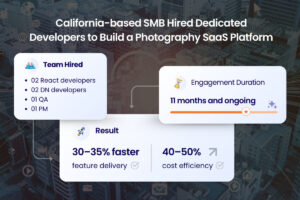
California-based SMB Hired Dedicated Developers to Build a Photography SaaS Platform
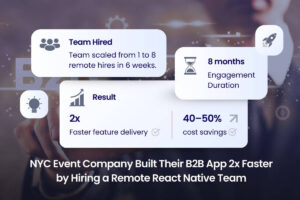
NYC Event Company Built Their B2B App 2x Faster by Hiring a Remote React Native Team